By time of year
Seasonal butterfly identification guide: which species fly in March, April, May, June, July, August, and autumn — with examples by month.
How season helps identification
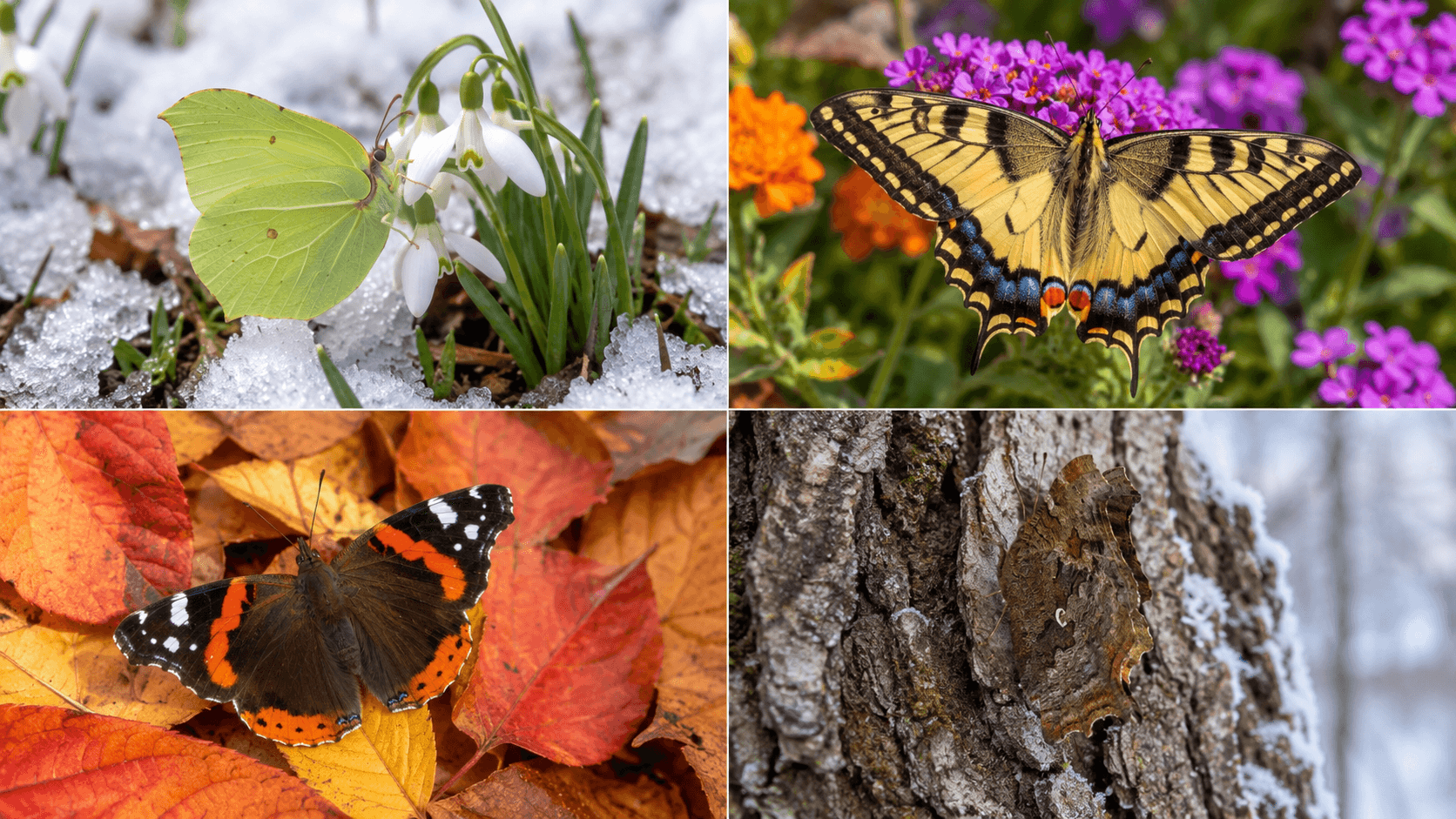
Time of year is one of the fastest traits for narrowing the search. Many species fly only in a set period: one group in early spring, another in mid-summer, a third in autumn. A butterfly in late March is almost certainly an overwintered adult; one in early August is likely a second summer generation.
Use this guide together with identification by colour and by place of encounter.
Note: flight periods shift by 1–2 weeks depending on year and region. Dates refer to central Russia (Moscow ±400 km). In the south (Krasnodar) everything is 2–4 weeks earlier; in the north (Saint Petersburg, Urals) 1–2 weeks later.
March — first early species
The first butterflies appear above 8–10 °C — usually late March, sometimes earlier. These are species that overwinter as imago: they survived winter as adults, hidden in bark crevices, sheds, and attics.
What you may see:
- Brimstone (Gonepteryx rhamni) — male bright yellow; female pale greenish. First mass spring butterfly. Overwintered as adult, hidden among leaves.
- Small tortoiseshell (Aglais urticae) — orange with black spots. Emerges from hibernation at the first warmth.
- European peacock (Aglais io) — red-brown with “eyes”. Emerges with the tortoiseshell.
- Mourning cloak (Nymphalis antiopa) — dark brown with a pale yellow border. Overwintered in bark crevices; appears early, feeds on flowering willow.
- Comma (Polygonia c-album) — ochre-brown with ragged margins; less conspicuous but also early.
April — first “new” butterflies
In April overwintered species are joined by the first butterflies from pupae and eggs of the new season.
New species in April:
- Map butterfly (Araschnia levana, spring generation) — small, russet with a dark pattern; very unlike the summer generation
- Orange tip (Anthocharis cardamines) — white with orange patch in male; female without orange; flies at edges with bittercress
- Black-veined white (Aporia crataegi) — white with dark veins; first individuals by late April
- Winter moth (nocturnal) — males can still be found from autumn
April is the best time to watch the first active flights of brimstones by flowering willow and dandelions.
May — peak of spring diversity
The richest “spring” month. Host plants leaf out; overwintered species fly actively and the first summer species appear.
What flies in May:
- All overwintered species (brimstone, tortoiseshell, peacock, mourning cloak) — in the first half of the month
- Black-veined white — white clouds on garden edges
- Orange tip — peak flight in the first half of May
- Map butterfly, spring generation — russet spring form
- Small heath (Coenonympha pamphilus) — first generation
- Blues — first generation of many species, especially common blue (Polyommatus icarus)
- Green hairstreak (Callophrys rubi) — bright green below; in shrubs
- Checkerspots — checkered, May
- Mnemosyne (Parnassius mnemosyne) — late May in the Caucasus and Altai
June — peak species diversity
The richest month of the year. All spring species fly; second generations of many species begin; summer species start.
Characteristic species in June:
- Old World swallowtail (Papilio machaon) — first generation; on umbellifers (carrot, dill)
- Scarce swallowtail (Iphiclides podalirius) — yellow-white with dark stripes and long tails
- Apollo (Parnassius apollo) — white with red eyespots; mountains and limestone slopes
- Fritillaries — large russet nymphalids with silver below
- Red admiral (Vanessa atalanta) — first migrants
- Satyrines — meadow brown, ringlet
- Clouded yellows (Colias) — yellow and orange
- Map butterfly, summer generation — dark with white spots (second generation, unlike the spring form)
July — peak abundance
July has the highest number of individuals with slightly fewer species than June. Second flight peak for many species.
Characteristic species in July:
- Painted lady (Vanessa cardui) — migrant; mass flights in “good” years
- Second generation of blues, whites, checkerspots
- Grayling (Minois dryas) — large dark satyrine with blue eyespots
- Purple emperor (Apatura iris) — male with blue sheen; floodplain forest
- Admirals — poplar, white
- Ringlets (Erebia) — peak in mountains
- Second generation of tortoiseshell, peacock
August — late summer, start of hibernation
Species diversity drops. Some species are already in diapause (pupa, egg, caterpillar); adults that overwinter prepare for dormancy.
What is active in August:
- Painted lady — migrates south by month’s end
- Red admiral — feeds on overripe fruit (plums, pears)
- Tortoiseshell, peacock — second generation; enter hibernation by late August
- Second generation of swallowtail, clouded yellows
- Satyrines — small heath, meadow brown still flying
- In mountains — last ringlets and apollos
August is good for watching thistle, burdock, and buddleia: painted lady, admiral, and checkerspots gather there.
September — late species
Only the hardiest and latest species are active. Nights are cold, days still warm — butterflies bask on heated stones and trunks.
What you may find:
- Brimstone — active while temperature stays above 10 °C; hibernates under leaves
- Tortoiseshell, comma — until frost
- Red admiral — last individuals on warm days; some migrate
- Clouded yellows — late generation still flies in the first half of September
October–November — winter geometrids
Day-flying butterflies are gone, but in October–November specific overwintering geometrid moths fly:
- Winter moth (Operophtera brumata) — males fly at freezing temperatures; females wingless, crawl on tree trunks. Look on oak and apple trunks in November with a torch.
- Autumnal moth (Epirrita autumnata) — slightly earlier, October.
Summary table by month
| Month | What flies |
|---|---|
| March | Brimstone, tortoiseshell, peacock, mourning cloak |
| April | + orange tip, map butterfly spring form, first blues |
| May | + black-veined white, green hairstreak, small heath, checkerspots |
| June | + swallowtail, scarce swallowtail, apollo, fritillaries, satyrines |
| July | + painted lady, red admiral, purple emperor, admirals, grayling |
| August | Late generations; tortoiseshell and peacock heading to hibernation |
| September | Brimstone, tortoiseshell, admiral — in declining numbers |
| October–November | Winter geometrids (nocturnal) |
Two-brooded species: identification caution
Some species have two generations per year that look very different:
Map butterfly (Araschnia levana): spring generation russet with a dark pattern, like a small fritillary; summer generation dark brown with a white band, like a small admiral. They are often taken for two species.
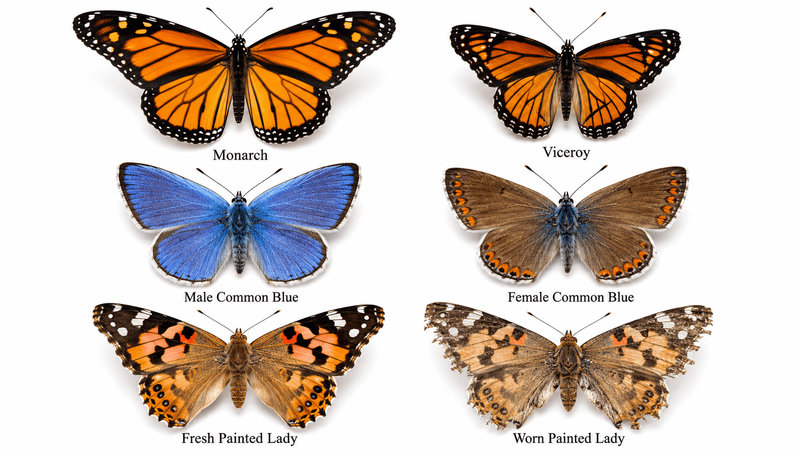
Many blues: the spring brood is smaller and duller than the summer brood.
If a butterfly does not match the usual look — check whether it is another seasonal generation.
More on seasonality — in butterfly life cycle and how butterflies overwinter.
See also

Butterfly flight calendar
Data are a guide for the temperate zone of Europe; actual dates vary by region and year.