How Do Butterflies Overwinter?
Butterflies survive winter in different ways: some as adults in shelters, others as pupae, caterpillars, or eggs; still others migrate south.
Winter — the Main Challenge
For butterflies in temperate climates, winter is a period the entire life cycle prepares for. Insects cannot maintain a constant body temperature: in frost their muscles stop working and metabolism drops to a minimum. To survive, each species has evolved one of several strategies.
Strategy 1: Overwintering as an Adult (Imago)
This is the best-known strategy because these species are the first to appear in spring — sometimes in February during a thaw.
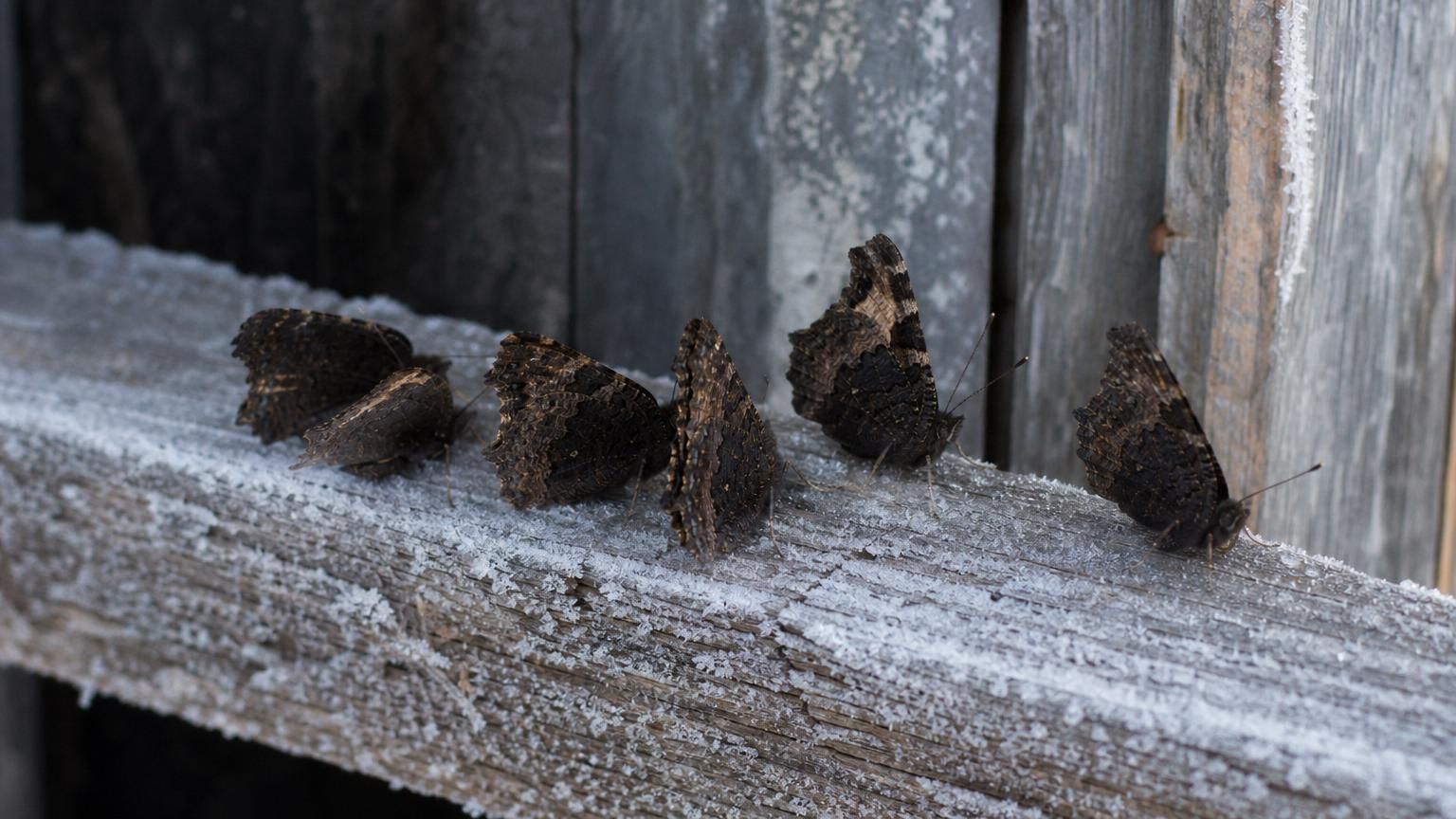
The small tortoiseshell (Aglais urticae) hides in bark crevices, hollow trees, attics, sheds, and caves. Its body cools almost to ambient temperature; the butterfly enters torpor. Fat reserves built up in summer sustain it through 7–9 months of overwintering. When temperatures rise above +10°C, it wakes and flies in search of early nectar plants.
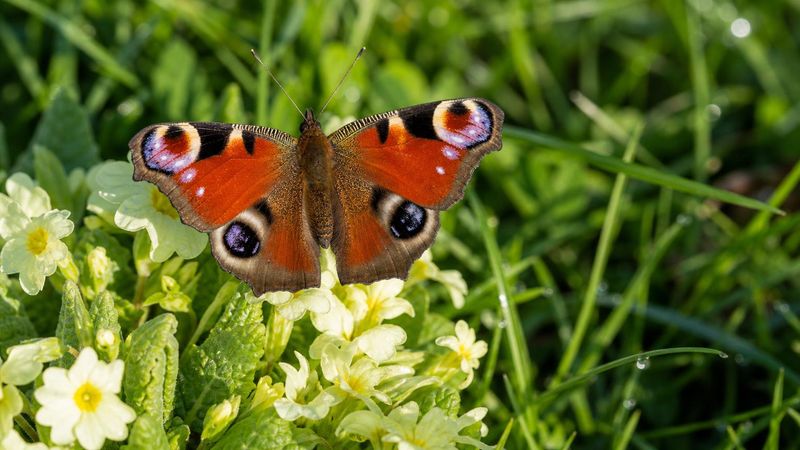
The European peacock (Aglais io) uses the same strategy. The underside of the wings is camouflaged, almost black: in a shelter the butterfly is nearly invisible.
The brimstone (Gonepteryx rhamni) overwinters among evergreen foliage — ivy, mistletoe, conifers. The angular wing shape mimics a leaf, and the greenish underside enhances camouflage. The body accumulates glycerol — a natural antifreeze allowing survival down to about -20°C.
The mourning cloak (Nymphalis antiopa) overwinters under bark, in hollows, and in rock crevices. It is among the first to appear in spring — sometimes flying over snow.
The painted lady (Vanessa cardui), unlike the species above, overwinters irregularly in Russia: in most regions it dies in frost, and spring populations are rebuilt by migration from the south.
Strategy 2: Overwintering as a Pupa
This is the most common strategy among day-flying butterflies. The pupa is cold-resistant and needs no food.
The large white (Pieris brassicae) attaches its pupa to a tree trunk, fence, or house wall. The pupa overwinters, and the first generation emerges in April–May.
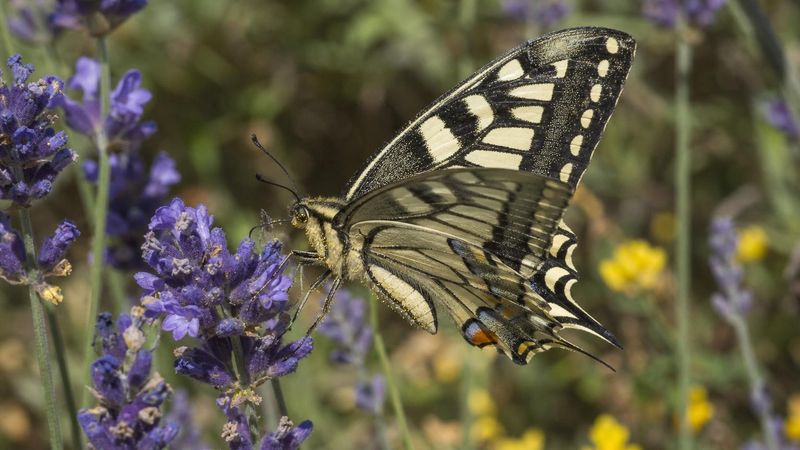
The swallowtail (Papilio machaon) overwinters as a pupa on tall grass stems or shrubs. Pupa color varies — green or brown — depending on the substrate where the caterpillar pupated.
The scarce swallowtail also overwinters as a pupa.
Pupae withstand significant frost thanks to cryoprotectants (glycerol, trehalose) in the hemolymph.
Strategy 3: Overwintering as a Caterpillar
Some species enter winter as undersized caterpillars — they hide in soil, leaf litter, or leaf tubes.
Many ringlets (many Erebia, Coenonympha) overwinter as early-stage caterpillars. In spring the caterpillar feeds on grasses and pupates in summer. In harsh mountain climates development may take two years: the caterpillar overwinters twice.
Some fritillaries (Melitaea) form winter nests: dozens of caterpillars weave a silk cradle in leaf axils and overwinter together, warming one another.
Many blues (Lycaenidae) overwinter as small caterpillars in litter or in ant nests — myrmecophilous species may still receive care from ants in winter.
Strategy 4: Overwintering as an Egg
Some species lay eggs in autumn; the egg overwinters under snow or in bark cracks.
Eggs have a tough chorion with a waxy layer that protects against drying and frost. Inside the egg, diapause (developmental arrest) starts automatically as temperature falls and day length shortens.
Examples: the gypsy moth lays eggs in rings around thin twigs; some blues lay eggs on dry stems of host plants.
Strategy 5: Migration
Some species avoid winter by flying to warm regions — like migratory birds.
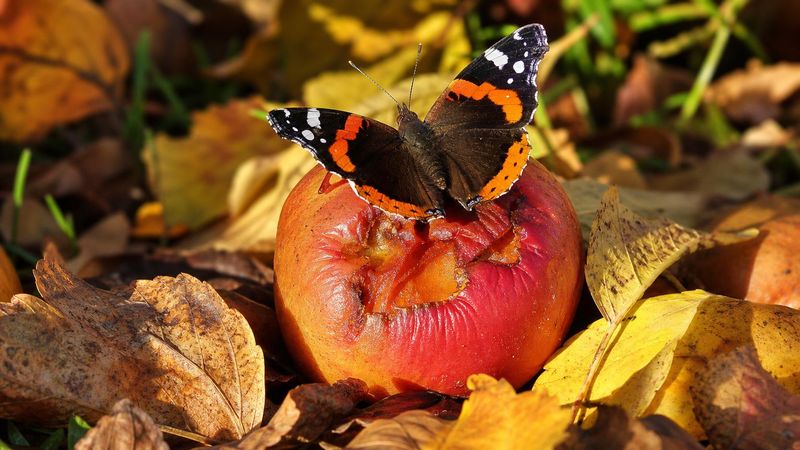
The red admiral (Vanessa atalanta) is partly migratory. In Europe some individuals fly south to the Mediterranean and North Africa. In Russia overwintering populations are small; most arrive in spring from the south.
The painted lady (Vanessa cardui) is the longest-migrating butterfly in the world. From Africa through the Mediterranean to Europe and back — a route of up to 15,000 km across several generations. It reaches Russia in late May–June.
The monarch (Danaus plexippus) is the most famous migrant, though it does not breed in Russia. Its millions-strong flocks fly annually from Canada to Mexico and back.
What Is Diapause?
Diapause is a physiological mechanism that halts development, built into insect biology. It is not simply “sleep from cold”: diapause is triggered in advance, when day length shortens at the end of summer, before cold arrives.
The insect stores fats and cryoprotectants, lowers metabolism, and “pauses” all growth and reproduction. Exiting diapause requires a certain amount of heat (degree-days), so butterflies do not wake too early during a brief midwinter thaw.
What to Do If You Find a Butterfly in Winter
A butterfly indoors in winter is usually a small tortoiseshell or peacock that entered by accident during a thaw or was brought in with firewood.
- Do not release it outdoors in frost — it will die.
- Place it in a cool (0 to +5°C), dark place — a balcony, glazed loggia, or cellar. There it will sleep again and complete overwintering.
- Do not keep it in a warm room: a butterfly that wakes in winter uses fat reserves, nectar is unavailable, and it dies of exhaustion.
For more on adult-stage biology, see how long butterflies live.
See also