How to Use the Atlas
Guide to using the butterfly atlas: how to identify a species, how sections are organized, and how to use the identification guide and encyclopedia.
What This Atlas Is
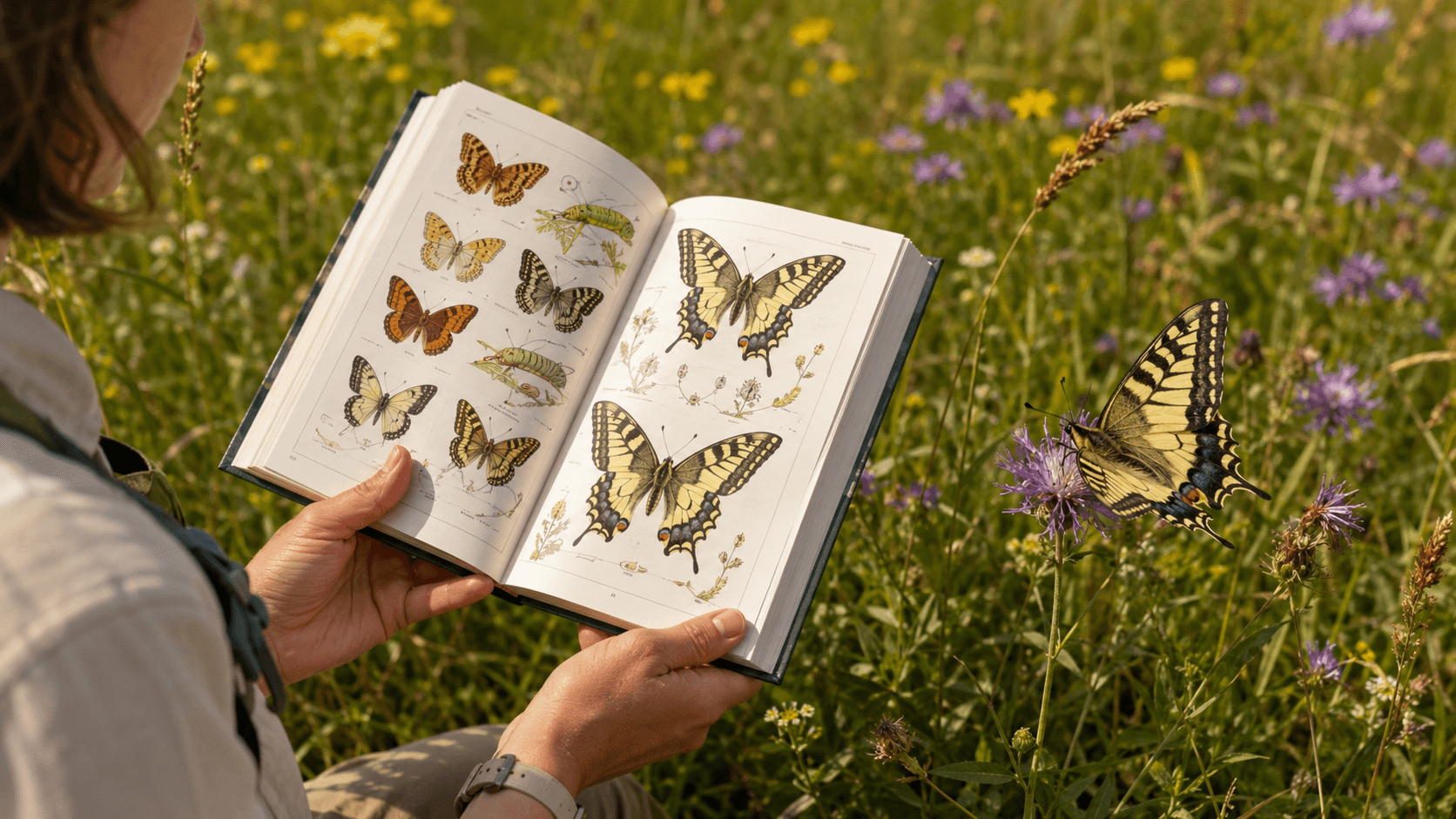
Butterfly-atlas.ru is a reference site about butterflies of Russia and the world. It is organized to help two types of visitors:
- The observer "with a question": encountered a butterfly — want to know what it is. Need a quick identification guide.
- The curious reader: want to learn about butterfly life — feeding, overwintering, ecology, species. Need an encyclopedia.
The atlas requires no special training: everything is written in accessible language with concrete examples.
Site Structure
The site is divided into six main sections. Here is what each contains:
Identification Guide
The main tool for field identification. Several "entry points" are available — choose the one convenient for your situation:
- By wing color — fastest start: "butterfly is white / blue / orange"
- By wing shape — tails, angular edges, elongated or rounded wings
- By size — small / medium / large
- By location — meadow, forest, forest edge, garden, bog, mountains
- By season — when it flies: spring, summer, autumn
- By caterpillar — if you found a larva, not an adult butterfly
- Common mistakes — analysis of classic confusions
Recommended order: start with color → refine by shape → check size and location → compare with similar species.
Butterfly Species
Overview articles on species groups:
- Day-flying butterflies — general characteristics, families, 6 species
- Nocturnal butterflies and moths — differences, main families
- Large butterflies — records of Russia and the world
- Rare butterflies — Red Data Book, 6 protected species
- How to identify a species — step-by-step algorithm
Families
Detailed pages for each major day-flying butterfly family of Russia:
- Nymphalids — small tortoiseshell, peacock, red admiral, fritillaries
- Swallowtails — swallowtail, scarce swallowtail, Apollo
- Whites — large white, green-veined white, brimstone
- Blues — "blue" and "brown" small species
- Fritillaries — marsh fritillary, pearl-bordered fritillary, ringlets
Each family page contains: diagnostic features, list of Russian species with descriptions, where and when to find them.
Encyclopedia
Articles on butterfly life and biology in general:
- What are butterflies — structure, scales, classification
- Life cycle — egg, caterpillar, pupa, imago
- How many species exist — global numbers, table by region
- How they differ from moths — antennae, posture, body
- Popular species — 12 best-known species
- Where they live — biotopes from tropics to tundra
Butterfly Life
Ecological and behavioral topics:
- How long they live — lifespan by species
- What they eat — nectar, puddling, caterpillar host plants
- Why bright wings — mimicry, aposematism, camouflage
- How they overwinter — diapause, 5 strategies
- Role in nature — pollination, food chains, bioindication
Glossary
Short but complete articles on terms:
- Metamorphosis — complete and incomplete, stages
- Pupa — chrysalis, cocoon, histolysis
- Imago — adult butterfly, eclosion
Atlas (by Region)
Cards with fauna of different world regions:
- Russia — climatic zones, top species, Red Data Book
- Europe — 500 species, Alps, Mediterranean
- Asia — from Siberia to tropics, birdwings
- Africa, both Americas, Australia — most interesting species of each continent
How to Use the Atlas for Identification
Scenario 1: found a butterfly, want to know the species
- Open the identification guide by color
- Choose the nearest color type
- Read candidate descriptions — find a match by wing shape and size
- If doubts remain — common mistakes
- If identification failed — upload a photo to iNaturalist
Scenario 2: want to know who flies on your meadow in July
- Open the identification guide by season — find July
- Narrow by biotope: meadow in the location guide
- Study species descriptions in the corresponding families
Scenario 3: found a caterpillar in the garden
- Open the identification guide by caterpillar
- Find the host plant in the table
- Check caterpillar description — color, hairs, horns
Tips for Beginners
Start with the basics — read "What are butterflies" and "How they differ from moths". This takes 10 minutes and immediately gives you a working framework.
Don't try to memorize everything — the atlas is designed as a reference, not a textbook. Return to it when you encounter a specific butterfly.
Photograph systematically — upper side, underside, head with antennae. Three shots provide all needed information.
Keep a journal — record date, place, biotope. Over time you will build a personal observation database and start noticing patterns: "every July marsh fritillary appears on this meadow."
For Experienced Observers
If you already know basic species, the atlas will help:
- Understand difficult groups: blues, fritillaries, fritillaries — through family pages
- Learn species biology — feeding, overwintering, ecology
- Plan observations by region — through the atlas section
Content Notes
The atlas covers day-flying butterflies of Russia and the world. Nocturnal butterflies are presented in overview — there are several thousand species, and a detailed identification guide for nocturnal forms is beyond this project's scope.
Data are current as of 2026. Lepidopteran systematics is periodically revised: some species are split or merged. If there is a discrepancy with the latest sources — refer to Fauna Europaea and Lepidoptera and some other life forms (BOLD Systems) for current names.
All species names follow international binomial nomenclature (Genus species author, year).
See also