By wing colour
Butterfly identification by wing colour: find a species by main colouration — from white whites to blue blues and patterned nymphalids.
How to use colour for identification
Wing colour is one of the fastest ways to narrow the search when identifying a butterfly. Find the matching colour group below and compare the description with what you see.
Important caveats before you start:
- Upper and lower wing surfaces often differ. The upper side is visible in flight; the lower side when the butterfly sits with wings folded.
- In many species males and females are coloured differently (especially in blues). Below, males are described unless stated otherwise.
- Colour can vary slightly with lighting, wear, and geographic population.
- One colour alone does not guarantee identification. Also use wing shape and size.
White and cream
Butterflies with predominantly white upper wings almost always belong to whites and sulphurs (Pieridae).
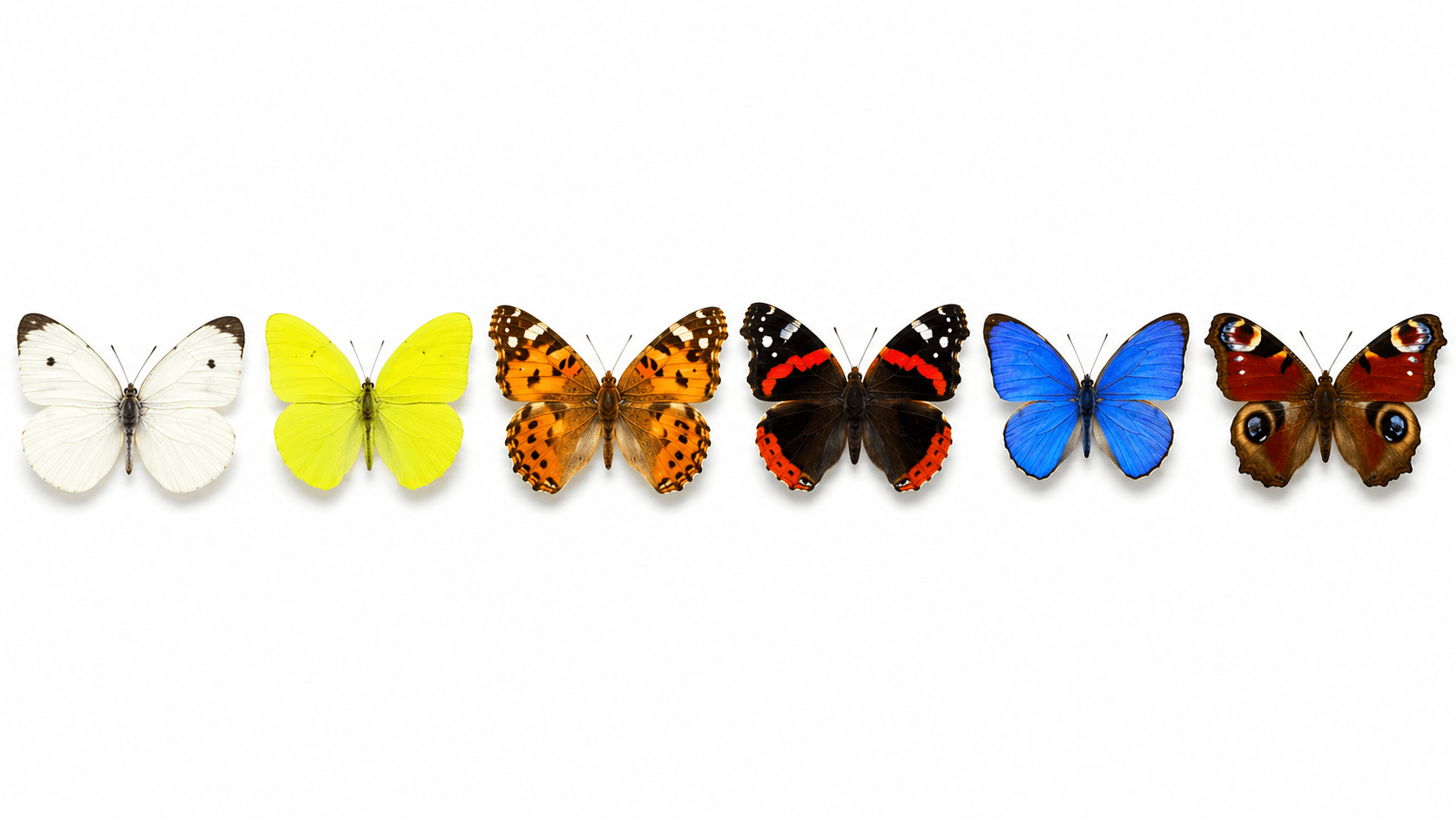
Large white (Pieris brassicae) — a large white. Black apical spots on the forewings. The female has two additional black spots mid-wing. Very common wherever cabbage and other crucifers grow.
Small white (Pieris rapae) — similar to the large white but noticeably smaller. The apical spot is paler; the female’s spots are smaller.
Black-veined white (Aporia crataegi) — white with clearly visible dark wing veins. Often seen in large groups in gardens and at woodland edges. The caterpillar feeds on hawthorn and other rosaceous plants.
Wood white (Leptidea sinapis) — a small, delicate white with a rounded dark spot at the forewing apex. Flies on meadows and woodland edges.
Yellow and lemon
Brimstone (Gonepteryx rhamni) — the male is bright lemon-yellow; the female pale greenish, almost white. Angular wing projections mimic a leaf. Long-lived — up to 12 months. One of the first spring butterflies.
Pale clouded yellow (Colias hyale) and moorland clouded yellow (C. palaeno) — yellow with a dark border. Clouded yellows are hard to tell apart — note the width of the dark border and the pattern on the underside.
Orange tip (Anthocharis cardamines) — a white butterfly; the male has a bright orange forewing tip. The female is entirely white. A spring species, flying April–May.
Orange and russet
Orange colouration is typical of many nymphalids.
Small tortoiseshell (Aglais urticae) — rich orange with black spots and a blue marginal band on the hindwings. The underside is dark grey, camouflaged. The caterpillar lives on nettle.
Painted lady (Vanessa cardui) — orange-brown with white spots at the forewing tips and a black-and-orange pattern. The hindwing underside has a fine mosaic pattern. The most widespread butterfly in the world.
Fritillaries (genera Argynnis, Fabriciana, and others) — bright orange with a characteristic black dot pattern. The hindwing underside has metallic silvery spots (“pearls”). They fly on meadows and glades.
Red with black spots
Red admiral (Vanessa atalanta) — dark brown or almost black with a scarlet (red) transverse band on the forewings and a scarlet border on the hindwings. White spots on the dark forewing apex. One of the most striking species.
Brown and ochre
Brown tones are the “working colour” of satyrines and many nymphalids.
Meadow browns and ringlets — in most species the base is brown or yellow-brown with characteristic “eyespot” markings on the wings. The spots deter birds. More detail in satyrines.
Mourning cloak (Nymphalis antiopa) — dark maroon, almost black, with a cream-yellow border and blue spots. One of the largest day-flying butterflies in Russia; long-lived.
Blue and violet
Blue colour in blues occurs only in males. Females of the same species are usually brown.
Common blue (Polyommatus icarus) — one of the most widespread species. The male is bright blue with a white fringe. The underside is grey-beige with black dots in white rings and orange spots.
Silver-studded blue (Plebejus argus) — blue with more pronounced dark margins. An orange border on the hindwings in both sexes.
Patterned and multicoloured
European peacock (Aglais io) — dark red with four large “eyes”: blue, yellow, and black. The underside is almost black — when the butterfly folds its wings it becomes nearly invisible on tree bark.
Checkerspots (Melitaea) — orange-brown with a chessboard pattern of dark spots. Several similar species, distinguishable mainly by the hindwing underside.
If colour alone is not enough
Colour is the first, not the only, trait. Also try:
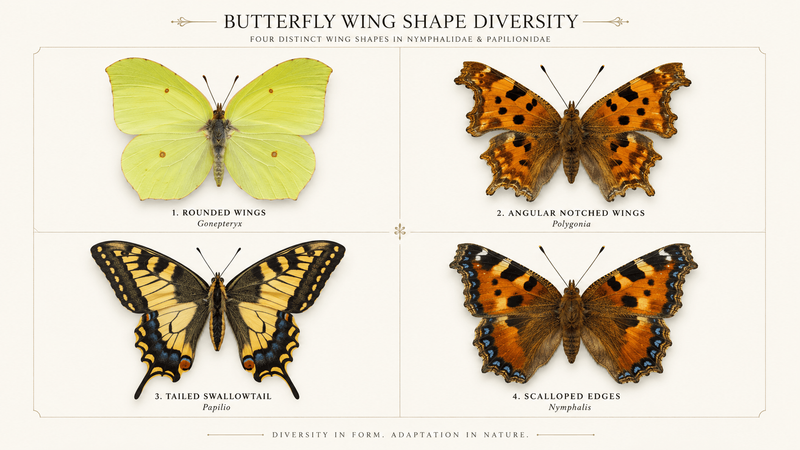
- Identification by wing shape — tails, angular edges, rounded form
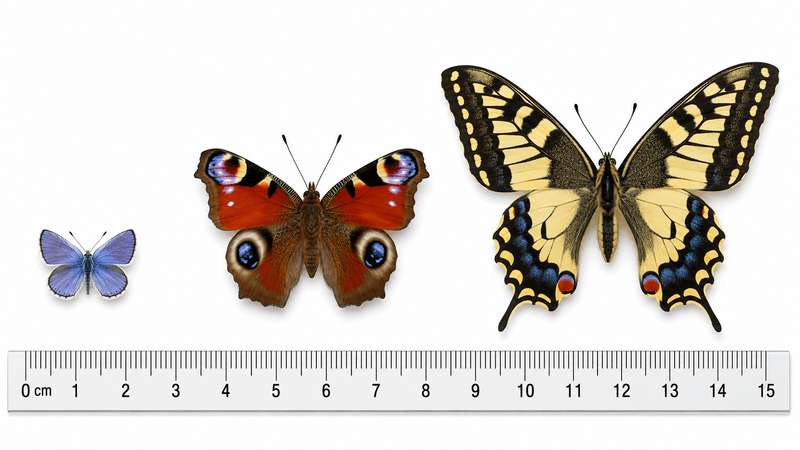
- Identification by size — from tiny blues to large swallowtails
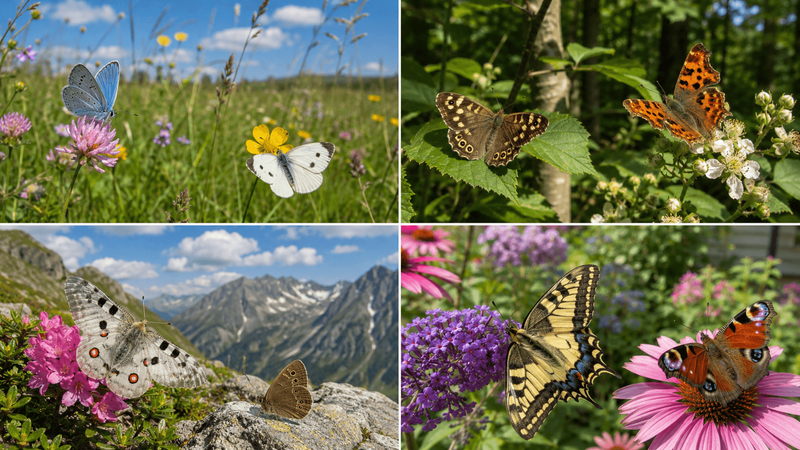
- Identification by place of encounter — meadow, forest, mountains, bog
- Common identification mistakes — similar species that are easy to confuse