By size
Butterfly identification by size: from tiny blues with a 15 mm wingspan to giant birdwings with wings wider than 25 cm — a quick guide by wingspan.
How to use size for identification
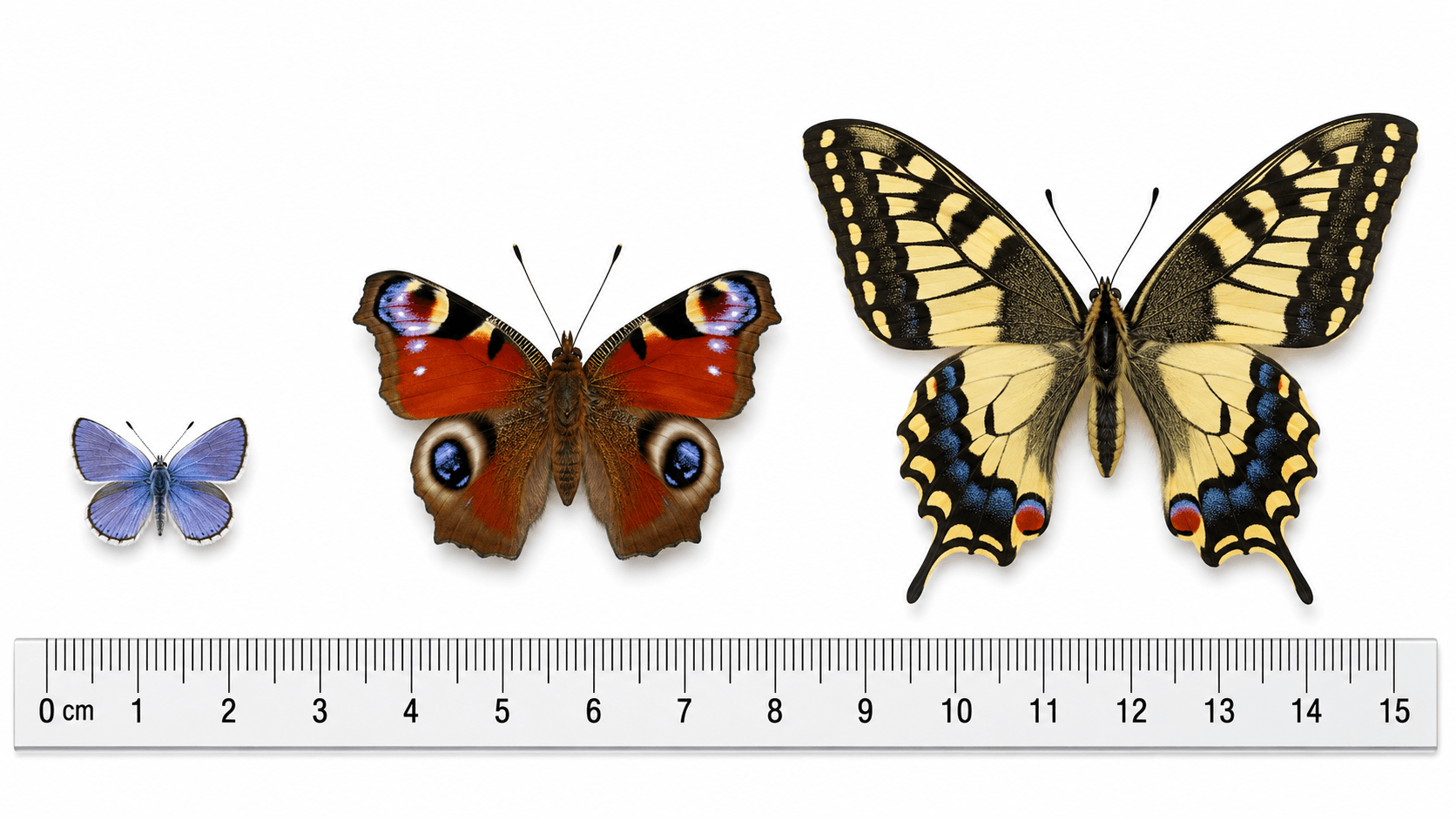
Wingspan is one of the first traits noticed when you meet a butterfly. It is not always exact: wings may be damaged, and estimating by eye is hard. Still, size narrows the search well together with colour and wing shape.
How to measure correctly: wingspan is the distance from tip to tip of the forewings with wings spread. Not wing length alone, but full span.
Very small: up to 25 mm
Butterflies with a span under 2.5 cm are almost always blues or skippers.
Small blues (Cupido, Everes) — 14–20 mm. The smallest day-flying butterflies in Russia. Blue above (males) or brown above; grey-white below with spots. Many have thread-like “tails”. Live on dry meadows and glades.
Small blue (Cupido minimus) — 16–22 mm, among the smallest. Male dull blue; female brown. Caterpillar feeds on rockrose.
Small skippers (Thymelicus, Hesperia) — 20–28 mm, brown-orange, stocky. Characteristic “jet-like” flight.
Small: 25–40 mm
The most numerous size group. Includes most blues, some nymphalids, and small whites.
Common blue (Polyommatus icarus) — 28–36 mm. The most common blues in Russia. Male blue; female brown.
Small copper (Lycaena phlaeas) — 26–34 mm. Copper-orange with dark spots.
Orange tip (Anthocharis cardamines) — 32–42 mm. White; male with orange wing tip.
Small white (Pieris rapae) — 32–46 mm. White with black spots; smaller than the large white.
Small fritillaries and checkerspots — most species in the 30–40 mm range.
Medium: 40–60 mm
The most noticeable and easy-to-watch butterflies.
Small tortoiseshell (Aglais urticae) — 40–50 mm. Orange with black spots and a blue border. One of the most recognizable.
European peacock (Aglais io) — 50–60 mm. Maroon with four large “eyes”.
Large white (Pieris brassicae) — 50–60 mm. White with dark apical spots.
Brimstone (Gonepteryx rhamni) — 50–60 mm. Male bright yellow; female greenish-white.
Red admiral (Vanessa atalanta) — 55–65 mm. Dark brown with a scarlet band.
Painted lady (Vanessa cardui) — 50–60 mm. Orange-brown with white spots.
Scarce swallowtail (Iphiclides podalirius) — 55–75 mm. Pale yellow with dark stripes and long “tails”.
Large: 60–90 mm
Conspicuous butterflies that always draw attention.
Old World swallowtail (Papilio machaon) — 65–80 mm. Yellow with a black pattern and “tails”. The largest and best-known butterfly of central Russia.
Apollo (Parnassius apollo) — 60–90 mm. White with red spots. Mountain species; Red Data Book.
Mourning cloak (Nymphalis antiopa) — 65–80 mm. Dark maroon with a cream border. One of the largest nymphalids in Russia.
High brown fritillary (Argynnis paphia) — 55–70 mm. Orange with a black pattern; silvery underside.
Admirals (Limenitis, Neptis) — 55–75 mm. Black or dark with white bands and spots.
Very large: over 90 mm
Russia has only a few such species — an encounter is memorable.
Maack’s swallowtail (Papilio maackii) — 90–120 mm. Black with a green-blue sheen. Primorsky Krai; one of the largest swallowtails in Russia.
Monarch (Danaus plexippus) — 90–105 mm. Orange-black. Rare in Russia — a vagrant in the Far East.
Largest butterflies in the world
Outside Russia the scale is different:
Queen Alexandra’s birdwing (Ornithoptera alexandrae, Papua New Guinea) — female wingspan up to 280 mm. The largest day-flying butterfly in the world.
Priam’s birdwing (Ornithoptera priamus) — up to 200 mm; Australia and Melanesia.
Atlas moth (Attacus atlas) — not a day-flying butterfly but a giant silkmoth — up to 300 mm span. The largest winged insect by wing area.
If size does not help
Size varies: females are usually larger than males of the same species; worn specimens look smaller than fresh ones. Use several traits at once:
- Wing colour — the fastest first step
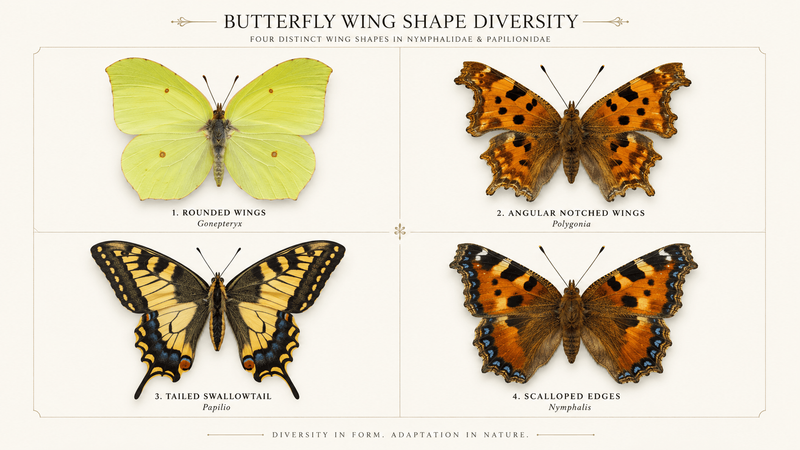
- Wing shape — tails, scalloped edges, angular tips
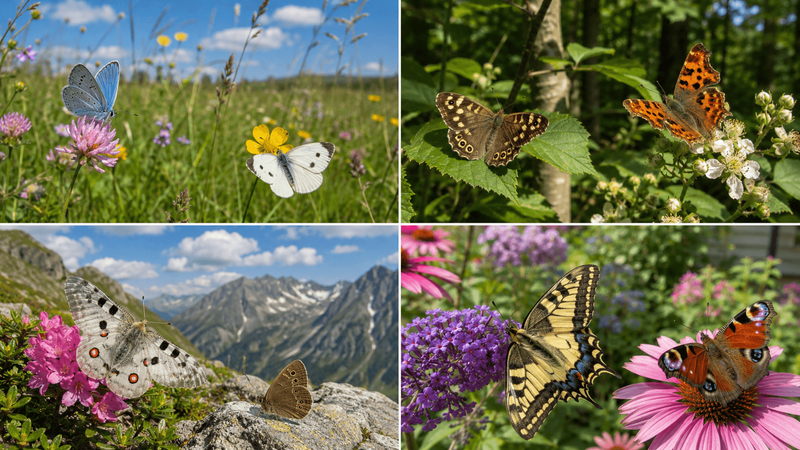
- Place of encounter — meadow, forest, bog, mountains
More on the largest species — in large butterflies.
See also