Common identification mistakes
The most common mistakes when identifying butterflies: confusing sexes, seasonal forms, similar species. Each case explained with examples.
Why know mistakes in advance
Most identification errors are not random — they follow patterns. Some species pairs are always confused; others mislead because of sexual dimorphism or seasonal forms. Knowing the pitfalls, you will deliberately check the right trait from the first look.
Mistake 1: male and female as “different species”
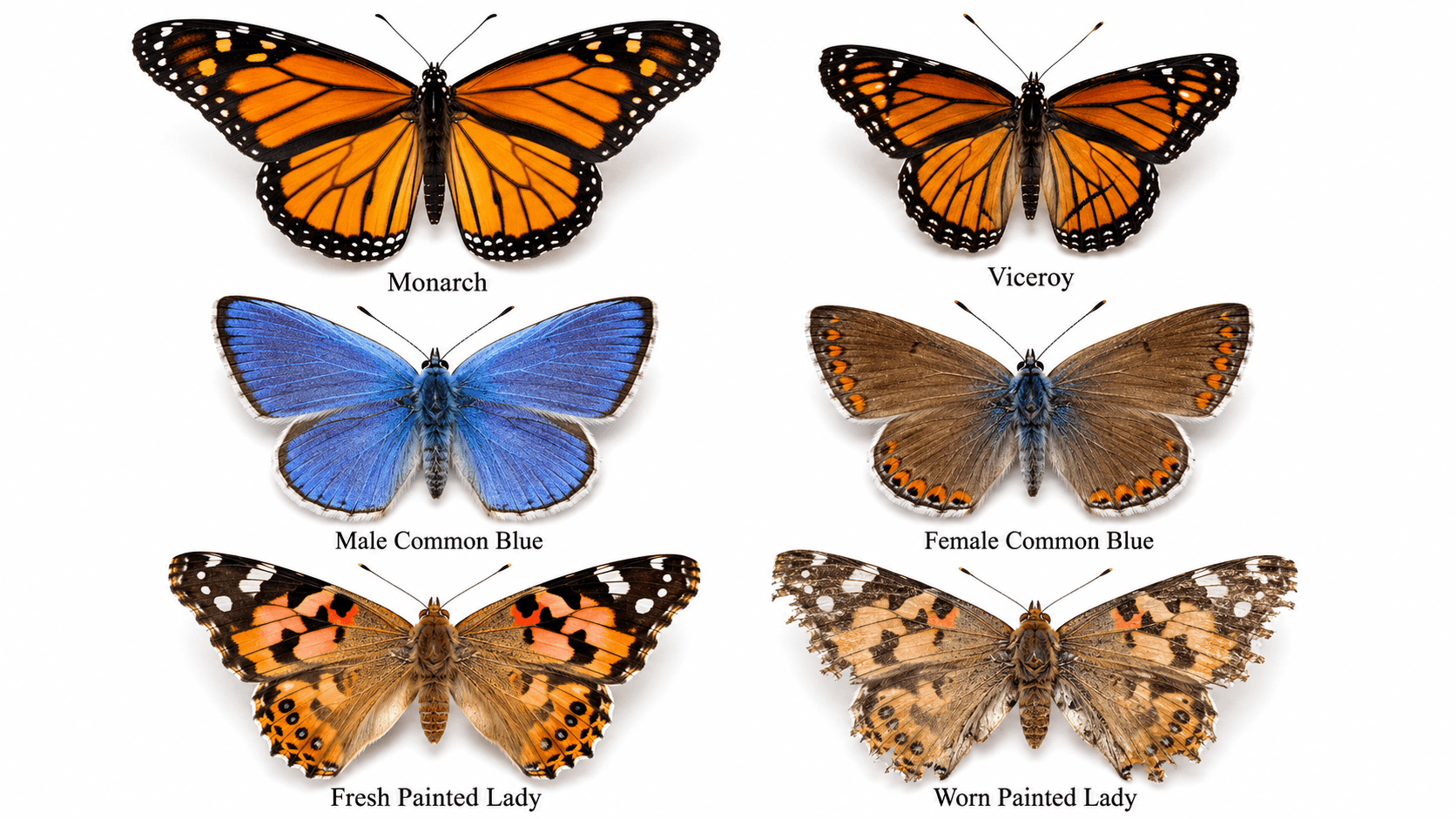
Sexual dimorphism in butterflies is often so strong that male and female are taken for different species.
Brimstone (Gonepteryx rhamni): male bright yellow; female pale greenish, almost white. In flight they seem like two butterflies. What unites them is the angular wing shape and a bright orange spot in the centre of each wing (both sexes).
Blues (almost the whole group): male blue or azure above; female brown or grey. In flight both colours may show. Identify them by the underside, where the pattern is the same in both sexes.
Orange tip (Anthocharis cardamines): male white with a large orange spot; female white without orange, almost like a small white. Tell them by the characteristic green “marbled” pattern on the hindwing underside (both sexes).
Purple emperor (Apatura iris): male with bright blue sheen at certain angles; female brown without sheen, much larger. People often think the blue male and the large brown female are different species.
How to avoid: if you see an unusual “brown” butterfly without bright marks — check whether it is the female of a known species.
Mistake 2: spring and summer broods as “different species”
Some species have two generations per year that look very different.
Map butterfly (Araschnia levana) — a classic example. Spring brood: russet with a dark pattern, like a small fritillary. Summer brood: dark brown with a white band, like a small admiral. One species — but in the field they are often treated as two.
How to tell them apart: in both broods the underside is characteristic — a fine mesh of yellow and brown bands. This trait is constant.
Common blue (Polyommatus icarus): spring brood smaller and duller; summer brood larger and brighter. Females are especially variable — sometimes with blue scales at the wing base, sometimes entirely brown.
How to avoid: if you cannot ID a small russet or dark nymphalid — check whether it is a seasonal form of the map butterfly.
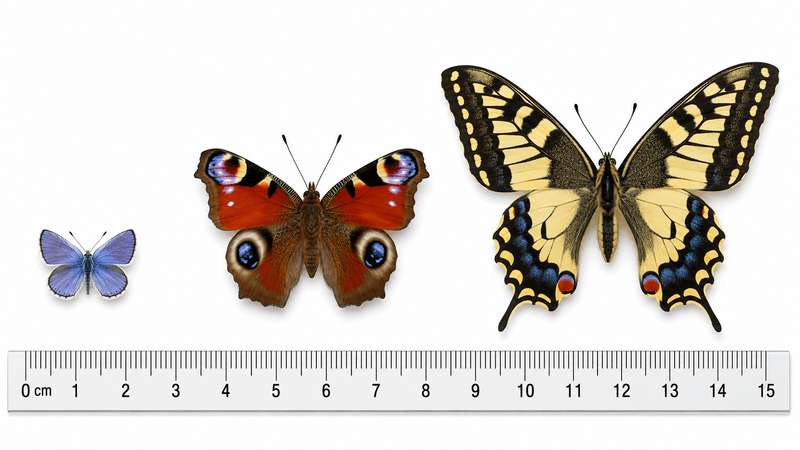
Mistake 3: large white vs. small white
Both white, both on crucifers — a classic confusing pair.
| Trait | Large white | Small white |
|---|---|---|
| Size | Larger (45–65 mm) | Smaller (35–50 mm) |
| Forewing spots (♂) | Two black spots | One black spot |
| Hindwing underside | Yellow-green with dark veins | Uniform yellow, no veins |
| Dark wing tip | Large, dark | Smaller, paler |
Main field mark: spots on the male forewing — two in large white, one in small white. If the butterfly is female — look at the hindwing underside.
Mistake 4: small tortoiseshell vs. large tortoiseshell
Both orange with black spots — similar but distinct.
| Trait | Small tortoiseshell (Aglais urticae) | Large tortoiseshell (Nymphalis polychloros) |
|---|---|---|
| Size | 40–50 mm | 55–65 mm (larger) |
| Forewing spots | 3 black spots | 4 black spots |
| Blue marginal band | Bright, pronounced | Less conspicuous |
| White apical spot | Present | Smaller or absent |
| Caterpillar host plant | Nettle | Willow, elm, fruit trees |
Main trait: 4 forewing spots in large tortoiseshell vs. 3 in small tortoiseshell.
Mistake 5: look-alike blues
Male blues are almost all blue above. They must be told apart by the underside.
Common blue (Polyommatus icarus) vs. silver-studded blue (Plebejus argus):
- Icarus: underside with orange marginal spots and black dots; female often without orange spots
- Argus: same general scheme, but in Argus the orange spots on the hindwing underside have metallic green “pupils” — absent in Icarus
Common blue vs. chalkhill blue (Polyommatus bellargus):
- Icarus: blue with a violet tint; dark marginal border
- Chalkhill blue: more intense bright sky-blue; border contrastingly dark with a white chequered fringe between dark veins — a characteristic mark
Mistake 6: look-alike fritillaries
Large russet nymphalids with “silver” below — a difficult group.
Main method: hindwing underside. Silvery spots are unique to each species. Hard to memorize at once — but in the field you can photograph the underside and identify at home.
Most common species in central Russia:
- High brown fritillary (Argynnis paphia): large; male with 4 black stripes on the forewing upperside (pheromone areas)
- Niobe fritillary (Argynnis adippe): slightly smaller; silvery spots below separated by brown bars
- Small pearl-bordered fritillary (Boloria selene): smaller; on wet meadows
Mistake 7: mistaking a moth or noctuid for a day-flying butterfly
Several nocturnal and crepuscular species fly by day or resemble day-fliers.
Burnets (Zygaenidae): bright red-black or blue-red; fly by day on flowers. Can be taken for beetles or day-flying butterflies. Burnet antennae are thread-like or clubbed — look closely.
Tiger moths (Arctiinae): some species fly by day. Garden tiger on flowers is a typical daytime sight. Nocturnal sign: hairier body and horizontal wings at rest.
Clearwings (Sesiidae): transparent or semi-transparent wings, body with yellow bands — mimic wasps and hornets. Fly by day. If you see a “wasp” with antennae and wings — check for a clearwing.
Mistake 8: worn butterfly
In late season (August–September) many butterflies fly with worn, faded wings. Pattern rubs off, colour pales. Such a butterfly is often taken for another species or not identified at all.
How to cope: look at overall silhouette and wing shape — they do not wear away. Seek remnants of key traits: eyespot shape, general pattern type, underside colour (it wears less).
Practical tips
- Always photograph the underside — for blues, fritillaries, and nymphalids it is the decisive shot.
- Determine sex before searching for the species — that immediately narrows candidates.
- Check the season — if the species “does not fit” the time of year, it may be another brood or another species.
- Upload to iNaturalist — the community will correct mistakes; it is one of the best ways to learn.
- Do not worry about unresolved IDs — female blues, fritillaries, and some noctuids cannot be identified even from good photos without a specialist.
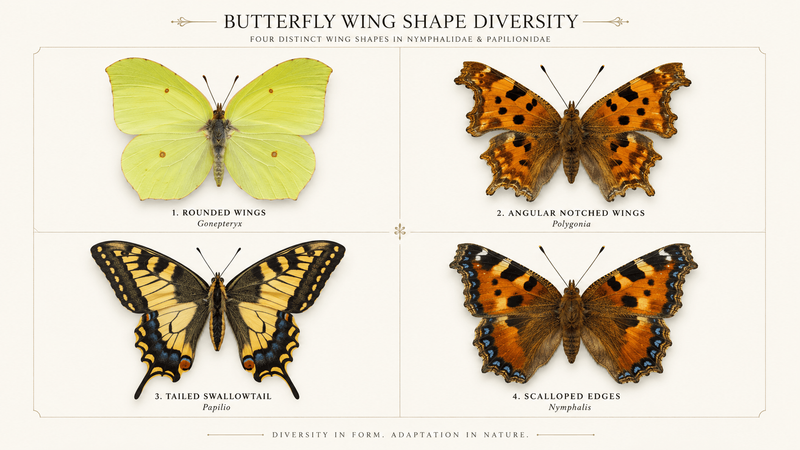
To start — identification by colour and by wing shape.
See also