By place of encounter
Butterfly identification by place of encounter: meadow, forest, woodland edge, garden, bog, mountains, coast — which species live where.
Why consider place of encounter
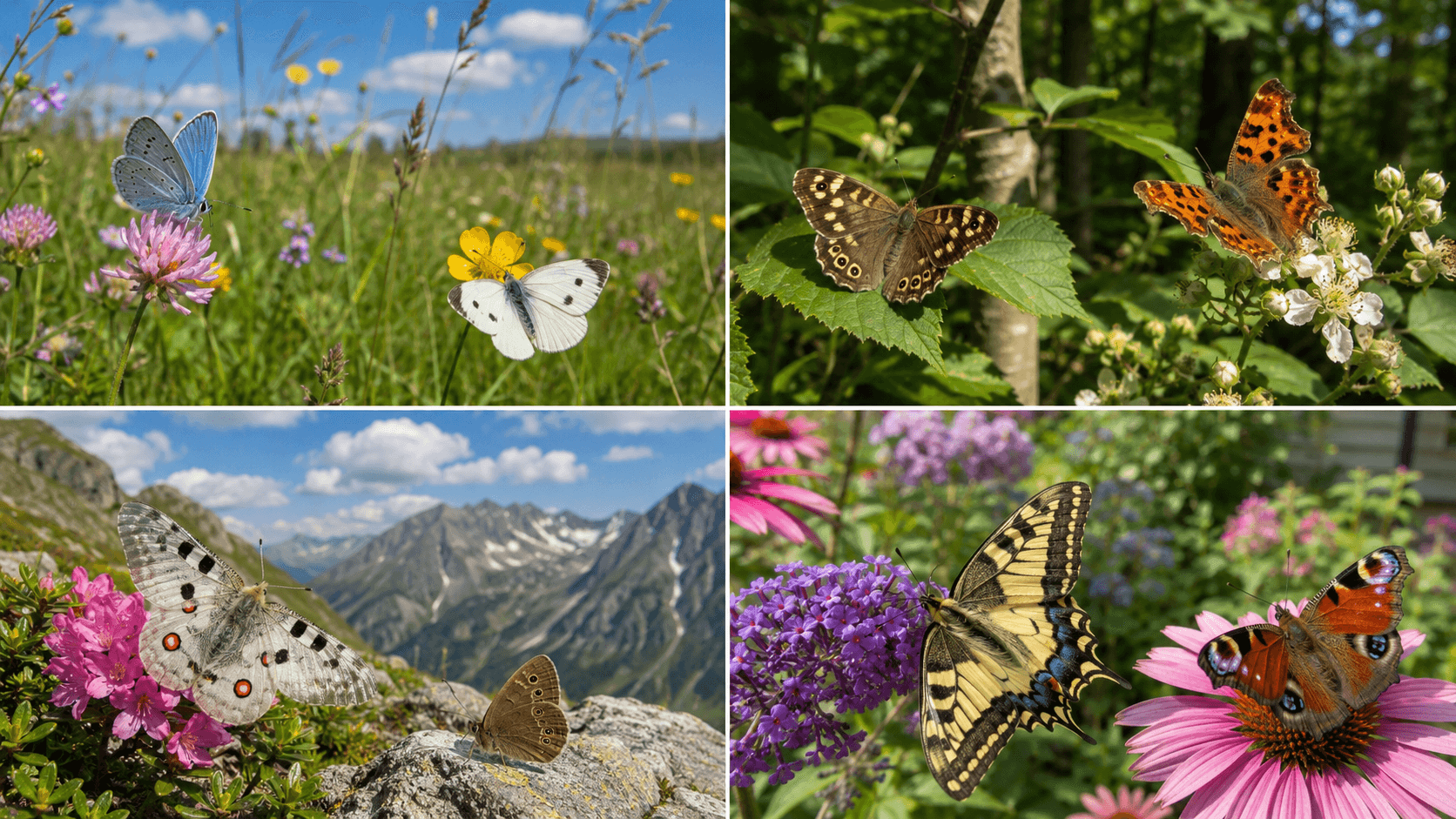
Habitat is one of the fastest filters when identifying. Many species are tightly tied to a specific environment: where the caterpillar’s host plant grows, the adult butterfly will stay. The combination “place + season” often points to one or two candidates before you study the pattern.
Use this guide together with identification by colour, by wing shape, and by season.
Open meadow and flower-rich glade
Meadows are the richest habitat in the temperate zone. Nectar flowers for adults and grasses/forbs for caterpillars make them the main home of day-flying butterflies.
Common species:
- Meadow brown (Maniola jurtina) — brown with an eyespot, June–August
- Small heath (Coenonympha pamphilus) — small ochre species, May–September
- Large white (Pieris brassicae) — white, large, all season
- Small white (Pieris rapae) — white, smaller than large white, two generations
- Black-veined white (Aporia crataegi) — white with dark veins, June
- Fritillaries (Argynnis, Speyeria) — russet with “silver” below, June–August
- Glanville fritillary (Melitaea cinxia) — checkered russet-brown, May–June
What to look for on a meadow: flowering clover, thistle, yarrow, purple umbellifers — several species always feed there.
Woodland edge and clearing
The border between forest and open ground has the greatest diversity. Woodland and meadow species meet here, plus edge specialists.
Characteristic species:
- Small tortoiseshell (Aglais urticae) — orange with black spots; wherever nettle grows
- Comma (Polygonia c-album) — ragged wing margins; bark camouflage
- Red admiral (Vanessa atalanta) — black with a red band
- Painted lady (Vanessa cardui) — russet with white spots; migrant
- Brimstone (Gonepteryx rhamni) — male bright yellow, female greenish; first spring butterfly at the edge
- Wood white (Leptidea sinapis) — small white, flutters by shrubs
Forest (mixed and deciduous)
Deeper in the forest there are fewer species — few nectar plants. But there are forest specialists.
What you may find:
- Purple emperor (Apatura iris) — male with blue sheen; tops of oaks and willow thickets by water
- Poplar admiral (Limenitis populi) — large, dark with a white band; in aspen stands
- White admiral (Limenitis camilla) — smaller, narrower white band
- Woodland brown (Lopinga achine) — brown with rows of eyespots; light deciduous forest
- Purple hairstreak (Favonius quercus) — small, blue male; by oaks
- Green hairstreak (Callophrys rubi) — bright green below; shrubby edges
In oak and lime woods look for purple emperors patrolling high in the canopy.
Coniferous forest (spruce, pine)
Poorer than deciduous forest, but with several characteristic species.
Typical species:
- Pine looper (Bupalus piniaria) — nocturnal, but seen by day on trunks
- Ringlets (Erebia) — in mountain spruce forest
- Common blue (Polyommatus icarus) — on warm edges with clover
- Brown argus (Aricia agestis) — small, brown, on sunny edges
Garden, allotment, urban areas
Synanthropic species are well established in cities, gardens, and parks where nectar plants remain.
What flies in town:
- Small tortoiseshell — wherever nettle grows (wasteland, fences, roadsides)
- European peacock (Aglais io) — very common in gardens; caterpillar on nettle
- Large white, small white — on cabbage beds and rape fields
- Brimstone — first to appear in spring in parks
- Painted lady — on thistle, burdock, yarrow
- Common blue — on lawns with clover
What to plant to attract butterflies: willow, nettle, clover, violets, nectar annuals (buddleia, verbena, lavender).
Bog and wet meadow
A specific habitat with narrow specialists.
Characteristic species:
- Marsh fritillary (Euphydryas aurinia) — checkered, May; strictly on bogs with devil’s-bit scabious
- Cranberry blue (Plebejus optilete) — bluish-violet; in sphagnum bogs
- Large heath (Coenonympha tullia) — pale ochre; heath and sphagnum bogs
- Small pearl-bordered fritillary (Boloria selene) — russet; wet meadows with violets
River, lake, and stream bank
Damp banks are used for “puddling” — butterflies gather at puddles and damp soil for mineral salts.
What to find by water:
- Old World swallowtail (Papilio machaon) — often nectars on umbellifers along banks
- Purple emperor — by willows and aspens over water
- Poplar admiral — in willow and aspen stands by water
- Males of many blues and clouded yellows on damp sand or mud
Mountains (Caucasus, Urals, Altai, Sayan)
Mountain fauna differs greatly from the lowlands. Each belt has its own set of species.
Subalpine belt (800–2000 m):
- Ringlets (Erebia) — dark brown with orange eyespots; dozens of species
- Apollo (Parnassius apollo) — white with red eyespots; rocky meadows with houseleek
- Mnemosyne (Parnassius mnemosyne) — white with dark spots; meadows with larkspur
Alpine belt (above 2000 m):
- Phoebus Apollo (Parnassius phoebus) — in the Altai
- Specialized mountain blues and clouded yellows
On the Caucasus butterfly diversity is especially high: Mediterranean, steppe, and European faunas meet.
Steppe and rocky slopes
Southern Russia and the Volga region have their own steppe fauna.
Steppe species:
- Pale clouded yellow (Colias hyale) and moorland clouded yellow (C. palaeno) — yellow, fast flight
- Eastern festoon (Zegris eupheme) — white with an orange spot; south of Russia
- Scarce swallowtail (Iphiclides podalirius) — yellow-white with dark stripes and long tails; by blackthorn
- Various blues: eastern baton blue, silver-studded blue, Rippart’s blue
Practical tip
Before going out, decide on habitat and season — that cuts the candidate list in half. In your observation notebook record not only the species but the place type: “meadow by forest”, “stream bank”, “oak woodland edge”. Over time you will see that some species are always predictable where their host plant grows.
For difficult cases — common identification mistakes. Seasonal aspect — by time of year.
See also