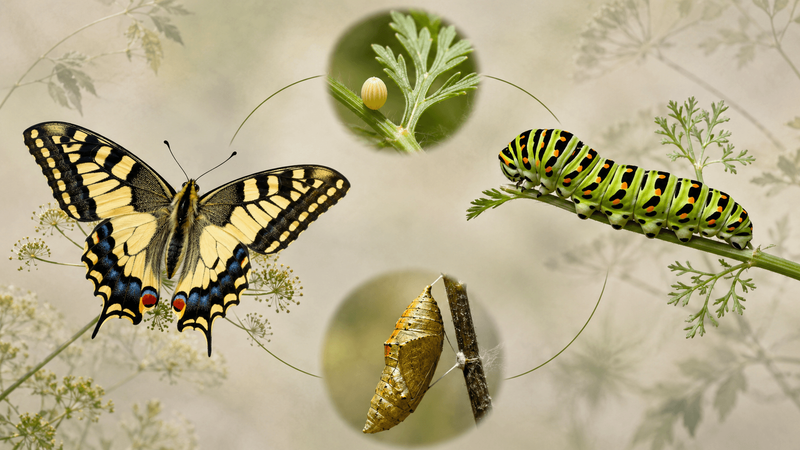
How Butterflies Differ from Moths
Butterflies and moths are both lepidopterans, but differ in antennae, resting posture, and activity time. We examine the features with examples.
Where the Word "Moth" Comes From
In Russian, "motylёk" and "babochka" are used as synonyms or as a "nocturnal/daytime" pair. In scientific classification there is no such division: all butterflies and moths are one order Lepidoptera (scale-winged insects). The word "motylёk" does not denote any taxon; it merely tells us we are likely looking at a small nocturnal species.
The situation is similar in other languages: English butterfly (day-flying) and moth (nocturnal) — an everyday distinction, not a biological one. In German — Tagfalter and Nachtfalter (literally "day wing-folder" and "night wing-folder").
Why is this important? Because no single feature works without exceptions. But several features together give a confident answer in the vast majority of cases.
Main Feature: Antenna Shape
Antennae are the most reliable way to distinguish a day-flying butterfly from a nocturnal one.
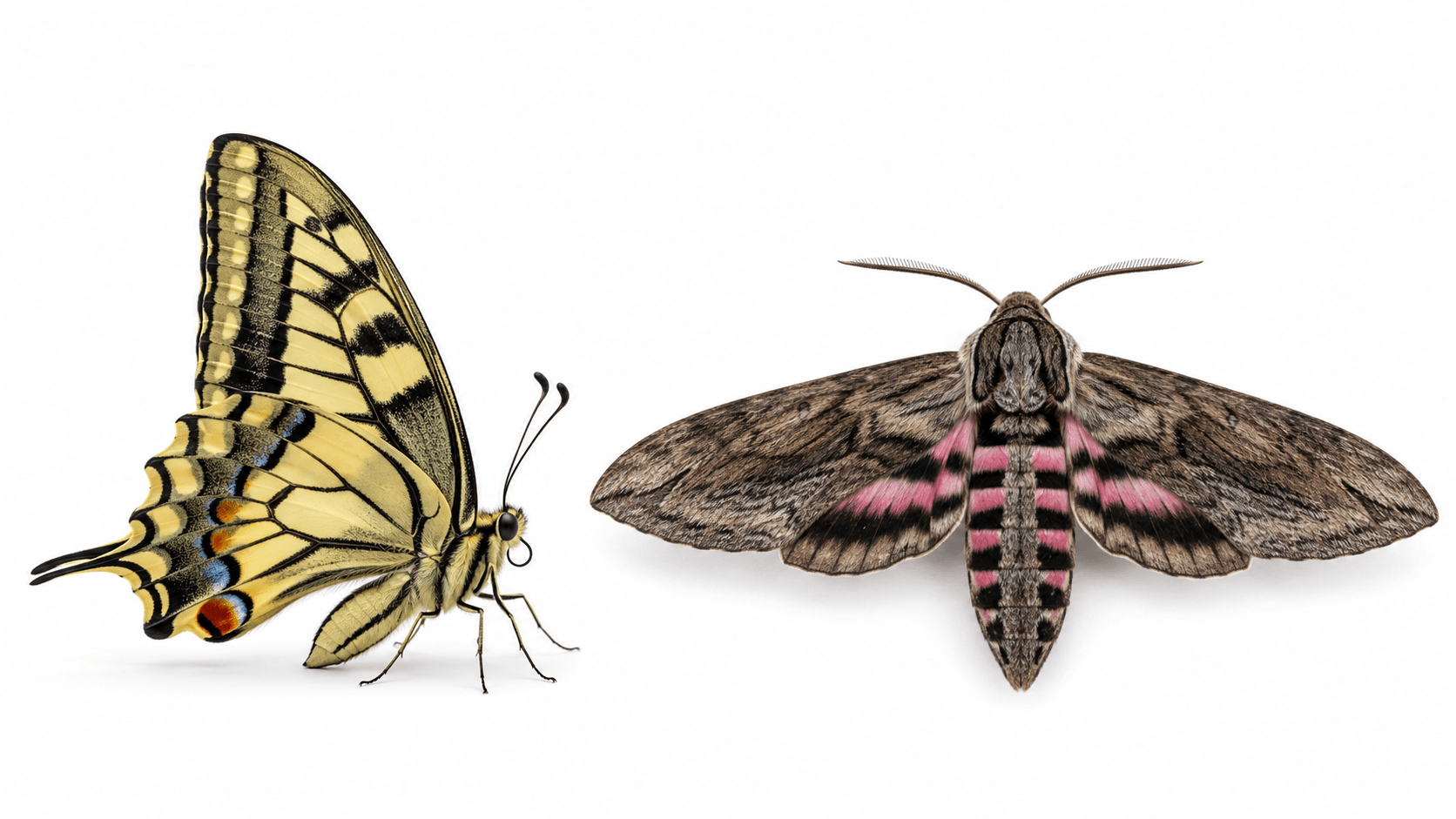
Day-flying butterflies (superfamily Papilionoidea) have club-shaped antennae: a thin "stem" with a noticeable thickening — a "club" — at the tip. The club may be oval, pear-shaped, or spindle-shaped, but the thickening is always present.
Nocturnal butterflies have antennae of fundamentally different structure:
- Feathery (bipectinate) — in many male noctuids, hawkmoths, and emperor moths. They look like a tiny fir tree or bird feather. The huge surface area allows detection of trace concentrations of female pheromones.
- Thread-like — thin, without thickening, in geometer moths and ermine moths.
- Comb-like — with teeth on one side only, an intermediate form.
Exceptions exist: skippers (Hesperiidae) — day-flying, but antennae with a hook at the tip, not a club. Forester moths (Zygaenidae) — nocturnal or crepuscular, but fly by day. Still, the rule "club = day-flying" gives the correct answer in about 95% of cases.
Resting Posture
Look at a sitting butterfly.
Day-flying species fold wings vertically over the body — both pairs pressed together and pointing upward. The underside is exposed outward: in many species it serves as camouflage (brimstone imitates a leaf, comma imitates bark).
Nocturnal species fold wings horizontally or tent-like — differently in different families:
- Noctuids lay wings flat along the body, like a folded airplane.
- Geometer moths spread wings wide to the sides, like a flattened leaf.
- Hawkmoths at rest fold narrow wings back along the body.
Mixed behavior also occurs: some nocturnal species fold wings vertically. But together with antenna shape, posture allows confident group identification.
Body Structure
Day-flying butterflies are generally slimmer: thin abdomen, light body. They rely on solar heat to warm flight muscles.
Nocturnal species are often stockier and "hairier": dense hairs on thorax and abdomen serve as insulation — in night coolness they must retain heat longer to fly. "Hairiness" is especially noticeable in large noctuids, tiger moths, and emperor moths.
In hawkmoths it is the opposite: the body is streamlined and almost bare — they need speed, not insulation.
Activity Time
This is the best-known but least reliable feature on its own.
Day-flying butterflies fly in sunny hours, at temperatures above 12–15 °C. In cloudy weather they sit motionless, basking on a stone or leaf.
Nocturnal species are active at dusk and night, navigating by scent and faint scattered light.
But there are many exceptions:
- Tiger moths (Arctiinae) — nocturnal but brightly colored, often fly by day.
- Forester moths (Zygaenidae) — nocturnal in structure but fly in bright sun.
- Winter moth (Operophtera brumata) is active in late autumn and winter, including daytime.
- Death's-head hawkmoth feeds at night but is also found at dusk.
Summary Feature Table
| Feature | Day-flying butterflies | Nocturnal butterflies / moths |
|---|---|---|
| Antennae | Club-shaped (with thickening) | Feathery, thread-like, or comb-like |
| Resting posture | Wings vertical | Wings horizontal or tent-like |
| Body | Slender, without dense hair | Often bulky, hairy |
| Activity time | Sunny hours | Dusk and night (mainly) |
| Coloration | Often bright | Usually cryptic |
| Species worldwide | ~18,000–20,000 | ~137,000–140,000 |
| Species in Russia | ~300–350 | ~1,800–1,900 |
Why There Are So Many More Nocturnal Species
Of ~157,000 lepidopteran species (2011 estimate) about 140,000 are nocturnal. For every day-flying species there are roughly seven nocturnal ones.
Reasons for the evolutionary success of the nocturnal strategy:
Less competition. Daytime space is shared among bees, flies, beetles, and other pollinators. At night there are fewer competitors.
Fewer predators. Most birds are diurnal hunters. At night butterflies face only bats, spiders, and some predatory insects. Many nocturnal butterflies have tympanal organs — hearing organs tuned specifically to bat ultrasound: on hearing the signal, the butterfly sharply changes course.
Nectar abundance. Many plants open flowers and intensify scent toward night — specifically for nocturnal pollinators. Hawkmoths with long proboscises occupy this niche.
Practical Questions
"A nocturnal butterfly in my apartment — is it a pest?"
Not necessarily. Most nocturnal butterflies that fly in through windows are accidental visitors. True pests of fabrics and stores — clothes moth (Tineola bisselliella) and Indian meal moth (Ephestia kuehniella) — are small (wingspan 10–15 mm), modestly colored, run on surfaces rather than flying to light.
"It flies to light — so it's nocturnal?"
In 95% of cases yes. The mechanism of light attraction disrupts moon-orientation: the insect tries to keep the light source at a constant angle and spirals around it. Day-flying butterflies lack this trait — they have a different navigation system.
"A hawkmoth hovering at a flower — butterfly or hummingbird?"
A hawkmoth, of course. Many mistake large hawkmoths (Macroglossum stellatarum, Deilephila elpenor) for birds — they hover in flight and quickly move from flower to flower. But these are nocturnal butterflies active at dusk.
Crepuscular Species: Neither One Nor the Other
Some species are active precisely at dusk — neither by day nor by night. These are crepuscular species:
- Many hawkmoths appear 20–30 minutes before sunset.
- Garden tiger moth often flies in late afternoon.
- Some geometer moths fly in deep dusk.
For observations: go out 15–30 minutes after sunset — crepuscular species are most active then.
What to Read Next
More on nocturnal families — in the article nocturnal butterflies and moths. On day-flying species — in the day-flying butterflies section. To learn species identification — identification guide by wing shape and identification guide by color.
See also