By wing shape
Butterfly identification by wing shape: tails, scalloped edges, angular tips, rounded and elongated wings — with species examples.
Why look at wing shape
Wing shape often narrows the search to a few species before you have studied colour or pattern. It is especially useful in flight: a butterfly’s silhouette stays recognizable in any light.
Use shape together with colour and size — all three traits together almost always lead to the right family, and often straight to the species.
With long “tails” on the hindwings
Tails are thread-like or paddle-shaped projections on the hindwing — typical of several groups.
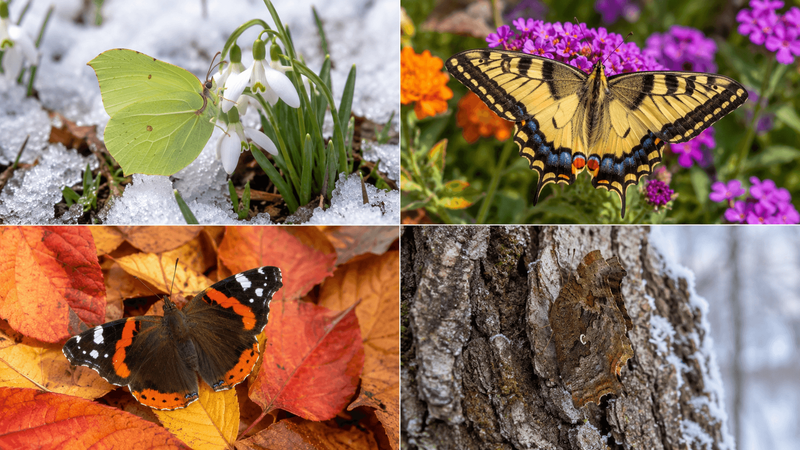
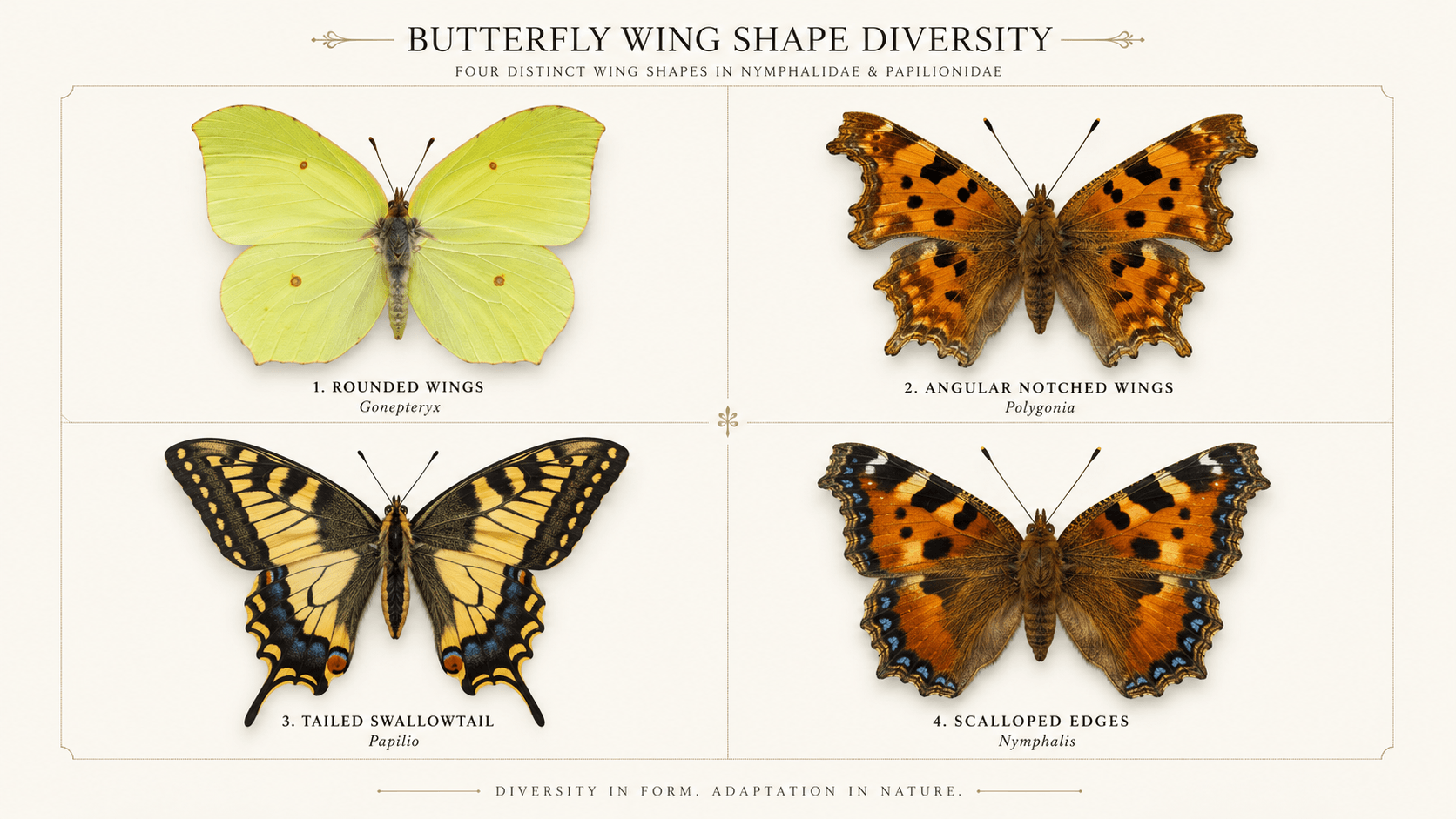
Old World swallowtail (Papilio machaon) — yellow with a black pattern. Tails 1–1.5 cm long, moderately broad. Russia’s best-known “tailed” species. Swallowtail family.
Scarce swallowtail (Iphiclides podalirius) — pale yellow with dark stripes. Tails very long and narrow — the longest among Russian swallowtails, almost thread-like.
Maack’s swallowtail (Papilio maackii) — black with a blue sheen, large. Russian Far East.
Hairstreaks (Callophrys, Favonius) — small, with thin thread-like tails. Blues family. Tails are short but clearly visible.
Small blues (Cupido, Everes) — very small; tails are thread-like and barely visible without a hand lens.
Swallowtails vs. blues by tails: swallowtails have broad or medium tails on a large butterfly’s broad wing. Blues have fine threads on a tiny wing.
With angular, “ragged” wing edges
Scalloped or angular uneven edges are camouflage: such wings resemble a chewed or dry leaf.
Brimstone (Gonepteryx rhamni) — wings with characteristic angular “teeth” along the margin, mimicking a leaf. Yellow male and greenish female.
Comma (Polygonia c-album) — ochre-brown with dark spots. Wing margins deeply cut; silhouette angular. The underside resembles bark with a white “C” mark on the hindwings. Nymphalid family.
Small tortoiseshell (Aglais urticae) — orange with black spots. The forewing apex is blunt and slightly uneven; hindwing margin moderately scalloped.
With rounded wings, without projections
Most “ordinary” butterflies have more or less smooth margins.
Nymphalids in general: small tortoiseshell, European peacock, red admiral, fritillaries, checkerspots — in most, forewings are triangular with a straight or slightly concave leading edge; hindwings more rounded.
Whites (large white, small white, black-veined white) — broad wings; forewing apex rounded-angular; hindwings softly rounded.
Satyrines — hindwings often with a wavy margin and small teeth, but without pronounced tails.
With elongated, “arrow-shaped” wings
Narrow forewings and swept-back hindwings — a sign of fast, manoeuvrable species.
Hawk moths (Sphingidae, nocturnal) — wings very narrow and long; hindwings small. In flight they resemble small hummingbirds or jets. Active at dusk.
Skippers (Hesperiidae) — small; forewings triangular and rather narrow; hindwings relatively small. Flight fast and “skipping”.
With very broad, sail-like wings
Apollo (Parnassius apollo) — forewings broad and slightly elongated; hindwings rounded; together a large “sail”. Slow gliding flight.
Birdwings (tropical) — giant wings with an elongated forewing and narrow hindwing. Not found in Russia.
Asymmetry between fore- and hindwings
In most butterflies the forewings are larger than the hindwings. But the ratio differs:
- In whites and nymphalids — fore- and hindwings are roughly the same height; the butterfly looks “square”.
- In swallowtails — hindwings are noticeably wider and extend backward.
- In hawk moths — forewings are 2–3 times longer than hindwings.
- In blues — fore- and hindwings are almost the same size; at rest the butterfly folds them neatly upright.
Practical algorithm for identification by shape
- Are there tails? → Swallowtail or blue (by size).
- Are the edges angular or “ragged”? → Brimstone or comma.
- Are the wings very narrow and elongated? → Hawk moth (dusk) or skipper.
- Everything else → see colour and size.
For difficult cases — common identification mistakes.
See also