Whites and sulphurs
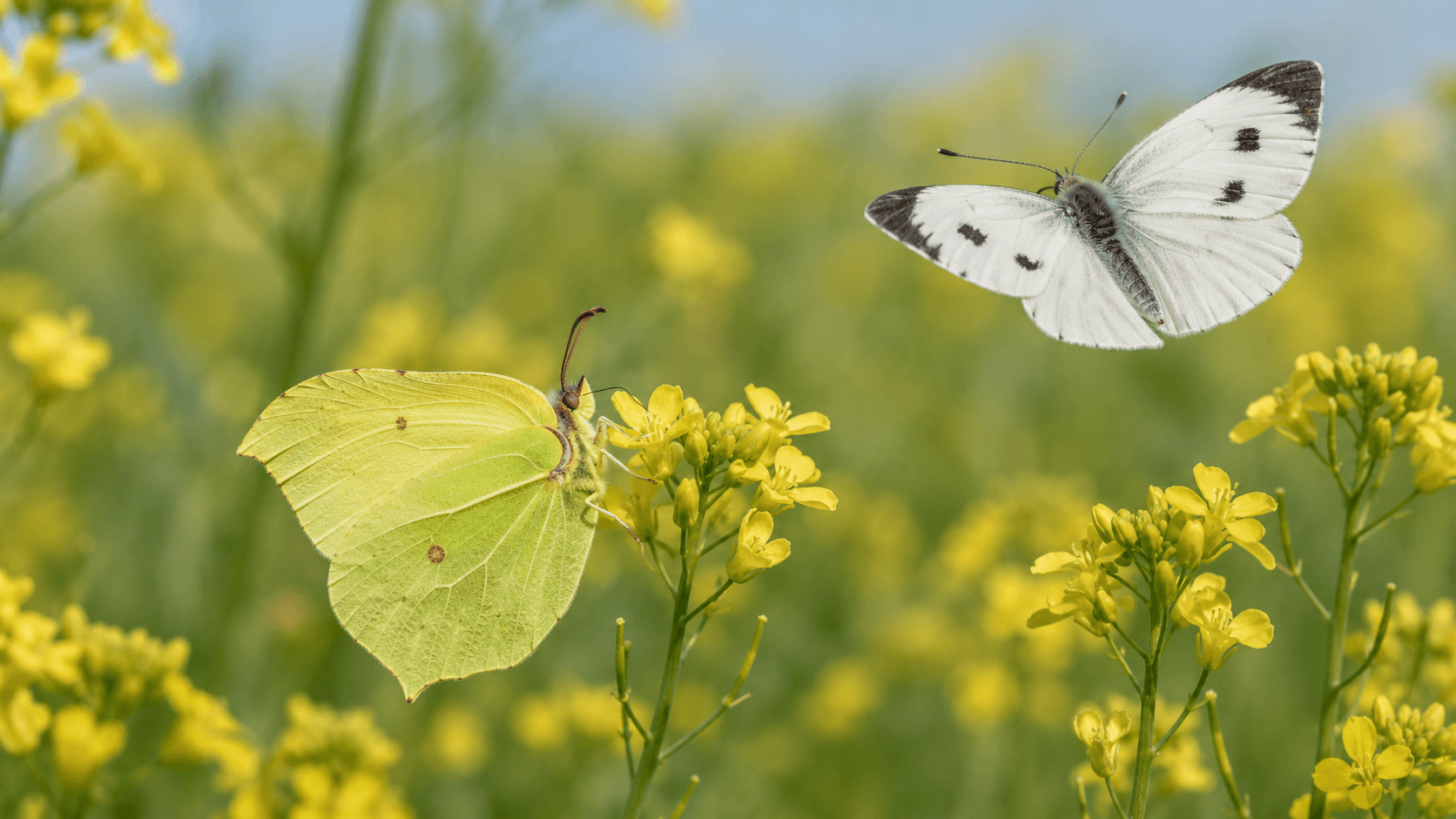
Whites (Pieridae) — butterflies with white and yellow wings: large white, small white, brimstone, and black-veined white.
What are whites
Whites (Pieridae) are a family of about 1,100 day-flying butterfly species worldwide. About 60 species occur in Russia. The family name reflects the characteristic white or yellow coloration of most species.
Whites are among the most familiar and conspicuous butterflies: the large white visits every vegetable garden, the brimstone is the first bright sign of spring, and the black-veined white sometimes flies in dense swarms.
Characteristic features
Unlike nymphalids, whites have all three pairs of legs normally developed — they walk on six. Wings are broad and rounded. Coloration is mainly white, yellow, or orange, with dark (black or gray) spots and borders. Females of many species are more spotted or darker than males.
Whites usually fly fast and straight — unlike the slow-gliding swallowtails or fluttering nymphalids.
White species in Russia
Large white (Pieris brassicae)
The largest and most common white in Russia — wingspan 5–6 cm. White, with dark angular spots on the forewings. The female has two additional black spots in the middle. The underside of the hindwings is yellowish.
The caterpillar is blue-green with yellow stripes and black dots; it feeds on cabbage, turnip, mustard, and other brassicas. Can cause significant damage in gardens.
Two to three generations per year. The first generation emerges April–May from pupae that overwintered on buildings and trees.
Small white (Pieris rapae)
Very similar to the large white but noticeably smaller — wingspan 3.5–5 cm. The angular spot on the forewing is paler; the female’s spots are smaller. The underside of the hindwings is cream-yellow.
Prefers the same host plants as the large white but is less troublesome for gardeners — populations have declined in Europe in recent decades.
Green-veined white (Pieris napi)
Similar to the small white, but the underside of the hindwings has greenish veins. Females are darker above, with a pronounced vein pattern. Lives in forested regions; the caterpillar feeds on wild brassicas — garlic mustard, bittercress.
Black-veined white (Aporia crataegi)
White with conspicuous dark (in fresh individuals gray-brown) wing veins. Large — wingspan 5–7 cm. One generation per year.
Caterpillars overwinter in colonies in silk nests on hawthorn, apple, and bird cherry. In years of population outbreaks, swarms of black-veined whites migrate, covering roads and fields. Such “invasions” were often noted as early as the 19th century.
Brimstone (Gonepteryx rhamni)
One of Russia’s best-known species. The male is rich lemon-yellow; the female is pale greenish, leaf-like. Wings have a characteristic angular outline and a small orange spot in the middle of each wing.
Record holder for longevity among European butterflies: up to 12 months. Overwinters as an adult in green foliage (ivy, mistletoe), emerging in March — one of the first spring butterflies.
The caterpillar is green and feeds on buckthorn leaves — the only host plant.
Orange-tip (Anthocharis cardamines)
A small, delicate spring white. The male is white with a bright orange tip on the forewing — unlike other whites. The female lacks orange; the underside has a green mosaic pattern.
Flies in April and May, one generation. The caterpillar feeds on toothwort, bittercress, and other woodland brassicas.
Sulphurs (Colias)
A group of species with yellow or orange-yellow ground color and a dark border along the wing margins. About 15 sulphur species occur in Russia — from steppe to mountain and arctic forms. Females are often white or cream. Species are hard to tell apart — identify by border width and underside pattern.
Ecology and host plants
Most whites are tied to brassicas (Brassicaceae) — cabbage, mustard, charlock, rape. Exceptions: brimstone (buckthorn), sulphurs (legumes — clover, sainfoin, vetch).
Whites are active in sunny weather; on cloudy days they hide in grass. They readily visit clover, mustard, and thistle flowers.
How to tell them from other families
- From swallowtails — whites are much smaller, without “tails,” with uniformly white or yellow coloration.
- From nymphalids — whites are not orange or boldly patterned (except some sulphurs), and walk on six legs.
- If a butterfly is white or yellow — it is almost certainly a white. Use the wing color identifier to refine the species.
See also