Nocturnal butterflies and moths
Nocturnal butterflies and moths are a diverse group of Lepidoptera active at dusk and night. There are far more species than among day-flying butterflies.
Who are nocturnal butterflies?
“Nocturnal butterflies” and “moths” are everyday names for most Lepidoptera with crepuscular or nocturnal habits. In scientific classification they do not form one group: they comprise dozens of families with different evolutionary histories, linked mainly by night activity.
By species count, nocturnal Lepidoptera far exceed day-fliers: of roughly 157,000 Lepidoptera species worldwide, about 140,000 are nocturnal. In Russia, nocturnal species make up 85–90% of Lepidoptera diversity.
How nocturnal species differ from day-flying butterflies
The line between “day” and “night” is blurred — some species are active at dusk or on overcast days. Still, reliable signs exist:
| Feature | Day-flying butterflies | Nocturnal butterflies / moths |
|---|---|---|
| Antennae | Club-shaped (with thickening) | Feathery, comb-like, or thread-like |
| Resting posture | Wings folded vertically | Wings spread horizontally |
| Body | Slender, not densely hairy | Often bulky and hairy |
| Wings at rest | Raised over the body | Roof-like or flat |
| Activity | Sunny hours | Dusk and night |
| Colouration | Usually bright | Often cryptic |
The main sign is antenna shape. Club-shaped antennae (thickened at the tip) indicate day-flying butterflies. Feathery, thread-like, or comb-like antennae occur in most nocturnal species. The rule is not absolute but is correct in about 95% of cases.
Main families of nocturnal Lepidoptera in Russia
Owlet moths (Noctuidae)
The largest family by species count — about 35,000 species worldwide, more than 1,000 in Russia. Most are grey-brown with cryptic patterns: transverse bands and spots mimicking bark or soil.
Underwing moths (Catocala) are characteristic — grey forewings and bright red, yellow, or orange hindwings hidden at rest. When alarmed they expose the hindwings, startling predators with sudden colour.
Cutworms — caterpillars live in soil and gnaw stems at the base: garden pests.
Geometer moths (Geometridae)
About 23,000 species worldwide, several hundred in Russia. Slender body, broad wings. They rest with wings spread, blending with bark or leaves. Inchworm caterpillars move in a looping “measuring” gait.
Some species are active in early spring at near-freezing temperatures; females of some species are wingless.
Hawkmoths (Sphingidae)
Large or very large moths with narrow powerful wings and a long body — among the fastest Lepidoptera, reaching speeds up to 50 km/h. Many hover in front of flowers like hummingbirds while feeding on nectar.
Among Russian species, the best known is the death’s-head hawkmoth (Acherontia atropos) — large, with a skull-like pattern on the thorax, able to squeak. It arrives from the south and does not overwinter in Russia. The bedstraw hawkmoth (Hyles gallii) is common in the middle latitudes.
Tiger moths (Arctiinae)
Brightly coloured nocturnal species — unusual for night-flying Lepidoptera. Brightness is aposematic: caterpillars feed on toxic plants and become unpalatable. Typical examples: garden tiger (Arctia caja) — forewings brown with white spots, hindwings orange-red with dark spots.
Giant silkmoths (Saturniidae)
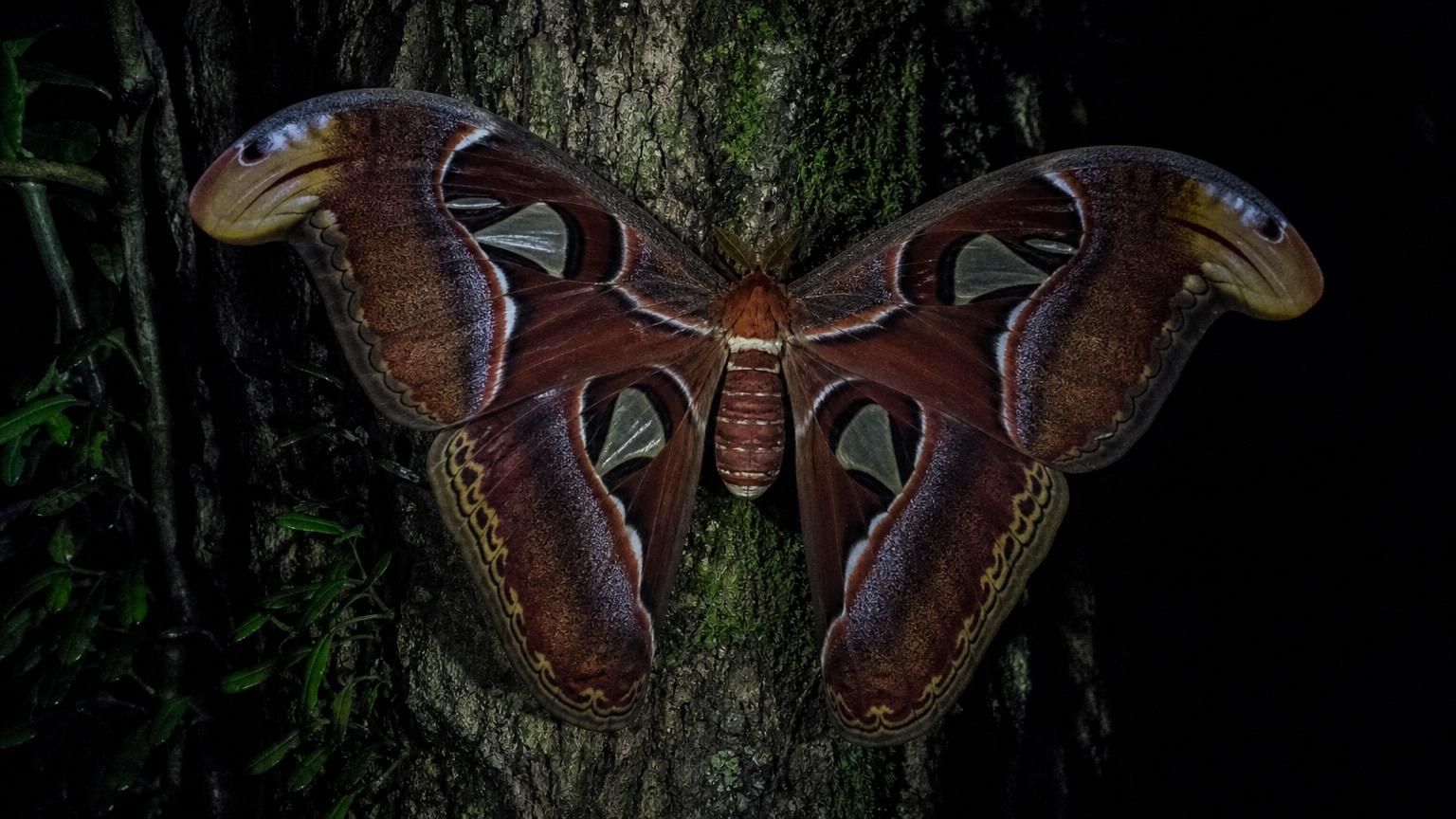
Among the largest Lepidoptera of temperate climates. Beautiful eyespot patterns on the wings. Adults lack mouthparts — they do not feed and live only a few days on fat reserves built up as caterpillars.
The great peacock moth (Saturnia pyri) — wingspan up to 15 cm, the largest nocturnal moth in Europe (not a day-flyer). Males use feathery antennae to detect females from several kilometres away.
Ermine moths, clothes moths, and other small families
Most nocturnal species are small moths from dozens of families. Many are synanthropic (live near humans): the clothes moth (Tineola bisselliella) — caterpillars damage woollen goods; grain moths — stored cereals.
Behaviour at light sources
Many nocturnal species fly toward light — a well-known phenomenon. One explanation: insects historically navigated by the moon, keeping it at a constant angle. Artificial light disrupts this — the insect spirals around the bulb trying to hold the source at the “correct” angle.
LED lamps attract fewer insects than mercury and sodium lamps — less ultraviolet.
Where and how to watch nocturnal species
The simplest method is a light trap: a white sheet lit by an ultraviolet lamp in a dark place. Dozens of species may land on it overnight.
Large hawkmoths and tiger moths can be found at flowering plants at dusk — they feed on nectar. Winter geometrids and early-spring species are searched on tree trunks in March–April.
More on differences between day-flying butterflies and moths — in butterflies vs moths.