Rare butterflies
Rare butterflies — threatened species: Apollo, clouded Apollo, large blue, and other declining Lepidoptera.
What does “rare species” mean?
Rare species are those with low or declining population numbers. At the global level the main reference is the IUCN Red List: species are assessed against shared quantitative extinction-risk criteria — from Least Concern (LC) to Extinct (EX). National and regional Red Data Books complement that picture: a species may be common worldwide yet rare and protected in a single country. In Russia the official instrument is the Red Data Book of the Russian Federation (latest edition — 2021). More detail is in the overviews of the IUCN Red List for butterflies and the Red Data Book of butterflies of Russia.
In Russia’s Red Data Book, species are assigned categories:
- 0 — probably extinct
- 1 — endangered
- 2 — declining in numbers
- 3 — rare
- 4 — status uncertain
Collection, keeping, sale, and export of species listed in Russia’s Red Data Book are prohibited by law regardless of category.
Examples of rare species
Below are protected species well known in temperate Eurasia (including Russia).
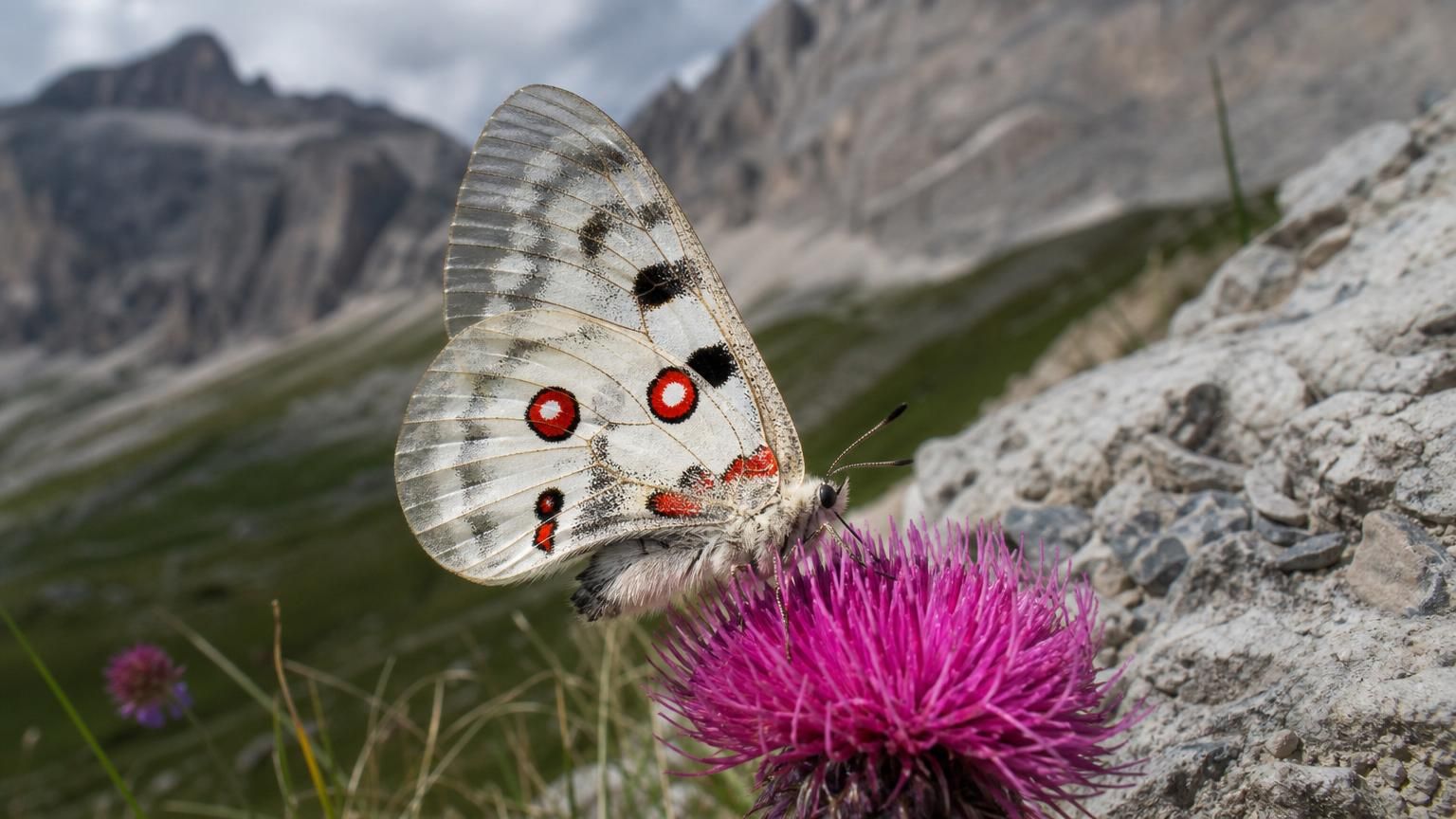
Apollo “Parnassius apollo”
Species declining in numbers.
A large white butterfly with red spots in black rings on the hindwings and black spots on the forewings. Wingspan 6–9 cm. Wings slightly translucent.
Lives on open rocky slopes with stonecrop (Sedum) — the caterpillar's host plant. In Russia found in the mountains of the Urals, Altai, Sayan, and Caucasus, and locally in some lowland areas.
Reasons for decline: habitat degradation, grazing, recreation pressure, past collecting. Now legally protected; numbers have stabilised in some areas.
Clouded Apollo “Parnassius mnemosyne”
Species declining in numbers.
White, without red spots, with black spots and slightly translucent wings. Smaller than Apollo — wingspan 4.5–6 cm.
A woodland species linked to moist broadleaf forests where corydalis (Corydalis) grows. Caterpillars feed exclusively on it. When corydalis finishes flowering by June, caterpillars go into the soil.
Numbers fall with loss of suitable forest. Clear-cutting of broadleaf stands and replacement with conifer monocultures is the main threat.
Large blue “Phengaris arion”
Species under threat of extinction.
Blue butterfly with black spots; underside grey-white with dark spots. Small — wingspan 3–4 cm.
One of the most specialised species in Russia. Caterpillars feed on thyme (Thymus) for the first weeks, then move into nests of red wood ants (Myrmica sabuleti), where they overwinter and complete development feeding on ant larvae. The species strictly requires both thyme and a specific ant species.
Found locally on limestone and steppe slopes in European Russia. Numbers are very low.
Alcon blue “Phengaris alcon”
Species declining in numbers.
Similar to the large blue but linked to wetland habitats. Caterpillars feed on gentian (Gentiana), then also move into ant nests. Bog degradation and peat drainage are the main threats.
Daphne fritillary “Brenthis daphne”
Rare species.
Orange with black dot pattern; underside of hindwings with a lilac tinge and dark pattern. A rare southern species on forest edges of the Caucasus and south of European Russia. Caterpillar feeds on bramble and raspberry.
False Apollo “Archon apollinus”
Species under threat of extinction.
Found in Russia only near Novorossiysk — the northernmost point of the species' range. White with red spots and dark pattern, but more complex than Apollo. Extremely rare.
Causes of population decline
Habitat destruction is the main cause of loss for rare butterflies. Meadows revert to scrub when mowing stops; steppes are ploughed; forests are cut. Highly specialised species tied to specific plants and conditions cannot adapt.
Pesticides. Insecticides, nematicides, and herbicides kill butterflies and caterpillars as well as host plants.
Climate change. Shifts in flowering time no longer match caterpillar emergence. Mountain species must move higher, but alpine meadows are finite.
Tourism pressure. Trampling of habitats; damage to slopes with thyme and stonecrop.
What to do if you see a rare butterfly
- Do not catch it. Collecting protected species is illegal and harms small populations.
- Photograph it. A good photo is worth more than a specimen. Record place and date.
- Report the observation on a biodiversity platform (iNaturalist, regional citizen-science projects, and similar) — your record reaches scientists.
- Notify the regional nature protection authority if you find a new locality for a rare species.
How to help butterflies
- Do not mow all meadows around you — leave patches of varied grassland.
- Keep nettle patches — a host plant for many species.
- Avoid insecticides on at least part of your land.
- Support protected natural areas.
More on finding a specific species — in the butterfly identification guide. Families of rare swallowtails — in swallowtails.
See also