By caterpillar
Caterpillar identification guide: green, hairy, with a horn, with eyespots, with spines. How to tell which butterfly will emerge from a caterpillar you found.
Why identify the caterpillar
You find caterpillars more often than adult butterflies: they are slow, live on a plant for weeks, and are easy to see. If you want to know which butterfly will emerge, or simply who is “eating” your allotment or garden — this guide is for you.
Key caterpillar traits for identification: colour and pattern, presence of hairs, horns and projections, host plant, size.
Green caterpillars
Green is the most common colour: camouflage among foliage.
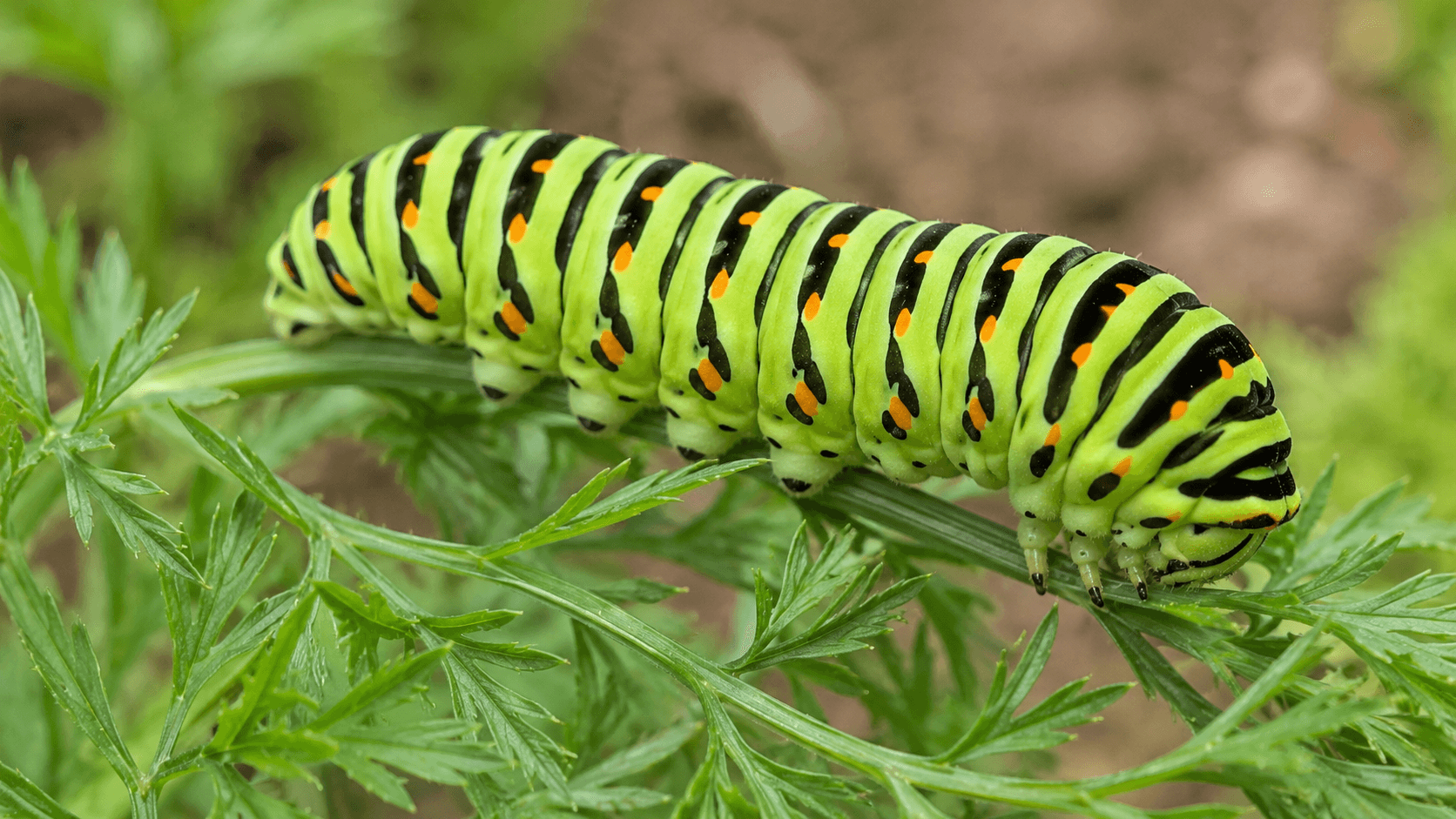
Swallowtail caterpillar (Papilio machaon) — green with black transverse bands and orange-red spots on each segment. Up to 45 mm long. Feeds on umbellifers (carrot, dill, hogweed). When touched it extends a soft orange forked osmeterium with a sharp smell.
Scarce swallowtail caterpillar (Iphiclides podalirius) — green with a yellow lateral band and oblique yellow stripes. Feeds on rosaceous plants: blackthorn, plum, cherry, hawthorn.
White caterpillars (large white, small white, black-veined white) — greenish or grey-green with longitudinal yellow stripes and black dots. Feed on crucifers (large and small white) or rosaceous plants (black-veined white).
Brimstone caterpillar (Gonepteryx rhamni) — uniformly green, very leaf-like. Feeds on buckthorn.
Bedstraw hawk-moth caterpillar (Hyles gallii) — green or dark brown with a row of yellowish spots along the sides and a red “horn” at the rear. Feeds on bedstraw and fireweed.
Hairy and woolly caterpillars
Hairs protect mechanically from predators and parasitoids; in some species they are chemical (hairs contain irritants).
Garden tiger (Arctia caja) — densely covered with russet and black hairs; from a distance like a small fur ball. Do not handle: hairs irritate the skin. Feeds on mixed herbs — nettle, sorrel, plantain.
“Woolly bear” (Arctia caterpillars) — often on paths and roads in late summer. Caterpillars of various tiger moths seeking a pupation site.
Brown-tail moth (Malacosoma neustria) — bluish caterpillar with a brown dorsal stripe and long white lateral hairs. Lives in colonies in silk “tents” on fruit trees; can defoliate branches. A garden pest.
Black arches (Lymantria monacha) and gypsy moth (Lymantria dispar) — caterpillars with long tufts of hair, grey with red and blue tubercles. In outbreaks they defoliate large forest areas.
Caterpillars with a rear horn (hawk moths)
A hallmark of hawk moths (Sphingidae) is a fleshy “horn” or bump on the last abdominal segment. Horn colour often contrasts with the body.
Death’s-head hawk moth (Acherontia atropos) — large caterpillar (up to 12 cm), yellow-green or brown with oblique violet stripes; horn dark, hooked. Feeds on potato, nightshade, ash.
Oleander hawk moth (Daphnis nerii) — bright green with a blue “eye” in a white ring near the head. Feeds on oleander and periwinkle; in Russia a rare vagrant.
Elephant hawk moth (Deilephila elpenor) — brown or green caterpillar with large “eyes” near the front (mimics a snake’s head when threatened). Feeds on rosebay willowherb, fireweed, bedstraw.
Privet hawk moth (Sphinx ligustri) — green with oblique white stripes and a violet horn. Feeds on lilac, privet, ash.
Caterpillars with “eyes” (false eyes)
Several species have large false “eyes” on the front of the body — to scare birds, mimicking a snake or owl head.
Hawk moths — as above; the elephant hawk moth is especially striking.
Poplar clearwing and some others — small caterpillars with spots mimicking eyes on the enlarged prothorax.
Caterpillars with spines (nymphalids)
Many nymphalids have branched or simple spines — they complicate body shape and hinder swallowing.
Small tortoiseshell (Aglais urticae) — black with yellow-white dots and a row of short branched spines over the body. Lives in groups on nettle in a “nest” of woven leaves.
European peacock (Aglais io) — similar to tortoiseshell but spines longer. Also on nettle, in large groups.
Painted lady (Vanessa cardui) — grey-greenish with yellow lateral spots and spines. Solitary; wraps a leaf in silk. On thistle, burdock.
Red admiral (Vanessa atalanta) — dark with yellow spots and branched spines. Solitary, in a tube of nettle leaves.
Mourning cloak (Nymphalis antiopa) — black with red spots and black spines. Lives in groups on willow, birch, poplar.
“Looper” caterpillars (geometrids)
Geometrid caterpillars are easy to recognize by locomotion: they lack some abdominal prolegs and move in a loop, pulling the rear toward the front — “inching”.
Colour is varied: green, brown, grey — usually good camouflage. At rest they often stand vertically, mimicking a twig.
Winter moth (Operophtera brumata) — green caterpillar with white longitudinal stripes. In spring defoliates oak, apple, cherry — a major orchard pest.
Host plant as a key to identification
Host plant is one of the main traits. Find the caterpillar on a specific plant and you immediately narrow candidates:
| Plant | Likely caterpillar species |
|---|---|
| Nettle | Tortoiseshell, peacock, admiral, painted lady |
| Umbellifers (carrot, dill) | Swallowtail |
| Blackthorn, plum, cherry | Scarce swallowtail, black-veined white, brown-tail moth |
| Crucifers (cabbage) | Large white, small white, cabbage moth |
| Rosebay willowherb (fireweed) | Bedstraw hawk moth, elephant hawk moth |
| Birch, willow, poplar | Mourning cloak, admirals, various noctuids |
| Buckthorn | Brimstone |
| Grasses, sedge | Satyrines (small heath, meadow brown, ringlet) |
What to do with a found caterpillar
If you want to watch metamorphosis:
- Move the caterpillar to a ventilated container with space.
- Provide fresh host-plant sprigs — change daily.
- When it stops eating and starts to “wander” it is ready to pupate. Add twigs for the pupa to attach to.
- Release the butterfly as soon as it ecloses.
More on development — in life cycle and metamorphosis.
See also