Large butterflies
Large butterflies impress with wingspan: from the familiar swallowtail to giant birdwings with wings wider than 25 centimetres.
What counts as a large butterfly?
“Large” is relative: by the standards of central Russia, a 7 cm wingspan is already big; in the tropics of Southeast Asia it is modest. For clarity we split by region: temperate-zone species first, then world record holders.
Large butterflies of the temperate zone
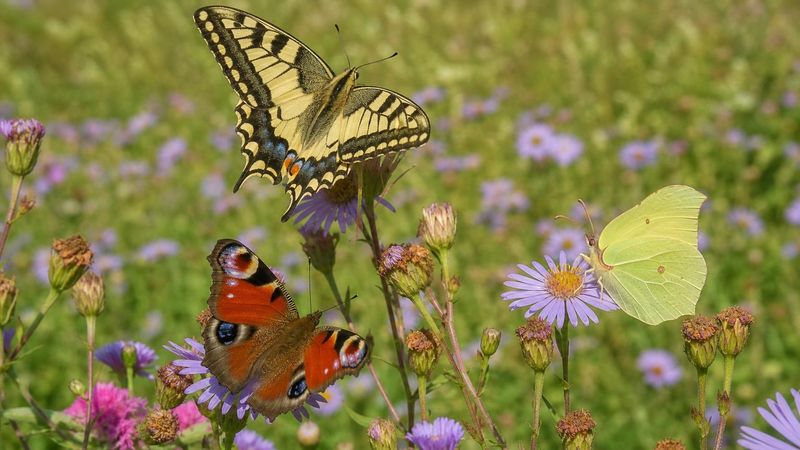
Swallowtail (Papilio machaon) — 65–80 mm
The best-known large day-flying butterfly in the temperate zone. Yellow with black patterning, characteristic “tails” on the hindwings, blue and red spots. Found across the temperate zone of Russia — meadows, clearings, gardens.
The caterpillar is green with black stripes and orange spots; it feeds on umbellifers: carrot, dill, hogweed, angelica. When threatened it extends a bright orange osmeterium with an unpleasant smell. More on the family — in swallowtails.
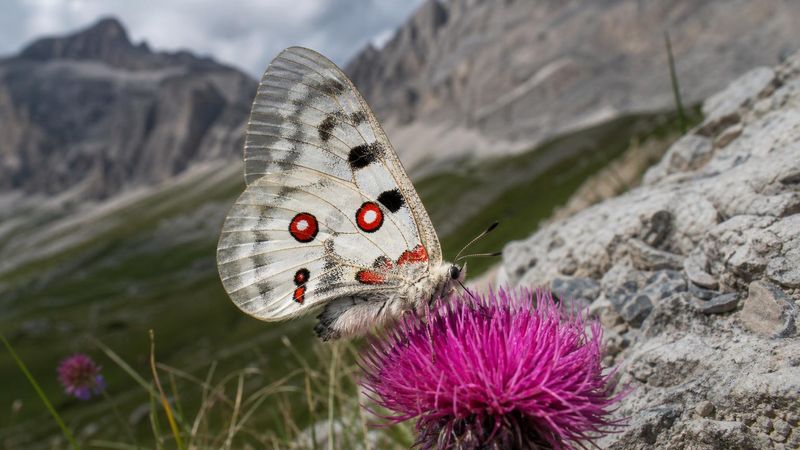
Apollo (Parnassius apollo) — 60–90 mm
White with red spots in black rings and dark spots on the forewings. Wings slightly translucent. A mountain species: lives on rocky slopes of the Urals, Altai, and Caucasus.
Listed in the Red Data Book of Russia. Flight slow and stately — it glides, barely flapping. If you see one, do not catch it.
Maack's swallowtail (Papilio maackii) — 90–120 mm
The largest swallowtail in Russia. Found only in Primorsky Krai and Amur Oblast — in mixed broadleaf forests of the Russian Far East.
Upper side black with green-blue metallic sheen; underside with red and blue spots. Flight fast and powerful. Listed in the Red Data Book of Russia. Caterpillar feeds on Amur cork tree (Phellodendron amurense).
Mourning cloak (Nymphalis antiopa) — 65–80 mm
One of the largest brush-footed butterflies in the temperate zone. Dark maroon with a cream-yellow border and blue spots. Overwinters as an adult; lives up to 10–11 months. Found across the temperate zone in woods and parks.
Scarce swallowtail (Iphiclides podalirius) — 55–75 mm
Pale yellow with several dark transverse bands and very long “tails”. Flight smooth. Lives in European Russia and the Caucasus; prefers warm edges with hawthorn and plum.
High brown fritillary (Argynnis paphia) — 55–70 mm
The largest of the fritillaries. Orange with black dot pattern; underside of hindwings with silvery pearly pattern. Flies in July–August on forest clearings and edges.
Poplar admiral (Limenitis populi) — 70–80 mm
One of the largest nymphalids in European Russia. Dark brown with a white band on the wings and a row of rusty spots along the hindwing margin. Lives in deciduous forests with poplars and aspens. Males often drink from puddles and on roads.
Largest butterflies in the world
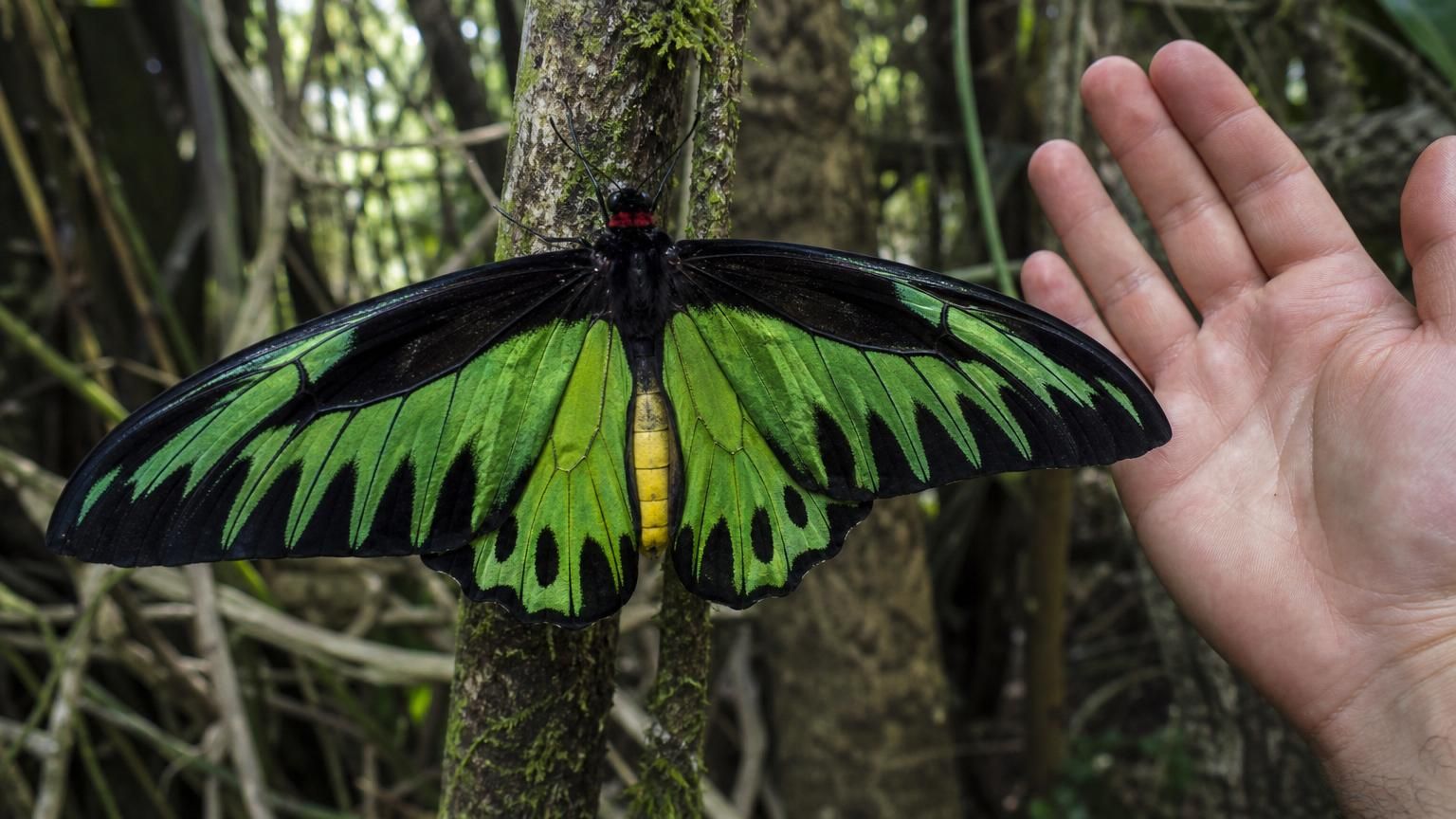
Queen Alexandra's birdwing (Ornithoptera alexandrae) — up to 280 mm
The absolute record holder among day-flying butterflies. Females are much larger than males: wingspan up to 28 cm. Lives in lowland forests of Oro Province, Papua New Guinea. The species is threatened; hunting is prohibited. The caterpillar feeds on the toxic vine Aristolochia schlechteri and accumulates toxins that make the butterfly unpalatable to predators.
Priam's birdwing (Ornithoptera priamus) — up to 200 mm
Males bright green with black; females brown-white. Found in Australia, Melanesia, and the Moluccas. Protected under international conventions.
Paris peacock (Papilio paris) — up to 130 mm
A large Asian swallowtail with an iridescent blue patch on the hindwings. Found in South and Southeast Asia.
Menelaus blue morpho (Morpho menelaus) — 100–200 mm
Famous tropical butterflies of South America with bright blue iridescent wings. The blue comes not from pigment but from nanostructure of scales scattering light. Males fly above the forest canopy, flashing in the sun.
Why large butterflies are usually tropical
Insect size is limited by heat and food availability. In the tropics it is warm year-round with evergreen vegetation — no rush as in temperate climates. Caterpillars can grow more slowly and gain more mass. Hence the largest species always come from the tropics.
In the temperate climate the short season forces fast development — so even “large” local species are modest by global standards.
To identify a large butterfly you have seen — identification by size and by wing colour.
See also