Day-flying butterflies
Day-flying butterflies are the most conspicuous Lepidoptera: they fly in sunlight, have club-shaped antennae, and often bright colouration.
What are day-flying butterflies?
Day-flying butterflies are an informal but widely used group of Lepidoptera with a diurnal lifestyle. In scientific classification they do not form a single taxon, yet they share several traits that set them apart from nocturnal species.
Russia has about 300 species of day-flying butterflies — roughly 15% of all Lepidoptera in the country. Despite fewer species, day-fliers are the most noticeable: they fly in fair weather, often land on flowers, and are easy to watch.
How to tell a day-flying butterfly from a nocturnal one
There are no strict rules (some “nocturnal” species also fly by day), but reliable signs exist:
| Feature | Day-flying butterflies | Nocturnal butterflies and moths |
|---|---|---|
| Antennae | Club-shaped — thickened at the tip | Feathery or thread-like, without a club |
| Resting posture | Wings folded vertically over the body | Wings spread horizontally |
| Body | Slender, without dense hair covering | Often bulky and hairy |
| Activity | Mainly by day, in sunny weather | Dusk and night (most species) |
| Colouration | Usually bright and conspicuous | Often cryptic and subdued |
The most reliable sign is antenna shape. If the antenna ends in a club, you are looking at a day-flying butterfly.
Main families
Day-flying butterflies of the temperate zone belong to six main groups:
Brush-footed butterflies (Nymphalidae)
The largest and most diverse family. It includes the small tortoiseshell, red admiral, peacock, mourning cloak, fritillaries, checkerspots, and satyrs. A characteristic trait is the reduced first pair of legs: nymphalids walk on four legs. More in the brush-footed butterflies section.
Satyrs (Satyrinae)
On this site satyrs are shown as a separate group: heaths, graylings, ringlets. Taxonomically they are a subfamily of Nymphalidae. More in the satyrs section.
Swallowtails (Papilionidae)
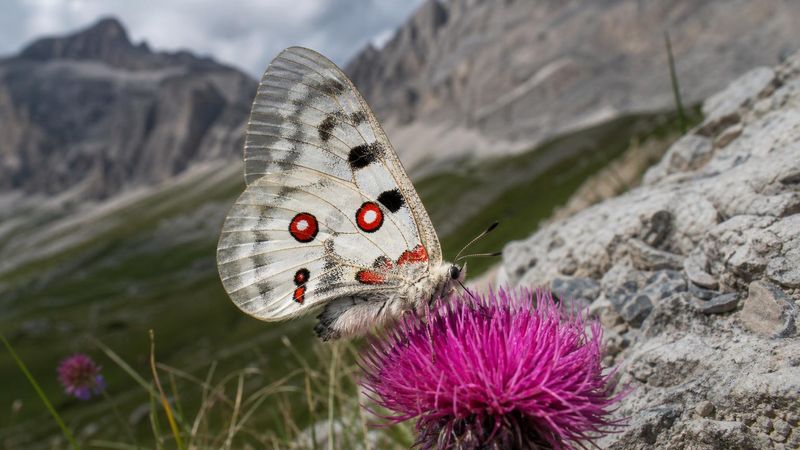
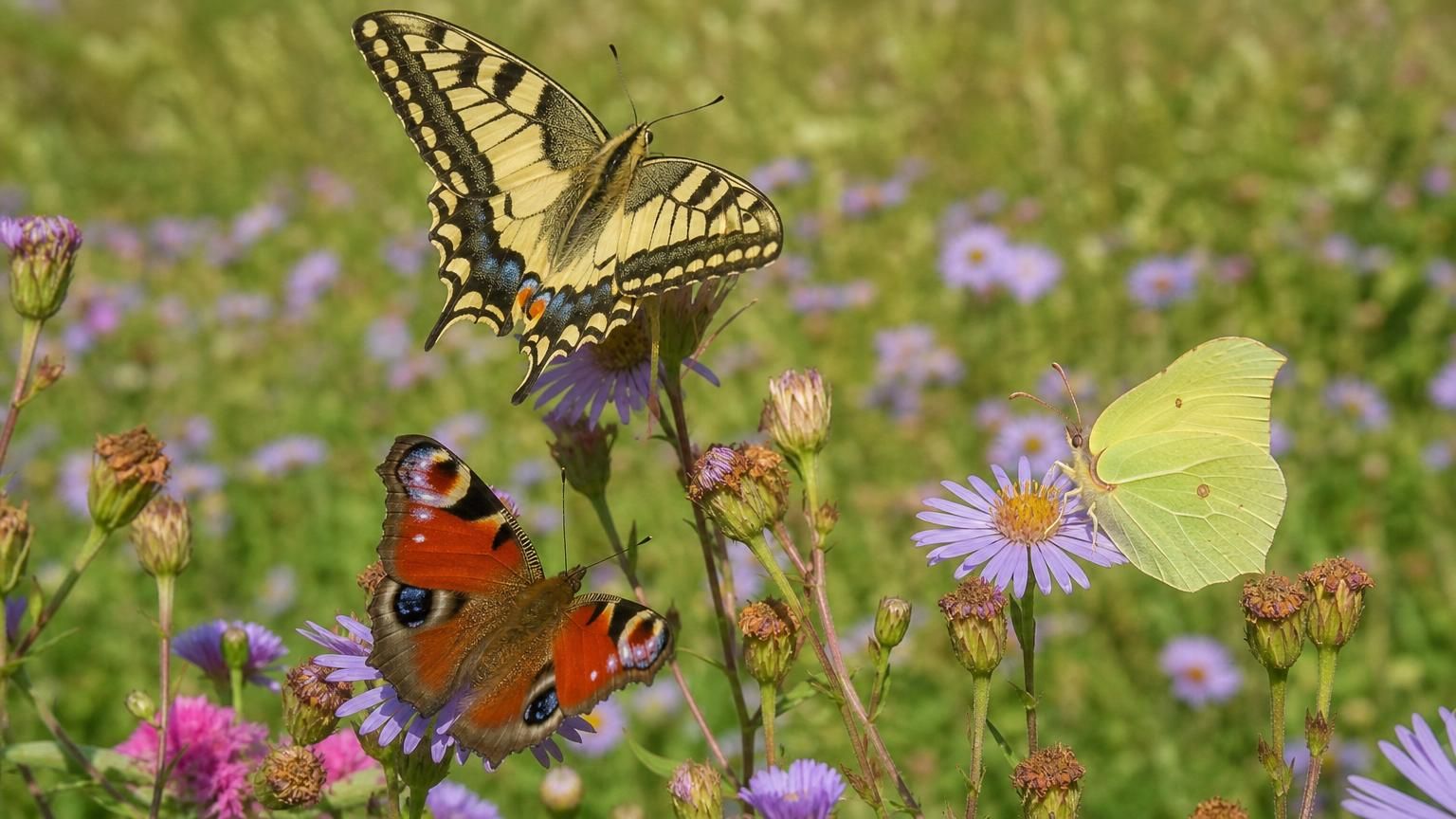
Large and often striking butterflies. Russian species include swallowtail, scarce swallowtail, Apollo, and clouded Apollo. Many swallowtails have “tails” on the hindwings. More in the swallowtails section.
Whites and yellows (Pieridae)
Butterflies mostly white, yellow, or orange. Common in Russia: large white, green-veined white, brimstone, orange tip, and southern white. More in the whites and yellows section.
Blues (Lycaenidae)
Small butterflies — males of many species are bright blue, females brownish. One of the most species-rich families by number of species. More in the blues section.
Skippers (Hesperiidae)
Small, stocky butterflies with widely spaced antennae. Often cryptic brown-orange colouration. About 40 species in Russia. More in the skippers section.
Most widespread species of the temperate zone
Small tortoiseshell (Aglais urticae) — perhaps the most familiar butterfly in the temperate zone. Orange with black spots and a blue border. Caterpillars live on nettles. Overwinters as an adult; among the first to appear in spring.
Brimstone (Gonepteryx rhamni) — males bright lemon-yellow, females whitish green. Can live up to 12 months — a record among European butterflies. Overwinters as an adult and emerges in March.
Large white (Pieris brassicae) — white with black angular spots on the forewings. Found wherever crucifers grow. Two to three generations per summer.
Peacock (Aglais io) — dark red with four large “eyes”. Deters predators by flashing the “eyes” when startled.
Red admiral (Vanessa atalanta) — dark brown with a scarlet band. Partially migratory: arrives from the south in spring; leaves or overwinters in shelter in autumn.
Painted lady (Vanessa cardui) — the only butterfly distributed on every continent except Antarctica. Orange-brown with white spots; migrates long distances each year.
When and where to see them
Most species are active from May through August. Some that overwinter as adults (small tortoiseshell, brimstone, peacock) appear as early as March–April.
Best places to watch are meadows and flowering woodland edges. Butterflies are most active in warm sunny hours: from about 10:00 to 16:00. In cloudy weather and extreme heat they hide in shade.
Use the wing colour identification guide if you want to identify an unfamiliar species by appearance.
See also