Blues
Blues (Lycaenidae) — small butterflies with blue, copper, or brown wings: one of the most species-rich families of day-flying butterflies.
What are blues
Blues (Lycaenidae) are one of the largest families of day-flying butterflies: about 6,000 species worldwide, of which more than 150 occur in Russia. By species count they rank second only to nymphalids, and in many regions they exceed even them.
Despite their modest size, blues are a remarkably diverse group. They include species with metallic blue wings, copper-red coppers, and inconspicuous dull brown “brown blues” that are hard to tell apart without a magnifying glass.
Characteristic features
Small size. Wingspan of most species is 2–4 cm. The smallest blues (small blues, Cupido) are about 1.5 cm.
Sexual dimorphism in coloration. In most species males and females are colored very differently:
- Males — intensely blue, violet-blue, or copper-red with a metallic sheen.
- Females — brown or dull brown, often with a blue wing base or orange marginal spots.
Underside of the wings. The upperside is bright; the underside is cryptic: gray or beige with a characteristic pattern of dark spots in white rings and orange spots. Most species are identified from the underside.
Fine tails. Some species (hairstreaks, green hairstreaks) have thread-like “tails” on the hindwings — often mistaken for antennae, which confuses predators.
Main groups
Typical blues (Polyommatus, Plebejus, Lysandra)
Blue males, brown females. The most characteristic and numerous group. Common in Russia:
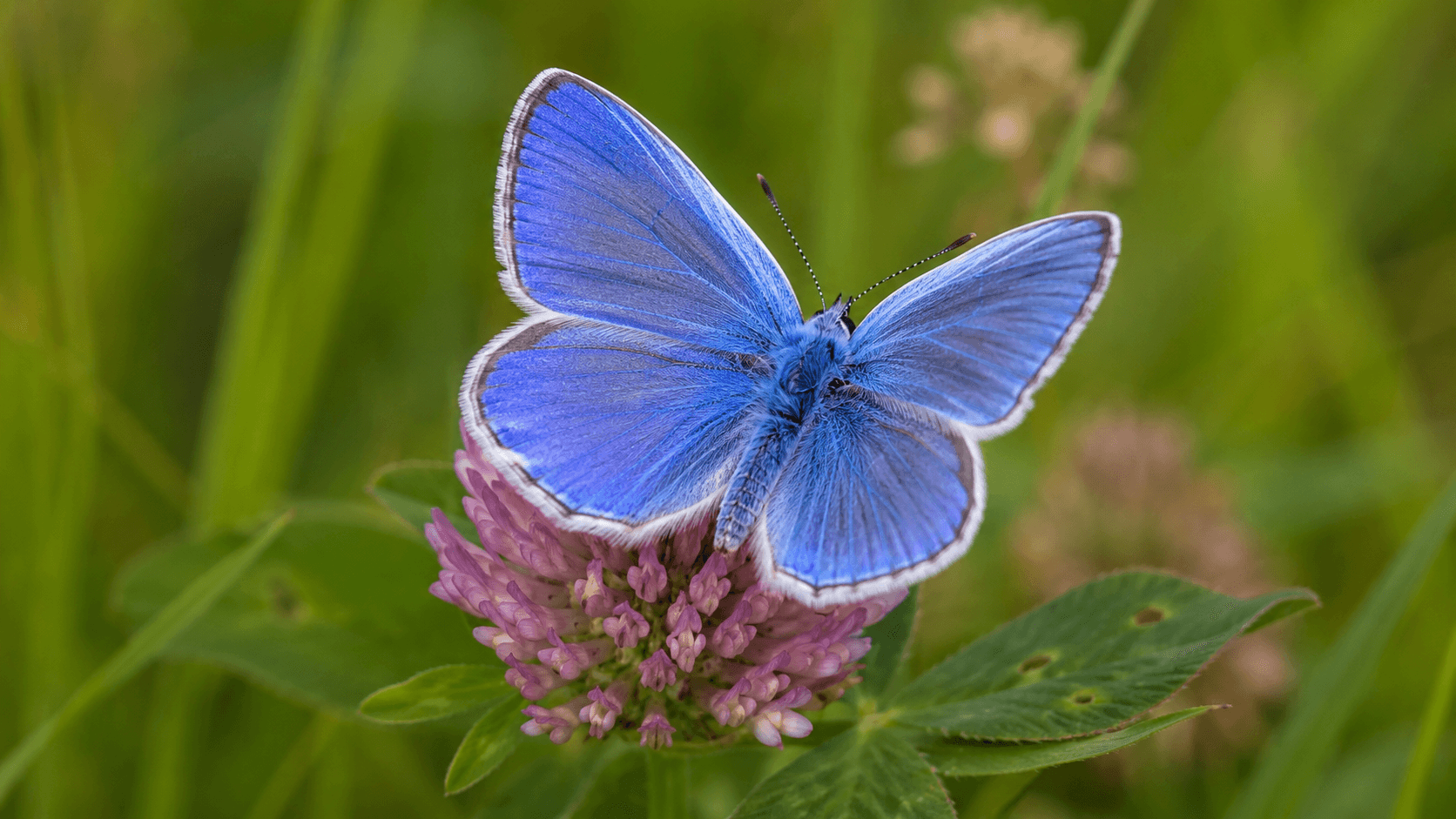
Common blue (Polyommatus icarus) — one of the most widespread species. The male is bright blue with a white fringe; the female is brown with orange marginal spots. The underside is gray with spots and an orange spot. Found everywhere in meadows, road verges, and clearings. The caterpillar feeds on clover, alfalfa, and other legumes.
Silver-studded blue (Plebejus argus) — blue with a pronounced dark border. Orange marginal spots on the hindwings in both sexes. Lives on dry meadows and heathland.
Mazarine blue (Polyommatus daphnis) — larger than typical blues, with a toothed hindwing margin. A southern species.
Coppers (Lycaena)
Copper-orange or fiery-red butterflies — sometimes called “fire butterflies,” though that confuses them with unrelated insects. Several species in Russia:
Small copper (Lycaena phlaeas) — orange-copper with dark spots and a gray underside. Widespread throughout Russia, very common. The caterpillar feeds on sorrel.
Large copper (Lycaena dispar) — larger than usual, the male bright orange without spots; protected in several European countries.
Green hairstreaks (Callophrys, Favonius, and others)
Small butterflies with a green underside — unique in the family. They fly in spring and early summer in woodland habitats. The purple hairstreak (Favonius quercus) is dark with a blue base in the male and occurs in oak woods.
Myrmecophilous blues (Phengaris, Maculinea)
The most unusual group. Caterpillars of these species move into ant nests in late instars and complete development there, feeding on ant larvae or begging food from ants. Ants accept them because caterpillars mimic the smell and sounds of ant brood.
This group includes rare species — large blue (Phengaris arion) and alcon blue (Phengaris alcon), listed in Russia’s Red Data Book.
Where and when to find blues
Blues prefer open areas with varied herbage: meadows, steppes, forest edges, hillsides, road verges. Woodland species (hairstreaks) stay near tree canopies.
Most species fly from May through August; some have two generations. They are active on warm sunny days; males are often seen lekking on hilltops or in sunflecks.
For identification, photograph both the upper and lower sides of the wings: many species are indistinguishable without the underside. Use the wing color identifier as a first step.
How not to confuse them with other families
- From satyrs: blues are much smaller and lack large eyespots.
- From checkerspots: blues are not orange-patterned; blue males have a uniform or weakly spotted upperside.
- From small whites: blues are not white or yellow.
See also