Satyrs
Satyrs (Satyrinae) — a nymphalid subfamily with characteristic eyespots. More than 2,400 species worldwide, many in temperate regions. Specialized on grasses.
What are satyrs
Satyrs are the subfamily Satyrinae within the nymphalid family (Nymphalidae). They are one of the largest groups of day-flying butterflies: about 2,400 species worldwide and about 150 species in Russia. They occur on every continent except Antarctica but are especially diverse in temperate zones and mountains.
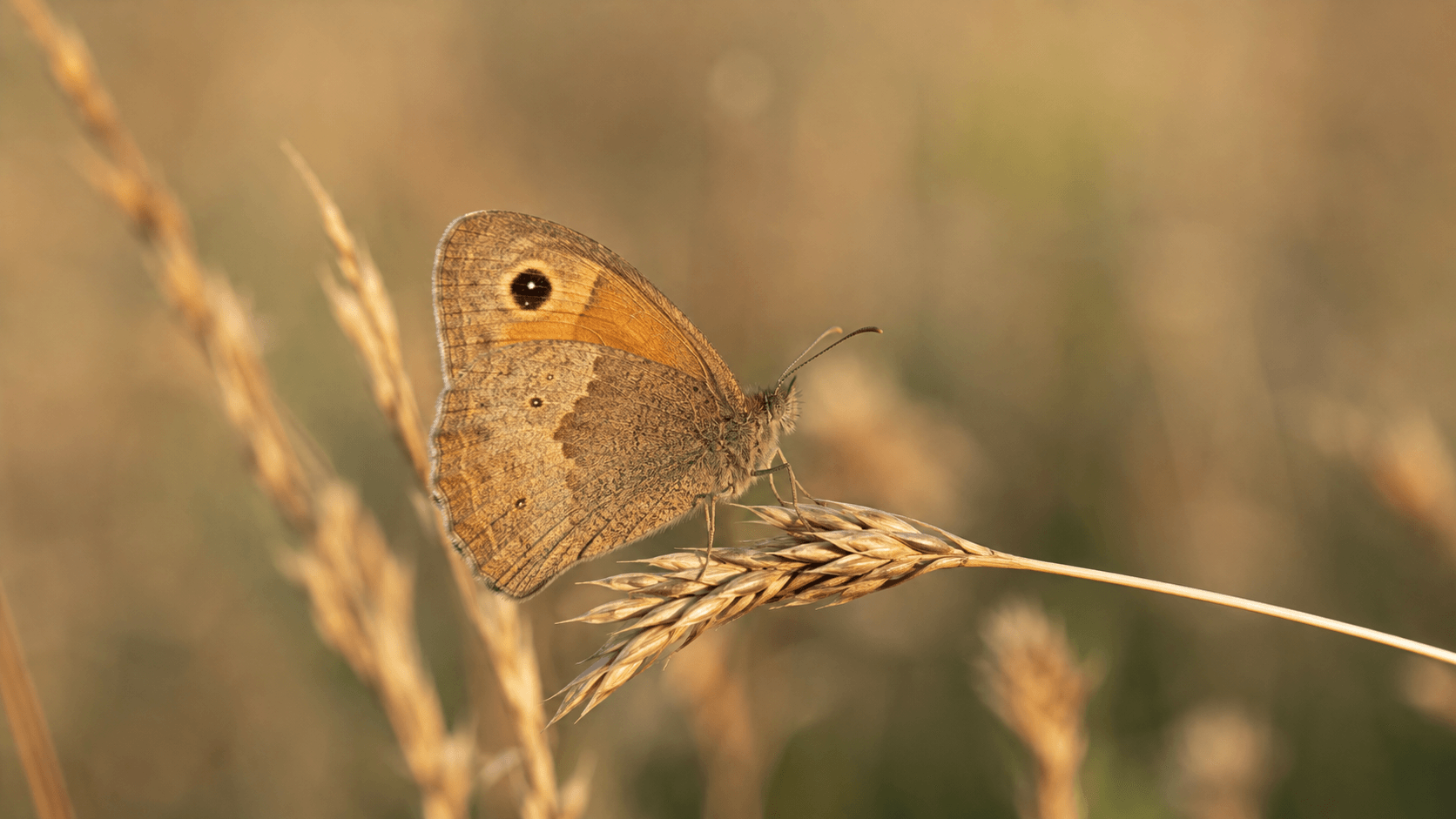
The name “satyrs” (Russian barkhatnitsy, velvet butterflies) reflects their appearance: in most species the wings are velvety brown, gray, or ochre with muted coloration. Against this background eyespots (ocelli) stand out — round patterns with a dark center and light ring, often with a white “pupil.” This is the main visual trait of the group.
Family traits
Eyespots are diagnostic for most satyrs. Spots may be on the forewings, hindwings, or both pairs. Their function is to deflect attacks: a predator (a bird) strikes at the “eye” rather than the body, giving the butterfly a chance to escape with a damaged but non-vital part of the wing.
Cryptic coloration. Most species are brown, gray, or ochre, matching soil, bark, or dry grass. The underside blends especially well with the substrate: a satyr with folded wings on a trunk or the ground is nearly invisible.
Reduced front legs — as in all nymphalids. Satyrs walk on four hind legs; the front pair is shortened and used as olfactory organs — the butterfly “tastes” a plant with them when deciding whether to lay eggs.
Flight in most species is low, “bouncing,” or gliding. They actively use thermal updrafts near heated rocks and slopes.
Caterpillars and host plants
This is a key feature distinguishing satyrs from most other nymphalids. Caterpillars of nearly all species feed on grasses and sedges (rarely other monocots): meadow grass, fescue, cock’s-foot, sedge. Hence their link to open meadow and steppe communities.
Caterpillars are slow-moving, green or green-striped, well camouflaged on grass stems. Many overwinter as caterpillars and resume feeding in early spring.
Main species in Russia
Meadow brown (Maniola jurtina)
The most common satyr in Russia’s middle latitudes. Wingspan 40–55 mm. Male: brown with one “eyespot” on the forewing. The female is noticeably paler, with an ochre field around the eyespots. Found on any meadow, forest edge, or roadside — one of the abundant summer species. Flight June through August.
Ringlet (Aphantopus hyperantus)
Dark brown, almost chocolate, with distinct yellow-bordered eyespots. Wingspan 35–45 mm. Prefers damp meadows, forest glades, and shrubs along streams. Widespread in European Russia and Siberia.
Dryad (Minois dryas)
Larger (50–60 mm), with large blue “pupils” in the eyespots. The male is dark brown; the female is paler. Lives at meadow edges and glades with tall herbage. Locally rare in places.
Small heath (Coenonympha pamphilus)
Small (25–35 mm), pale ochre or reddish, with a small eyespot on the forewing. Abundant and widespread in open habitats. Flies May through September in two generations. Perhaps the most “unnoticed” meadow butterfly — often overlooked because of its dull color.
Ringlets (Erebia)
A mountain genus with several dozen species in Russia. Dark brown or almost black, with reddish-orange bands and small eyespots. Live mainly in alpine and subalpine belts of the Urals, Caucasus, Altai, and Sayan Mountains. Some species are endemics of particular mountain ranges.
Woodland brown (Lopinga achine)
Large (50–60 mm), brown, with rows of yellow eyespots on both wing pairs. Lives in light deciduous and mixed forests with a well-developed herb layer. Listed in regional Red Data Books of several provinces.
Large wall brown (Lasiommata maera)
Brown with one or two eyespots on the forewing. Typical of stony slopes, forest edges, and clearcuts. The underside of the hindwings has a marbled pattern.
Where and when to find them
Most Russian satyrs live on open meadows and forest edges — where grasses grow for caterpillars and nectar flowers for adults. Other habitats: steppes, mountain meadows, sparse woodland, heathland.
| Species | Habitat | Flight period |
|---|---|---|
| Meadow brown | Meadows, forest edges | June–August |
| Ringlet | Damp meadows, shrubs | June–August |
| Small heath | All open meadows | May–September |
| Dryad | Meadow edges with tall herbage | July–August |
| Ringlets (Erebia) | Mountain meadows | June–August |
| Woodland brown | Light forests | June–July |
For observation, sunny, windless days from June through August are best. Satyrs actively feed on flowering grasses and umbellifers and often bask on dark stones with wings partly open.
Satyrs as indicators of meadow condition
Satyrs respond sensitively to changes in the herb layer. Overgrowth of meadows with tall herbs or shrubs destroys their food base — caterpillars need typical meadow grasses, not hogweed or raspberry. Stopping moderate grazing or mowing leads to rapid loss of several species.
High satyr diversity on a given meadow is a sign of traditional land use and good habitat condition.
Links to other families
Satyrs belong to nymphalids and share atrophied front legs with them. They are often confused with fritillaries or early-spring nymphalids — but fritillaries lack characteristic “eyespots,” and their coloration is brighter. A detailed separation guide is in the color identifier.
See also