How to identify a butterfly species
Step-by-step guide to identifying a butterfly: size, colour, wing shape, antennae, place and time of encounter. Methods without capture and using photographs.
Where to start
You can identify a butterfly to species — and in most cases you do not need to catch it, pin it, or use a microscope. A good photograph and a systematic approach are enough.
Identification means narrowing possible species step by step. Each new trait rules out some options until one or a few candidates remain to compare in detail.
Step 1: record the context
Before focusing on the butterfly, note the circumstances of the encounter — they sometimes rule out whole groups:
Where: meadow, woodland edge, forest, bog, garden, mountain slope, coast. Many species are tied to habitat. The large blue occurs only where thyme grows. Ringlets — peat bogs and wet meadows. Apollo — only high mountain meadows with stonecrop.
When: month and approximate time of day. First spring species (small tortoiseshell, brimstone, mourning cloak) appear in March–April; some geometrids fly in November. Butterflies active in sunny hours — so one seen on a cloudy day is more likely a crepuscular or nocturnal species.
Region: central Russia, Russian Far East, Caucasus, Urals — faunas differ greatly. Maack's swallowtail occurs only in Primorye; Apollo is a rarity near Moscow but common on the Urals.
Step 2: estimate size
Before details, ask mentally: how large is the butterfly?
| Wingspan | What to expect |
|---|---|
| Up to 20 mm | Micro-moth, ermine moth, small blue, copper |
| 20–40 mm | Most blues, small fritillaries, skippers |
| 40–60 mm | Whites and yellows, medium nymphalids, fritillaries |
| 60–90 mm | Small tortoiseshell, red admiral, peacock, swallowtail, Apollo |
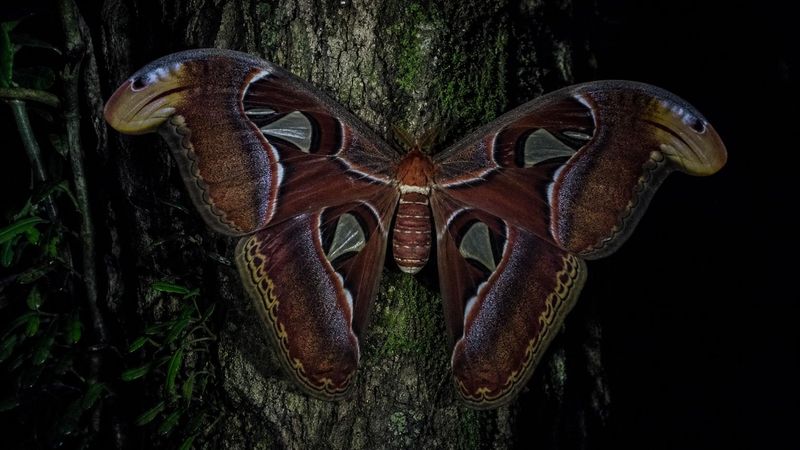
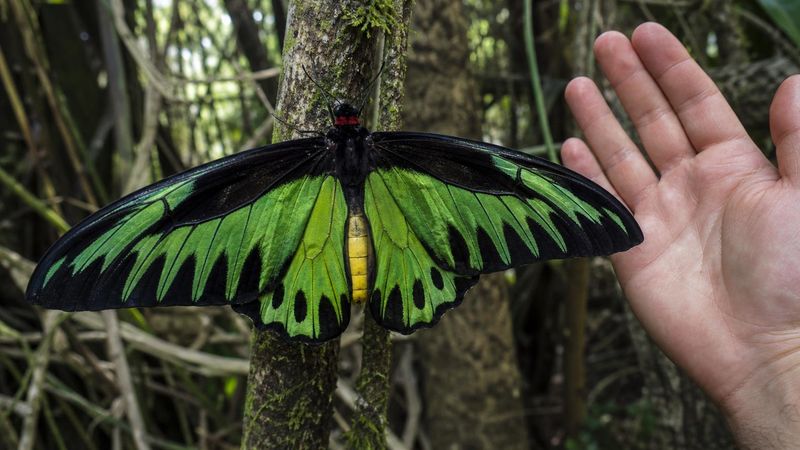
| Over 90 mm | Large nymphalids, hawkmoths, giant silkmoths |
Size immediately excludes families. If wingspan is under 25 mm, it is certainly not swallowtail or Apollo.
Step 3: determine the general colour type
Look at the upper side of the wings (if the butterfly has them open):
- White or yellowish → likely whites and yellows (large white, green-veined white, wood white) or brimstone.
- Orange with black pattern → brush-footed butterflies: small tortoiseshell, male brimstone, fritillaries, checkerspots.
- Blue → blues (males), rarely some nymphalids.
- Brown, cryptic, with eyespots → fritillaries, satyrs.
- Black with white spots → mourning cloak, Apollo, some nymphalids and whites.
- Bold mixed pattern → nymphalids, swallowtails.
Detailed sorting by shade — in the wing colour identification guide.
Step 4: look at wing shape
Silhouette is often recognised before colour — especially in flight.
- Tails on hindwings → swallowtails (large, broad tails) or blues (small, thread-like tails).
- Angular, “ragged” edges → brimstone, comma.
- Very narrow, arrow-shaped wings → hawkmoth (nocturnal) or skipper.
- Broad rounded wings → most nymphalids and whites.
- Wings with eyespot patterns → fritillaries, giant silkmoths.
More detail — in the wing shape identification guide.
Step 5: check the antennae
Antenna shape is key for separating day-fliers from nocturnal species:
- Club-shaped (thickened at the tip) → day-flying butterfly (superfamily Papilionoidea).
- Thread-like or feathery → nocturnal butterfly or moth.
- Hooked at the tip → skipper (also day-flying, but a separate group).
If antennae are club-shaped, you already know you are dealing with one of ~350 Russian day-flying species — not 1,800+ nocturnal ones.
Step 6: look at the underside
Many species look alike above but differ easily below. For this the butterfly must fold its wings — day-fliers do this automatically at rest.
- Comma: underside mimics bark with a small white “C” on the hindwings.
- Blues: underside often patterned with dots and rings — each species has its own design.
- Brimstone: underside green, leaf-like.
- Red admiral: underside of hindwings a mosaic of grey, brown, and rusty tones.
- Green hairstreaks (Callophrys rubi and others): green below — unique among small butterflies.
Step 7: rule out look-alikes
Many species have near duplicates. Common mistakes:
Large white vs. green-veined white: both white. Green-veined white has one large black spot on the forewing above (large white has two); the underside of the hindwing is uniformly yellow in green-veined white, with dark veins in large white.
Small tortoiseshell vs. large tortoiseshell (Aglais urticae vs. Nymphalis polychloros): in the large tortoiseshell the forewings have four dark spots, wings are larger, and the blue border is less prominent.
Male blues: most are blue above. They are separated by size, underside details, and nearby host plants.
Fritillaries: several similar species. Identification relies on the pattern of the underside of the hindwing — the silvery “pearly” spots are unique to each species.
How to take a good identification photo
If you want to identify later from a photograph:
- Upper side with wings open — for the general pattern.
- Underside with wings closed — for many species this is the key shot.
- Head close-up — antenna shape visible.
- Wide shot with a plant or landmark — helps judge size.
A good RAW or high-resolution photo allows cropping details. Shoot from the side or front — profile and antennae show well.
Online tools and apps
Several services help with photo identification:
iNaturalist — international platform: upload a photo, an algorithm suggests options, and the community of entomologists confirms or refines. Free, worldwide coverage, a large database of observations from Russia.
LepiDiv and other European databases — good sources for European Russia.
Identification keys of the Russian Entomological Society — for advanced identification, especially difficult groups (blues, fritillaries, geometrids).
Apps such as Seek (from iNaturalist) recognise species in the camera view — they work reasonably well for large, bright species; for small or rare ones, specialist verification is needed.
When identification is difficult
Some species need a specialist or collection material:
- Small nocturnal species (ermine moths, clothes moths, geometrids): hundreds of similar species; differences in venation or genitalia.
- Female blues: most are brownish; separation is subtle.
- Prominents and some owlet moths: variation within a species often exceeds differences between species.
If you cannot identify the species — upload to iNaturalist marked “needs ID”. The community actively helps.
Algorithm in one table
| Step | Question | Answer narrows to |
|---|---|---|
| 1 | Where and when seen? | Region, season, habitat → excludes some species |
| 2 | What size? | Family group |
| 3 | Main colour on upper side? | Whites / nymphalids / blues / fritillaries / others |
| 4 | Tails or angular wing edges? | Swallowtails / blues / brimstone / comma |
| 5 | Club-shaped antennae? | Day-flying (yes) or nocturnal (no) |
| 6 | Underside pattern? | Species or species group |
| 7 | Look-alikes ruled out? | Final identification |
What to read next
Use atlas sections in sequence: by wing colour, by wing shape, by size. If you already know the family, go straight to its page: brush-footed butterflies, whites and yellows, blues, swallowtails. Common identification mistakes are covered on common mistakes.
See also