Swallowtails
Swallowtails (Papilionidae) — a family of large, striking butterflies: swallowtail, scarce swallowtail, Apollo, and clouded Apollo.
What are swallowtails
Swallowtails (Papilionidae) are a family of about 600 species of day-flying butterflies on every continent. They include the largest day-flying butterflies of temperate climates: Russian species have wingspans of 6–9 cm, while tropical species reach 25–30 cm.
About 10–12 swallowtail species breed permanently in Russia; several more occur in the south as migrants or rare vagrants.
Characteristic features
Size. All Russian swallowtails are noticeably larger than most other day-flying butterflies.
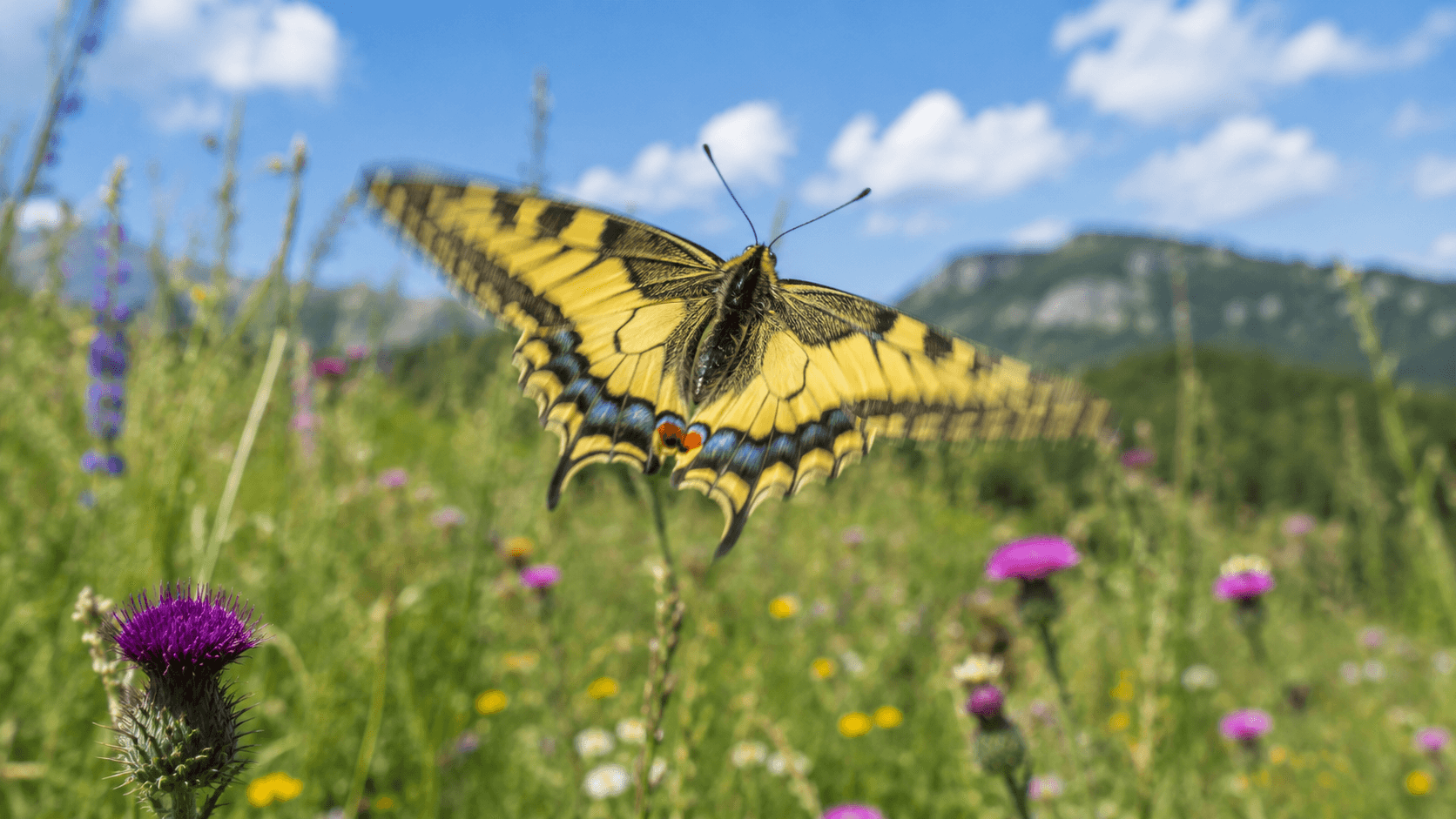
“Tails.” Many species (swallowtail, scarce swallowtail) have characteristic elongated extensions — “tails” — on the hindwings. Species of the genus Parnassius (Apollo, clouded Apollo) lack tails.
Slow flight. Swallowtails fly unhurriedly with gliding movements — hence their Russian name (“parusniki,” sail-like flyers). In good weather they are easy to spot over meadows and mountain slopes.
Osmeterium — chemical defense of caterpillars. When threatened, the caterpillar extends a bright forked orange or red organ with a sharp unpleasant smell from behind the head. This deters ants, spiders, and small predators. Osmeterium color varies by species.
Swallowtail species in Russia
Swallowtail (Papilio machaon)
The best known and most widespread Russian swallowtail. Yellow with a black pattern, characteristic “tails,” and blue and red spots on the hindwings. Wingspan 6.5–8 cm.
Found throughout Russia’s temperate and southern zones: in meadows, fields, forest edges, gardens, and wastelands. The caterpillar is bright green with black stripes and orange spots; it feeds on umbellifers — carrot, dill, parsley, angelica, hogweed.
Produces 2–3 generations per summer in the south and 1–2 in the north. Overwinters as a pupa.
Scarce swallowtail (Iphiclides podalirius)
Pale yellow with several dark bands and long “tails” on the hindwings. Wingspan 6–8 cm. Flight is light and swift.
Widespread in European Russia (except the north) and the Caucasus. Prefers warm slopes with shrubs: blackthorn, plum, cherry plum — host plants of the caterpillar. Less abundant than the swallowtail; can be rare in northern parts of the range.
Apollo (Parnassius apollo)
White with red (sometimes yellow) spots on the hindwings and black spots on the forewings. Wingspan 6–9 cm. Wings are partly translucent.
A mountain species: lives on rocky and stony slopes with flowering stonecrops (Sedum) — the main host plant of the caterpillar. In Russia it occurs in the Urals, Altai, Sayan Mountains, and the Caucasus.
Listed in Russia’s Red Data Book. Numbers are declining due to habitat degradation, collecting, and climate change. If you see one — do not catch it.
Clouded Apollo (Parnassius mnemosyne)
Semi-translucent white, without “tails,” with black spots and no red spots. Smaller than the Apollo — wingspan 4.5–6 cm.
A forest species: lives in moist deciduous forests where corydalis (Corydalis) grows — the sole host plant of the caterpillar. When corydalis finishes flowering, the caterpillar hides in forest litter.
Listed in Russia’s Red Data Book. Numbers are falling due to destruction of forest tracts and logging.
Phoebus Apollo (Parnassius phoebus)
Similar to the Apollo but lives even higher in the mountains — the alpine belt of the Altai and Sayan Mountains. It also has red spots, but the pattern differs somewhat. A rare species.
Ecology and observation
Swallowtails are active on warm sunny days. Lowland species (swallowtail, scarce swallowtail) occur from April through August; mountain species (Apollo) mainly in July.
Swallowtails are most often seen on flowering meadows, along rivers, and on mountain trails. Males of many species patrol fixed routes along forest edges or slopes.
If you see a large yellow or white butterfly with “tails” — it is almost certainly a swallowtail. Use the wing color identifier to narrow down the species.
Conservation
Two Russian species — the Apollo and clouded Apollo — are protected by law. Their collection, possession, and sale are prohibited. If you find a population of these butterflies, report it to the local conservation authority or submit records to a biodiversity monitoring system.
More on rare species — in the rare butterflies section.