What Are Butterflies
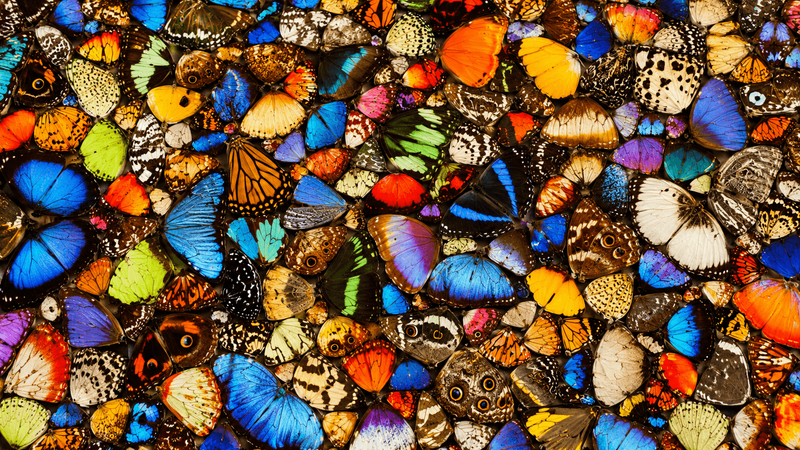
Butterflies are insects of the order Lepidoptera with four wings covered in scales. More than 157,000 species exist worldwide.
Definition
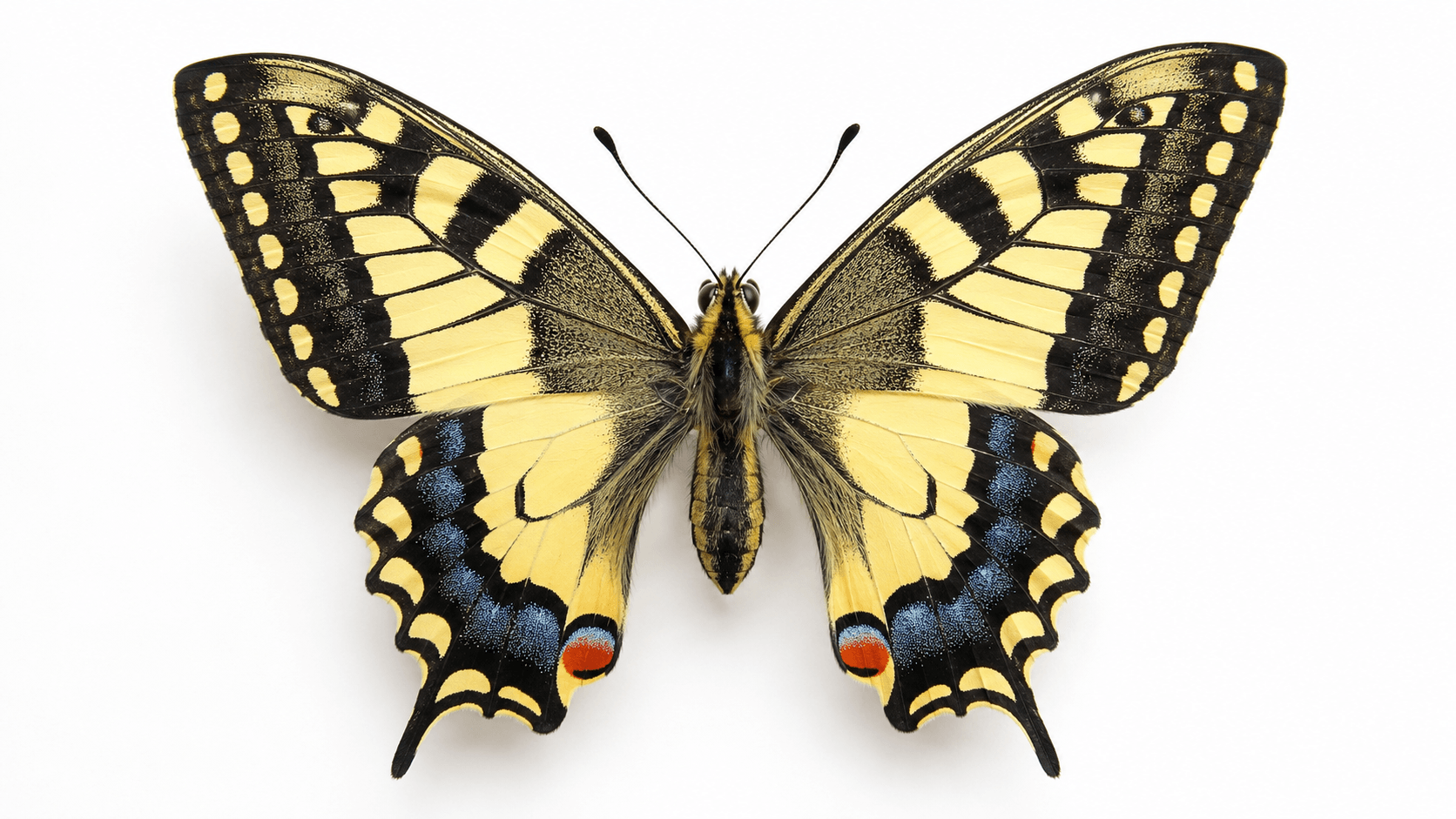
Butterflies are insects of the order Lepidoptera (scale-winged insects). The order name comes from the Greek words lepis (scale) and pteron (wing): lepidopteran wings are covered with microscopic flat scales that form the pattern.
In everyday speech, "butterflies" usually means day-flying members of the order. In scientific terms, all lepidopterans — both day-flying butterflies and nocturnal moths — are equal members of the order Lepidoptera.
How Many Butterfly Species Exist
The order Lepidoptera includes about 157,000 described species — and this is far from a final figure: scientists describe hundreds of new species each year, mainly from tropical regions.
Of these, day-flying butterflies (superfamily Papilionoidea) number about 18,000–20,000 species. The rest are nocturnal butterflies and moths.
About 2,200 species of lepidopterans live in Russia, of which day-flying butterflies account for roughly 300–350 species.
Body Structure
Like all insects, a butterfly has three body regions: head, thorax, and abdomen.
The head bears a pair of large compound eyes (providing a wide field of vision), a pair of antennae (organs of smell and balance), and mouthparts. In most butterflies the mouth is modified into a proboscis — a long coiled tube for sucking liquid. At rest the proboscis is coiled; when feeding it unrolls.
The thorax consists of three segments. It carries three pairs of legs and two pairs of wings. In nymphalids the front legs are atrophied — they walk on four. Wings are covered with scales that easily rub off on contact (which is why "powder" remains on your fingers).
The abdomen contains the digestive and reproductive systems. It also houses hearing organs in some species (tympanal organs) — they detect bat ultrasound.
Wings and Scales
Scales are flattened modified hairs. They overlap like roof tiles. Coloration forms in two ways:
- Pigment coloration: scales contain coloring substances — melanins (black, brown), flavones (yellow), pterins (white, yellow).
- Structural coloration: the nanostructure of scales scatters and reflects light of a specific wavelength. This is how the blue color of morphos and some blues works: there is no pigment, but the scales act as a diffraction grating.
Four Life Stages
Butterflies undergo complete metamorphosis — four fundamentally different stages:
- Egg — embryonic stage, 5–14 days
- Caterpillar (larva) — growth stage, from several weeks to several months
- Pupa — transformation stage, 2–8 weeks
- Imago (adult butterfly) — reproductive stage, from several days to a year
Read more about each stage in the articles life cycle and metamorphosis.
How Butterflies Differ from Moths
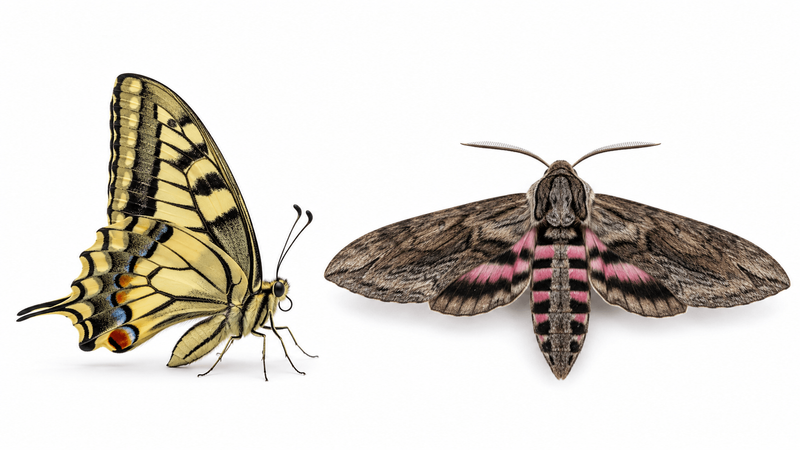
In Russian, "motylёk" (moth) is not a strict taxon but an everyday name for nocturnal lepidopterans. Biologically, the key features are:
| Feature | Day-flying butterflies | Nocturnal butterflies / moths |
|---|---|---|
| Antennae | Club-shaped (with a thickened tip) | Feathery or thread-like |
| Resting posture | Wings folded vertically | Wings spread horizontally |
| Body | Slender | Often bulky, hairy |
| Activity | Daytime, in sunny weather | Dusk and night (most species) |
There are no strict rules: some nocturnal species fly by day, and some day-flying species hide in cloudy weather. Read more in the article day-flying butterflies.
Why Study Butterflies
Butterflies are a convenient indicator of ecosystem health. They respond sensitively to climate change, soil and water quality, and vegetation condition. Scientists use butterfly community composition as a measure of regional biodiversity.
Butterflies are also important pollinators: visiting flowers for nectar, they transfer pollen. Some plants are pollinated almost exclusively by butterflies.
Finally, butterflies are attractive for nature observation — butterfly watching is gaining popularity as ecological tourism.
To start exploring — see the butterfly families section and the identification guide.
See also