Wing Scales and Structural Colour: How a Butterfly's Wing Actually Works
Why butterfly wings are covered in microscopic scales, and how some colours — like Morpho blue — come from physical structure rather than pigment.
An order named for its wings
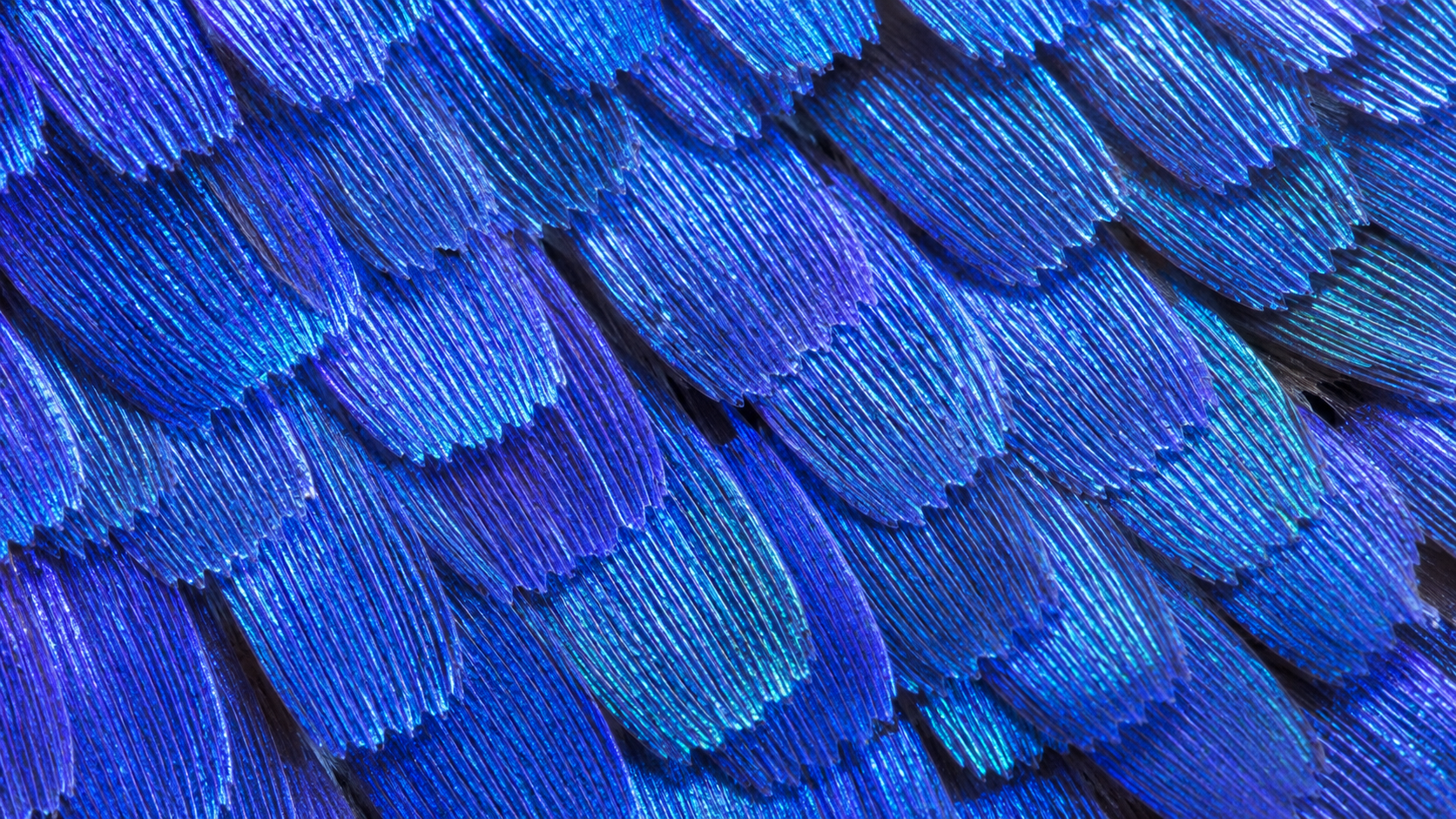
The scientific order Lepidoptera, encompassing all butterflies and moths, takes its name directly from the Greek for "scale wing" — a fair description, since a butterfly's entire visible pattern is produced by many thousands of tiny, overlapping scales covering the wing's transparent membrane like shingles on a roof. Brush a butterfly's wing and the fine powder that comes off on your fingers is these scales, dislodged from their moorings; a wing stripped bare of scales is essentially transparent, since the colour and pattern reside entirely in the scales rather than the membrane beneath them.
What a scale actually is
Each scale is a flattened, hollow, modified hair, built from chitin, the same tough structural material that forms the rest of an insect's external skeleton. A single specialised cell in the developing pupal wing produces each scale before dying, leaving the finished scale attached to the wing membrane by a small stalk, arranged in overlapping rows running from the wing's base toward its edge. Because the producing cell is dead by the time the adult emerges, a butterfly's wing pattern is effectively fixed for the rest of its life — damaged or lost scales cannot be regrown, which is why the wings of an older, weathered butterfly typically look faded and thin compared with a freshly emerged individual.
Two ways to make a colour
Butterfly wing colour arises through two fundamentally different mechanisms, often combined on the same wing.
Pigment colour comes from chemical compounds embedded within the scale that absorb certain wavelengths of light and reflect others, exactly as ordinary dyes and pigments do. Melanins produce blacks, browns, and greys; pterins, a class of compounds related to those found in some vitamins, produce whites and yellows; and carotenoids, often obtained directly from the diet, contribute oranges and reds in some species. This kind of colour looks essentially the same regardless of viewing angle, just as a printed page does.
Structural colour, by contrast, does not depend on any pigment at all. It arises from the scale's physical microarchitecture — stacks of ridges, thin-film layers, or more complex three-dimensional lattices, built at a scale of just a few hundred nanometres, comparable to the wavelength of visible light. Light waves reflecting off these closely spaced structures interfere with one another, reinforcing some wavelengths and cancelling others through the same physical principle that produces colour in a soap bubble or a thin film of oil on water.
Morpho blue: iridescence in action
The brilliant, almost unnaturally saturated blue of South American Morpho butterflies is the most famous example of structural colour in the insect world. Each scale carries a fine stack of microscopic ridges, precisely spaced so that reflected light waves interfere constructively for blue wavelengths viewed within a fairly narrow range of angles — a phenomenon called iridescence, in which the perceived colour shifts or disappears as the viewing angle changes relative to the light source. This is why a Morpho's wing can flash brilliant electric blue in flight one moment and look comparatively dull or dark the next, and why no amount of blue pigment could ever reproduce quite the same effect — there is, in fact, no blue pigment in the scale at all.
Why it matters beyond looking pretty
Structural colour and pigment colour are frequently combined for functional effect. Some species stack a dark pigment layer beneath a structurally coloured layer specifically to absorb any light that isn't reflected by the structural component, intensifying the perceived brightness of the structural colour above it. Iridescent structural colour, being highly angle-dependent, is also thought to play a role in mate recognition and signalling in some species, since a flash of colour visible only from certain angles during a characteristic flight display can serve as a distinctive, hard-to-fake identification cue between individuals of the same species — one of several ways that the same microscopic scale architecture responsible for a butterfly's visible beauty also does real biological work.
An engineering inspiration
Because structural colour produces such vivid, fade-proof colour without any pigment or dye, butterfly wing microstructure has become a genuine subject of interest for materials scientists and engineers, who study it as a model for developing pigment-free colour technologies, anti-counterfeiting features, and even certain optical sensors — a rare case of a purely aesthetic-seeming natural feature turning out to have direct technological relevance.