The Rarest Butterflies in the World
Thousands of butterflies face extinction, but a few now survive on a thread — a handful of sites or one habitat patch. A guide to the rarest species.
The scale of the crisis
The IUCN Red List currently assesses approximately 1,500 butterfly and moth species as threatened (Vulnerable, Endangered, or Critically Endangered). Given that only about 20,000 of the world's 160,000+ Lepidoptera species have been formally assessed, this is certainly an underestimate. The true number of butterfly species at significant extinction risk is likely in the thousands.
But within this broader crisis, a subset of species is in acute danger — populations measured in hundreds or low thousands of individuals, ranges contracted to a single site or habitat fragment, or species that have already lost so much ecological connectivity that normal evolutionary processes (dispersal, recolonisation, gene flow) can no longer function. These are the species discussed here.
Already lost: the Xerces blue
The Xerces blue (Glaucopsyche xerces) holds the melancholy distinction of being the first butterfly species known to have been driven extinct by urban development. Its habitat was the coastal sand dunes of the San Francisco Peninsula — a very restricted range even before human settlement began to consume it.
The last known colony occupied dune habitat at the western end of the San Francisco peninsula. In 1942–1943, the US military constructed a facility on the site. The last confirmed sightings of the Xerces blue were in April 1943; no specimens were found subsequently despite searches. It was formally declared extinct later that decade.
The Xerces Society for Invertebrate Conservation — one of the world's most influential invertebrate conservation organisations — was named in its honour in 1971, transforming an extinction into a lasting institutional legacy for insect conservation.
The large blue — extinction and resurrection
Perhaps the most instructive conservation story in European butterfly history is that of the large blue (Maculinea arion / Phengaris arion) in Britain.
The large blue requires two specific partners to complete its life cycle: the wild thyme (Thymus polytrichus) as a larval food plant in the first three instars, and the red ant Myrmica sabuleti to carry the caterpillar into its nest for the final larval stage, where it feeds on ant grubs. The ant requires a specific short, warm grass sward maintained by grazing — without grazing, grasses grow tall, the sward cools, and M. sabuleti is replaced by less suitable ant species.
British butterfly enthusiasts had collected and monitored the large blue for over a century without understanding this dependency. When sites were protected from grazing in the 1950s–1970s — with the intention of helping the butterfly by reducing disturbance — the sward grew tall, the ant population shifted, and the butterfly's larval survival collapsed. The species went extinct in Britain in 1979, at its last site in Somerset.
Entomologist Jeremy Thomas decoded the life history requirement in time to understand why the species had failed. Reintroduction from Swedish stock began in 1983 on restored short-sward grassland. Today, over 40 colonies are established across southwestern England and the Cotswolds, and the UK population exceeds 10,000 adults in good years — the most successful butterfly reintroduction in European history.
Miami blue (Cyclargus thomasi bethunebakeri)
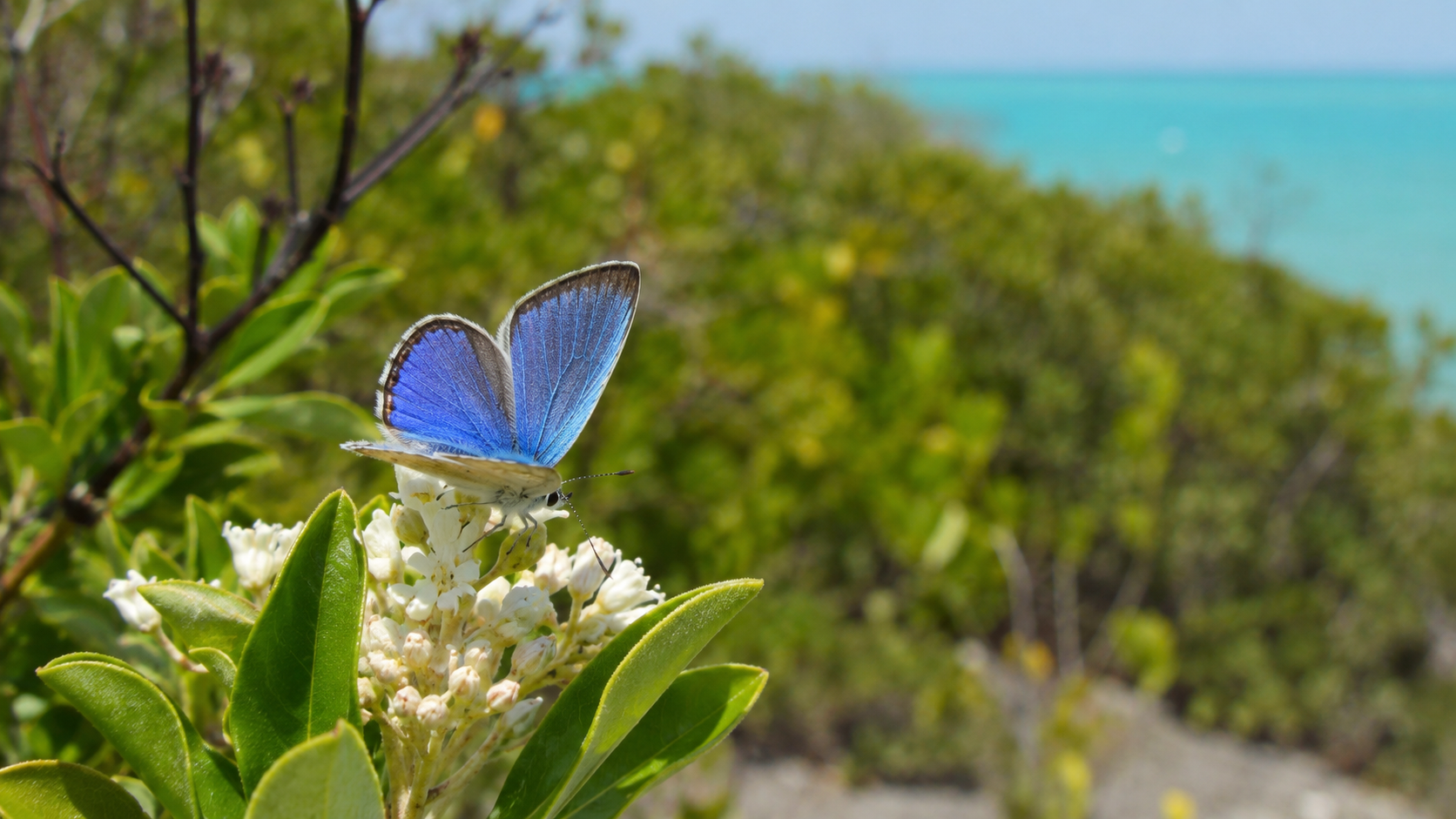
The Miami blue was once common throughout the Florida Keys and parts of peninsular Florida — a small, brilliant blue lycaenid of coastal scrub habitat. By the 1990s, hurricane damage, habitat loss, and an unexplained collapse had eliminated it from the mainland and the northern Keys. By the early 2000s, a single colony in Bahia Honda State Park on Big Pine Key contained the entire world population — estimated at fewer than 50 individuals.
Emergency conservation action — legal protection of the colony site, monitoring, and small-scale captive breeding — stabilised the population. Several additional small colonies have since been found on other Keys, and captive-bred individuals have been released at restored sites. The current total population is estimated at a few thousand in good years, but the species remains critically dependent on a handful of Keys sites and highly vulnerable to hurricane events that can eliminate entire colonies in a single storm.
The Miami blue feeds primarily on grey nickerbean (Caesalpinia bonduc) as a larva and uses native coastal scrub species as nectar sources. Both the host plant and the habitat are under sustained pressure from coastal development in one of the most intensively developed subtropical environments in North America.
Sinai baton blue (Pseudophilotes sinaicus)
The Sinai baton blue has the smallest confirmed range of any butterfly species in the world: it exists only on the upper slopes of Mount Sinai (Jabal Musa) and immediately adjacent peaks in Egypt's Sinai Peninsula, at altitudes above 1,800 m. The entire world population occupies an area of perhaps 6 km².
The species depends entirely on Sinai thyme (Thymus decussatus), a small aromatic shrub endemic to the Sinai highlands. The larva feeds on the flowers and buds of the thyme; the adult nectar-feeds on the same plant. Outside the thyme's restricted distribution, the butterfly cannot exist.
Population estimates range from 1,500 to 3,000 individuals in years with good thyme flowering. The principal threats are:
- Overgrazing by Bedouin livestock, which can strip thyme plants to bare stems
- Tourist pressure on Mount Sinai, which receives hundreds of thousands of pilgrims and tourists annually
- Climate change: the highland climate that supports thyme at altitude may warm beyond the plant's tolerance, reducing suitable habitat further
Queen Alexandra's birdwing (Ornithoptera alexandrae)
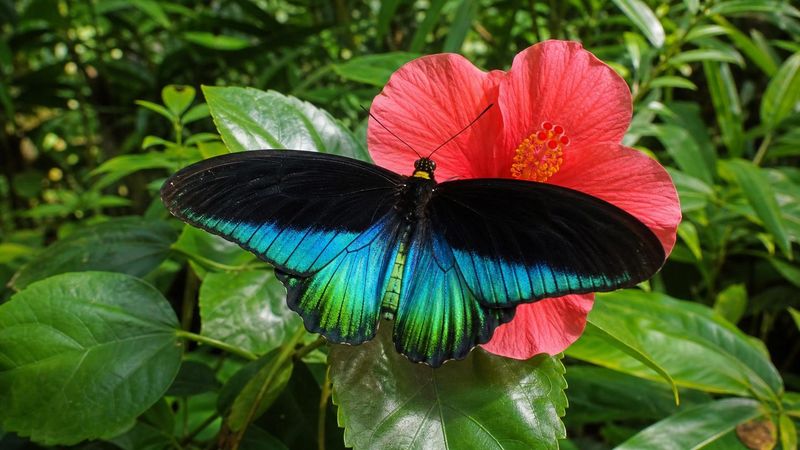
The world's largest butterfly is also one of its most endangered. Ornithoptera alexandrae is confined to a lowland rainforest area of approximately 100 km² on the Popondetta Plain of Oro Province, Papua New Guinea — a range that has been dramatically reduced from its original extent by oil palm plantation development.
The species is listed as Endangered by IUCN, with an estimated total population of approximately 15,000 individuals across its two remaining forest fragments. It is listed on CITES Appendix I — the highest level of trade regulation, effectively banning all commercial trade in wild-caught specimens. Despite this, it remains one of the most sought-after species by illegal collectors; a large female in perfect condition can command thousands of dollars on the black market.
Larvae feed exclusively on Aristolochia schlechteri — a large woody vine that grows only in undisturbed primary lowland forest. The loss and fragmentation of this forest is the central conservation problem. PNG's Oro Province has a history of community-based conservation efforts, and some landowner groups have negotiated conservation agreements to protect remaining forest blocks.
Schaus' swallowtail (Heraclides aristodemus ponceanus)
Florida's Schaus' swallowtail is a large, boldly patterned swallowtail of tropical hardwood hammock — the dense, broadleaved forest of the Florida Keys. Once found across the upper Keys from Key Largo to Key West, it had been reduced to two small populations on North Key Largo by the 1990s.
Hurricane Andrew (1992) eliminated one of the two remaining colonies. By 1993, population surveys found fewer than 70 adults. Emergency captive breeding at the University of Florida Zoo maintained the species through this period; subsequent reintroduction and habitat management have built the population back to several hundred individuals on protected land in Biscayne National Park and Crocodile Lake National Wildlife Refuge.
The Schaus' swallowtail's larval host plants are wild lime (Zanthoxylum fagara) and torchwood (Amyris elemifera), both characteristic species of mature hammock forest. Hammock quality, hurricane frequency (projected to increase under climate change), and pesticide use for mosquito control in the Keys are the critical variables for the species' long-term persistence.
El Segundo blue (Euphilotes battoides allyni)
One of conservation biology's most improbable success stories involves a tiny blue butterfly and an oil refinery. The El Segundo blue is a subspecies of the square-dotted blue, restricted to coastal buckwheat (Eriogonum parvifolium) on sand dunes of the Los Angeles basin. By the 1970s, virtually the entire original coastal dune habitat had been developed; one surviving dune remnant — sitting within the perimeter fence of the Chevron refinery at El Segundo — held the only known population.
Chevron partnered with conservation biologists to manage the dune habitat for the butterfly — removing invasive plants, planting additional coastal buckwheat, and monitoring population trends. The El Segundo blue population on refinery land has recovered to several thousand individuals, and additional habitat has been restored at Los Angeles International Airport and other nearby sites. The species remains listed as Endangered but has been substantially rescued by an unlikely combination of industrial cooperation and targeted habitat management.
Global patterns of rarity
The case studies above share several common factors that appear repeatedly in the biology of the world's rarest butterflies:
| Factor | How it creates rarity |
|---|---|
| Island or peninsula | Intrinsically limited range with no recolonisation source if populations fail |
| Obligate host plant | Loss of the host eliminates the butterfly regardless of habitat extent |
| Multi-species dependency | Requires host plant AND specific ant species — both must be present simultaneously |
| Coastal habitat | Development pressure concentrated at coast; hurricane and sea-level rise exposure |
| Narrow altitude range | Alpine species compressed between warming lower limit and fixed upper limit of terrain |
| Specialist soil | Calcareous grassland, sand dune, and serpentine species have no alternative habitat |
These factors are often not independent — the rarest butterflies typically combine several of them, creating a compound vulnerability that makes recovery difficult even with active management.
The conservation lesson
The large blue's extinction and reintroduction in Britain demonstrated something fundamental: understanding the mechanism of decline is the prerequisite for recovery. For fifty years, conservationists protected large blue colonies from disturbance without understanding that grazing management was the critical variable. Once the ant-plant-butterfly interaction was decoded, recovery became straightforward.
For the world's rarest butterflies, the priority is the same: identify the specific ecological requirement that has become limiting, restore or protect that requirement, and allow the butterfly's own reproductive capacity to do the rest. Butterflies, with their short generation times and high fecundity, can recover remarkably fast when the bottleneck is removed — the question is whether the knowledge and the will to remove it can be mobilised in time.