Queen Alexandra's Birdwing
Queen Alexandra's birdwing is the world's largest day-flying butterfly, female wingspan up to 280 mm. Lives only in Papua New Guinea; endangered.
Key facts
- Latin name
- Ornithoptera alexandrae
- Family
- Papilionidae
- Wingspan
- 200-280 mm
- Flight season
- Year-round
- Host plants
- Dutchman's pipe vine (Aristolochia dielsiana)
- Conservation status
- ENEndangered
Appearance
Queen Alexandra's birdwing (Ornithoptera alexandrae) is officially the world's largest day-flying butterfly by wingspan. Females reach 250–280 mm in wingspan at a body weight of about 12 g — comparable to a small bird. Males are noticeably smaller (160–200 mm) but more brightly coloured.
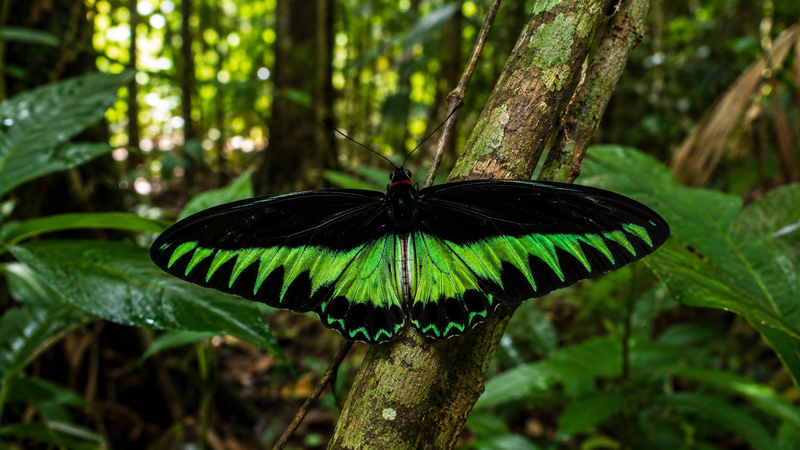
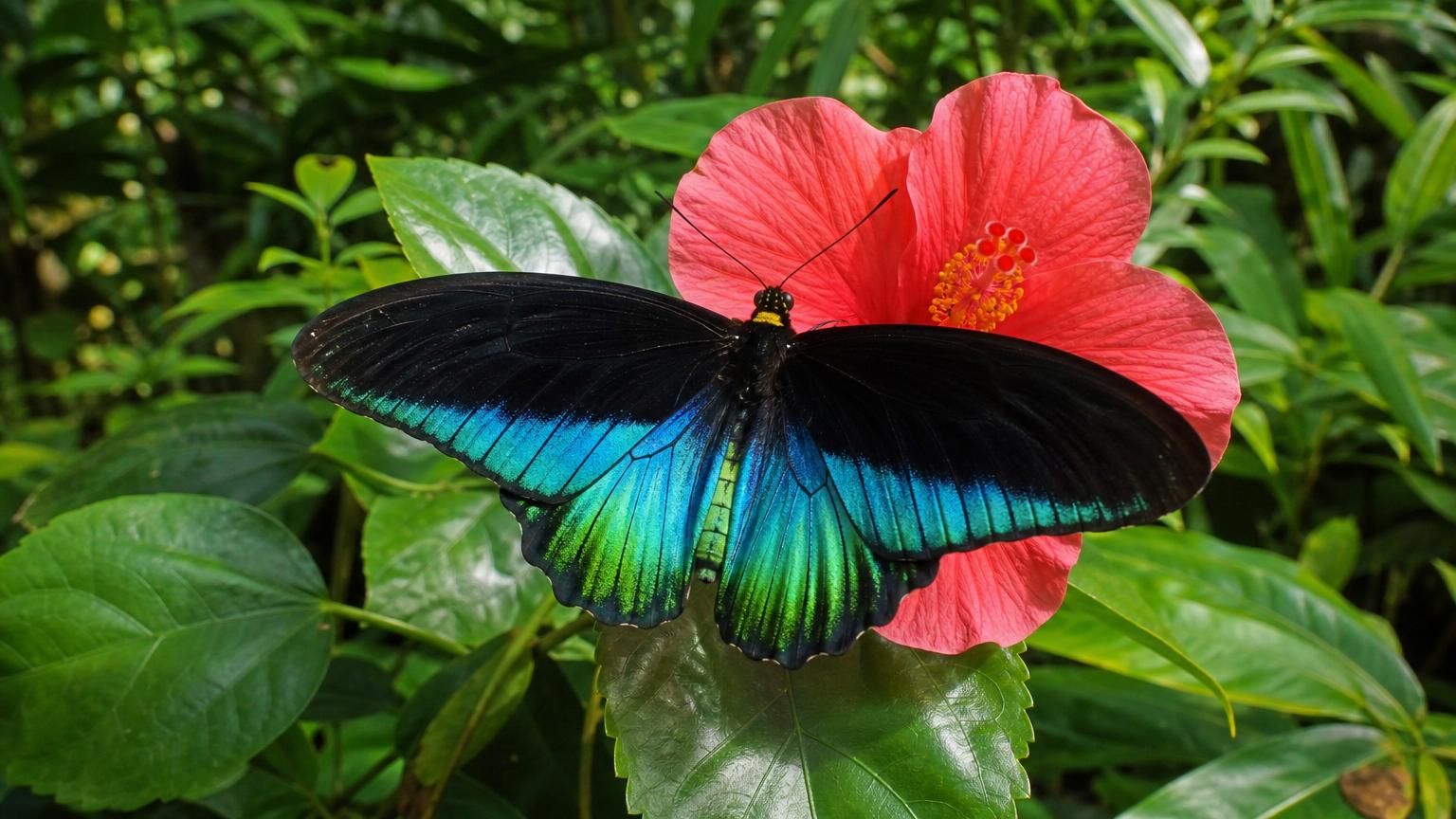
Male: forewings turquoise-green with a velvety sheen, hindwings yellow with a green border and black veins. Abdomen vivid yellow. Female: brown with white spots, less gaudy — classic cryptic coloration for the more vulnerable egg-laying individual.
In flight the birdwing produces an audible rustle of wings — the largest specimens were shot down by the first European naturalists with a shotgun, having mistaken them for birds.
Range
The species is strictly endemic to Oro Province (Northern Province) of New Guinea. The range is restricted to lowland and foothill forests within about 100 km of Oro Bay. This is one of the narrowest ranges of any large butterfly on Earth.
It inhabits primary and minimally disturbed tropical forests at elevations up to 400 m above sea level. The essential condition for its presence is the existence of Aristolochia dielsiana.
Feeding and host plant
The caterpillar feeds exclusively on the leaves of Aristolochia dielsiana — a large tropical vine. The species is a strict monophage. Aristolochia leaves contain aristolochic acids, which the caterpillar accumulates in its tissues, making itself toxic to predators. The adult inherits the toxins, which explains the male's vivid aposematic coloration.
Adult butterflies feed on nectar from large-flowered plants: hibiscus, Sesbania, Cordia. The male feeds actively for several hours in the morning; the female feeds less frequently.
Life cycle
The female lays large eggs singly on the underside of young Aristolochia leaves. A dark caterpillar emerges and feeds on vine leaves for several months. The caterpillar passes through five instars, the last reaching about 10 cm in length. The chrysalis is large, brown-green, attached to a branch. The cycle from egg to adult takes about 4–5 months.
The adult lives 3–4 months. Males patrol the tree canopy in search of females, which keep lower — near the host vines.
Threats and conservation
Status EN (Endangered) under the IUCN classification. Key threats:
- Logging for oil palm plantations and timber extraction — destroys Aristolochia dielsiana.
- The eruption of Mount Lamington in 1951 destroyed a significant part of the historical range.
- Illegal collection: rare specimens reach values of $8,000–10,000 on the black market.
The species is listed in CITES Appendix I (commercial trade prohibited). In Papua New Guinea it is protected by national legislation. IFTA ranching programmes legally breed other Ornithoptera species for sale; Ornithoptera alexandrae is not sold from those farms.
Discovery and name
The birdwing was discovered in 1906 — found by collector Albert Stewart Meek in Oro Province. Named in honour of Princess Alexandra of Denmark, wife of King Edward VII of Great Britain. Female specimens remained unknown to science for a long time: naturalists observed the butterflies in the canopy but could not catch them.
Interesting facts
- The only butterfly in the world that consistently exceeds 250 mm wingspan in the majority of females.
- In Papua New Guinea it is depicted on postage stamps and is the unofficial symbol of entomological tourism.
- Together with Priam's birdwing it belongs to the genus Ornithoptera — "birdwings," named for their size and flight resembling a soaring bird.