Australia and Oceania
Butterflies of Australia and Oceania: about 400 species in Australia, Papua birdwings, unique Pacific islands. Isolated fauna with high endemism.
Australia and Oceania: isolated faunas
The Australian zoogeographic region is one of the most isolated on Earth. Separation from Asia over tens of millions of years allowed unique life forms to evolve. In entomology this is expressed in high endemism: many Australian butterfly species occur nowhere else.
The region includes mainland Australia, Tasmania, New Zealand, Melanesian islands (primarily Papua New Guinea), and scattered Pacific archipelagos.
Australia
Mainland Australia has about 400 species of day-flying butterflies — few by world standards, but with a high proportion of endemics (about 80%). Diversity increases from south to north: the arid centre and south are poor, the humid tropics of northern Queensland are richest.
Tropical Queensland
Rainforests of Cape York and the McIlwraith Range are an Australian butterfly hotspot. More than 200 species occur here.
- Ulysses Birdwing (Ornithoptera priamus euphorion) — subspecies of birdwing endemic to Queensland; male emerald green with black, up to 16 cm wingspan; female larger, brown-white with black. One of Australia's protected butterflies — export prohibited
- Crow butterflies (Euploea) — dark blue or brown danaines; unpalatable; live in the forest canopy
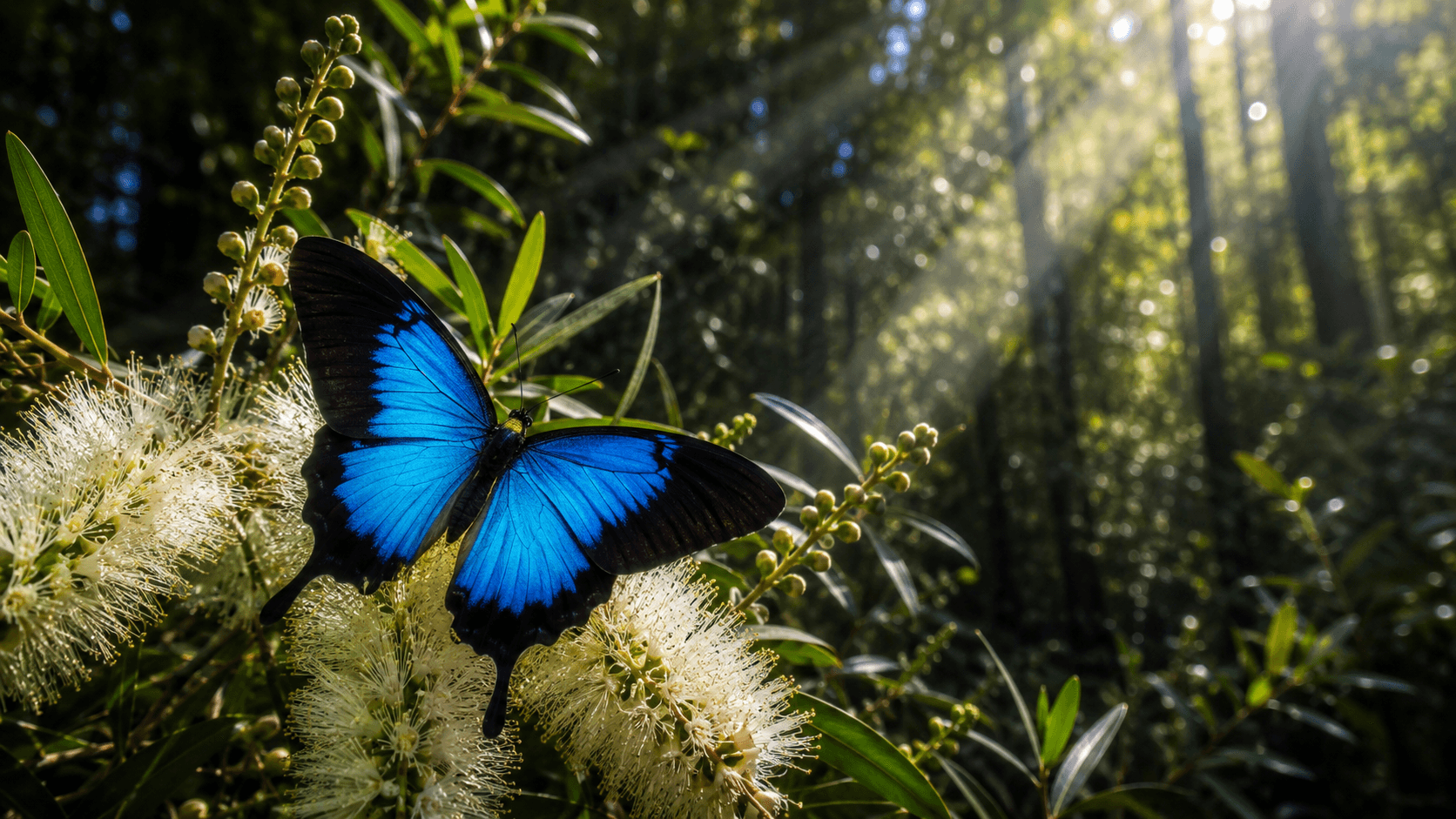
- Ulysses Swallowtail (Papilio ulysses) — "Mountain Blue"; blue with black; males patrol edges above blue flowers (respond to blue colour)
Southwestern Australia
An isolated floristic region with its own endemic plants — and corresponding specialised butterflies.
- Blues of the genus Acrodipsas — unique species whose caterpillars live in ant nests, feeding on ant larvae (true myrmecophiles)
- Jalmenus — another group of blues with obligate myrmecophily; rare and protected
Arid interior plateau
Deserts and semi-deserts of central Australia are poor in butterflies, but adapted species occur:
- Lemon Migrant (Catopsilia pomona) — white capable of migrating through arid zones; forms mass streams in rainy seasons
- Wattle Blues (Jalmenus evagoras and others) — specialised on acacias, from desert to humid forest
Tasmania
An isolated island to the south — temperate zone. About 60 day-flying species; several Tasmanian endemics.
- Orange Copper (Paralucia pyrodiscus lucida) — Tasmanian subspecies under threat; linked to a specific mountain shrub species
- Arctides guenei — nocturnal moth flying by day; resembles a day-flying species
Papua New Guinea
Papua New Guinea is a transition zone between Asian and Australian faunas. By species number PNG ranks in the world top ten: more than 800 day-flying species. Endemism is extremely high.
Papua birdwings
Papua is the homeland of the largest and most beautiful birdwings. Three species hold a special place:
Queen Alexandra's Birdwing (Ornithoptera alexandrae) — world record holder. Females reach 28 cm wingspan — the absolute record among all butterflies on Earth. Occurs only in a limited area of lowland forests in Oro Province. Listed in the IUCN Red List (critically endangered) and CITES Appendix I — trade completely prohibited.
Rajah Brooke's Birdwing (Trogonoptera brookiana) — "Rajah Brooke's Butterfly"; black with triangular bright green spots; in Papua its close relative T. trojana from Palawan (Philippines) occurs. Named after James Brooke, first White Rajah of Sarawak.
Goliath Birdwing (Ornithoptera goliath) — "Goliath Birdwing"; male yellow-green with black; one of the largest birdwings. Endemic to mountain forests of PNG.
Male birdwings feed on Aristolochia (birthwort) flowers, which caterpillars use as food plant and source of toxins.
Mountain fauna of Papua
Papua's mountains rise to 4,900 m — the world's highest tropical mountains. Each altitudinal belt contains its own specialised nymphalids, blues, and whites.
New Zealand
New Zealand is a special case: long isolated from Australia, it has a very poor butterfly fauna, only about 20 day-flying species. Many species are recent colonists from Australia. Endemics:
- Lycaena salustius — "Common Copper"; one of 8 New Zealand species of the genus
- Dodonidia helmsii and Argyrophenga antipodum — endemic satyrs of mountain meadows
Impact of introduced plants
Invasive species (migrant butterflies from Australia and North America) are increasingly colonising New Zealand. Monarch Danaus plexippus established here in the 20th century and became one of the most conspicuous species.
Pacific islands
Islands of Melanesia, Micronesia, and Polynesia have tiny faunas with a high percentage of endemics.
- Hawaii — before European settlement had unique endemic fauna; most local species became extinct after introduction of invasive animals and plants. Hawaii is now dominated mainly by introduced species
- Fiji and Vanuatu — several interesting endemic blues
- Solomon Islands — subspecies and isolated races of large swallowtails
Threats and conservation
Clearing of PNG lowland forests is the main threat to birdwings and other large species. Timber industry and clearing for palm plantations destroy habitat faster than in Borneo.
In Australia the problem is different: invasive plants displace larval food plants, disrupting established trophic links. Myrmecophilous blues are especially vulnerable: loss of host ant colonies leads to local extinction of the butterfly.
Birdwings are protected under the "Insect Farming and Trading Agency" (IFTA) programme in PNG: farmers legally breed birdwings for sale to collectors, reducing poaching pressure in the wild.
Best time for observations
- Queensland, Australia: October–March (southern summer); peak activity of rainforest species
- Papua: July–October (dry season); birdwings most visible on Aristolochia and Hibiscus flowers
- New Zealand: December–February (summer); mountain species in subalpine meadows
For adjacent fauna — see Asia. Wingspan records and largest species — in the article large butterflies.