Butterflies of Papua New Guinea
Papua New Guinea is home to over 800 butterfly species, including the Queen Alexandra's Birdwing, the world's largest butterfly with a 280mm wingspan.
Papua New Guinea: realm of the birdwings
Papua New Guinea occupies the eastern half of the island of New Guinea — the world's second-largest island — along with numerous surrounding archipelagos including New Britain, New Ireland, Bougainville, and the Trobriand Islands. Its tropical rainforests, which cover about 70% of the country's land area, harbour one of the most extraordinary butterfly faunas on Earth: approximately 820 recorded species, with endemism exceeding 90% at the species level.
New Guinea sits at the biogeographical crossroads between the Asian and Australasian realms. The result is a butterfly fauna that combines elements of both worlds, found nowhere else in quite this combination.
The birdwings: giants of the butterfly world
No discussion of Papua New Guinea's butterflies is possible without its birdwings — the tribe Troidini, particularly the genus Ornithoptera. These are the largest butterflies in the world, and New Guinea is their global centre of diversity.
Queen Alexandra's Birdwing
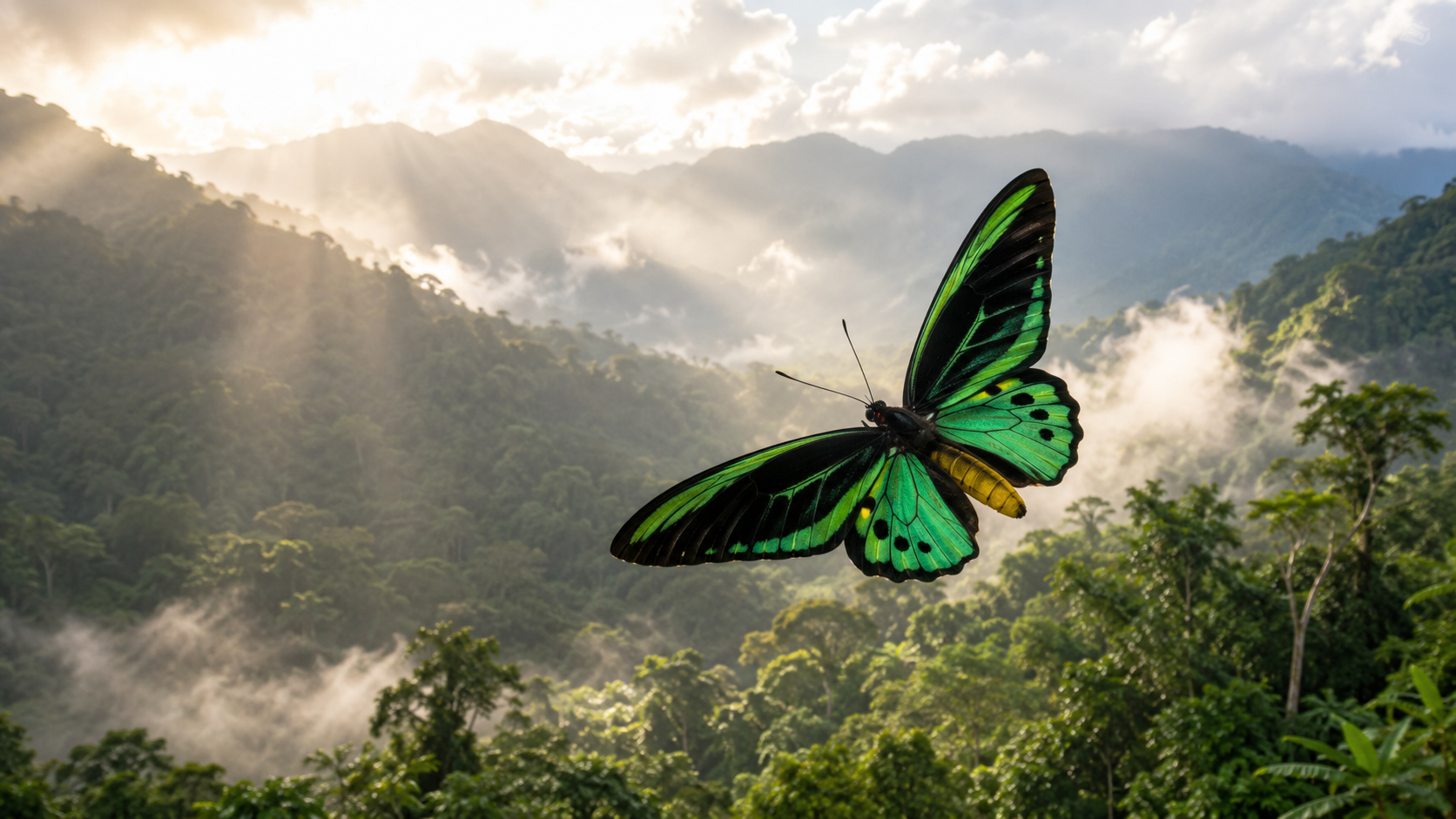
Ornithoptera alexandrae is the crown jewel: the largest butterfly species on Earth. Females are enormous brown-and-cream insects with a wingspan reaching 280 mm and a weight of up to 12 g — comparable in mass to a small songbird. Males are smaller but strikingly beautiful: velvety black wings with iridescent blue-green patches, a bright yellow abdomen.
The species is restricted to a strip of lowland rainforest in Oro Province (Northern Province) in eastern Papua New Guinea. Its entire known range covers less than 100 km². The 1951 eruption of Mount Lamington destroyed a large area of its habitat in a single day. Today the species is listed as Endangered on the IUCN Red List, primarily threatened by continuing rainforest clearance for oil palm plantations.
Other birdwing species
Papua New Guinea hosts approximately 12 species of Ornithoptera plus several Troides birdwings. Among the most spectacular:
Ornithoptera goliath — the second-largest butterfly in the world; male vivid yellow and black with metallic green, female massive brown and white.
Ornithoptera priamus — the Common Birdwing; widespread across New Guinea and northeastern Australia; the most frequently seen large birdwing in accessible areas.
Ornithoptera tithonus — confined to the Bird's Head Peninsula (Indonesian Papua New Guinea); remarkable for the male's orange wing patches.
Mountain ranges and endemism
The Owen Stanley Range, Star Mountains, Sepik highlands, and Huon Peninsula form a complex of mountain chains that have acted as barriers and refugia for millions of years. Each major range tends to have its own set of endemic butterfly species, particularly among the Delias genus (Jezebel butterflies) and in the family Lycaenidae.
Delias — the Jezebel genus — reaches its global peak diversity in New Guinea with more than 100 species recorded, many brightly patterned in red, yellow, and white. Their larvae feed on mistletoes parasitising rainforest trees, making host plant distribution a key driver of Jezebel geography.
Cloud forest above 1,500 m harbours many species unknown from lowlands: mountain swallowtails, high-altitude coppers, and endemic skippers.
Islands and archipelagos
Papua New Guinea's numerous islands add further endemism. Several offshore islands carry species found nowhere on the mainland:
- Bougainville and Buka islands: several endemic Ornithoptera and Papilio subspecies
- New Britain: endemic taxa of otherwise widespread species
- Manus Island and the Admiralty Islands: small island faunas with isolated endemic forms
Iconic species
Ornithoptera alexandrae — Queen Alexandra's Birdwing; the world's largest butterfly; female wingspan up to 280 mm. Critically endangered, Oro Province only.
Ornithoptera goliath — Goliath Birdwing; second-largest butterfly in the world; widespread in New Guinea hill forests up to 1,500 m.
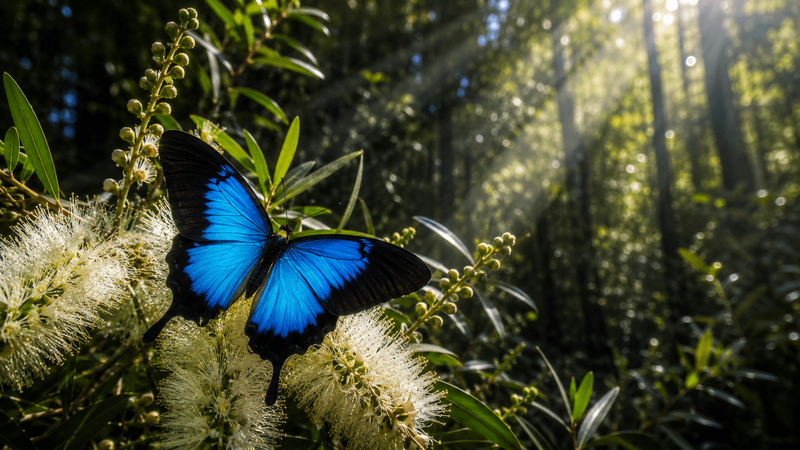
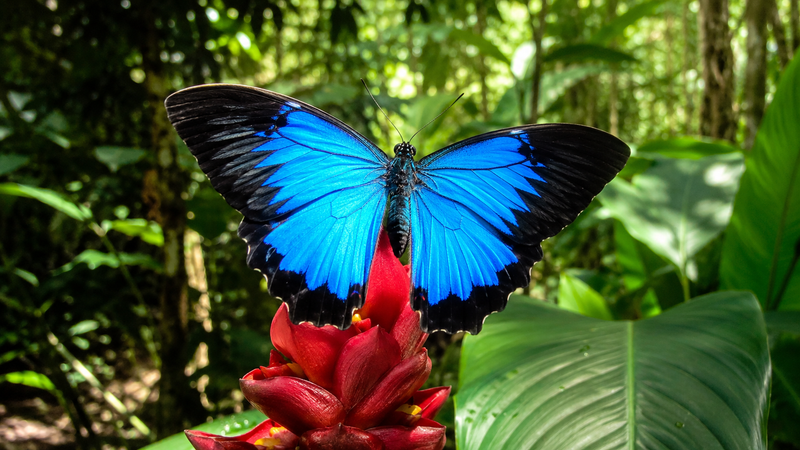
Papilio ulysses — Ulysses Butterfly; electric blue swallowtail shared with Australia; common in lowland and hill forest edges.
Graphium weiskei — Purple-spotted Swallowtail; one of the most striking swallowtails in the world; black wings with vivid purple spots; found in montane forest above 1,500 m.
Delias akkeae — a vivid Jezebel butterfly with orange, red, and white underside; typical of mid-elevation cloud forest.
Best observation sites
Varirata National Park (near Port Moresby) — the most accessible site for visitors; 30 km from the capital; lush hill forest with a range of species including Common Birdwing.
Madang (Madang Province) — a coastal town with good access to lowland rainforest; several birdwing species are regularly observed in forest gardens.
Kokoda Track — the famous WWII highland route through the Owen Stanley Range; the forest along the track holds many montane species; requires a multi-day trek but exceptional for mountain butterflies.
Milne Bay Province — the eastern tip of the mainland and its islands; excellent for birdwings and coastal forest species; accessible by boat from Alotau.
Observation season
Papua New Guinea lies entirely in the tropics, and butterflies fly year-round. The main wet season (December–March) brings heavy rain but lush vegetation and active butterflies. The dry season (May–November) offers easier movement through forest. The most stable butterfly activity is in the April–May and September–October transition periods.
High-altitude areas above 2,000 m are most productive in dry months when mornings are sunny before cloud builds in the afternoon.
Conservation
Papua New Guinea has some of the largest remaining areas of intact tropical rainforest outside Amazonia, but deforestation rates are increasing rapidly. Oil palm expansion in Oro Province has directly reduced Queen Alexandra's Birdwing habitat. Logging concessions cover large areas of lowland forest across Gulf, Western, and Sandaun provinces.
The country has an effective butterfly farming programme: villages are licensed to breed birdwings and other species commercially, providing income as an alternative to forest clearance. Farmed specimens are legally exported for scientific collections and exhibitions worldwide. This programme has been credited with reducing pressure on wild populations in some areas.
Interesting facts
- The Queen Alexandra's Birdwing was first brought to scientific attention in 1907 when a specimen was shot out of the forest canopy with a shotgun — nets were too small.
- Papua New Guinea's butterfly farming network involves hundreds of villages; it is one of the world's most successful wildlife farming programmes linked to conservation.
- Graphium weiskei (Purple-spotted Swallowtail) is so sought after by collectors that it appeared in illegal international wildlife trade catalogues; it is now protected under CITES.