Blue Morpho
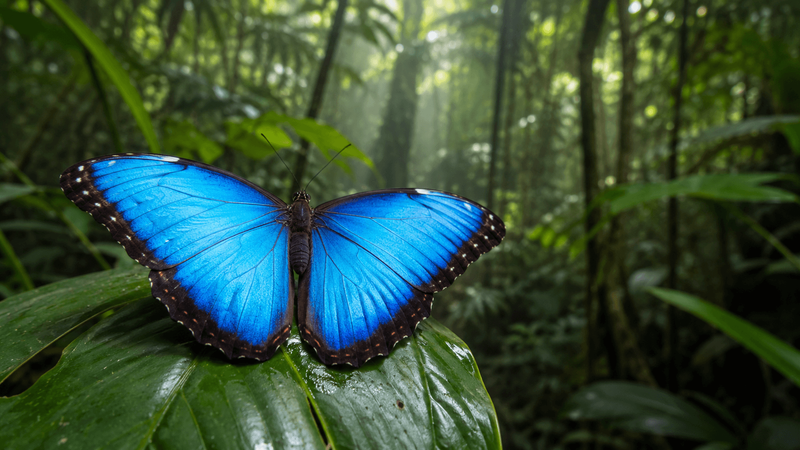
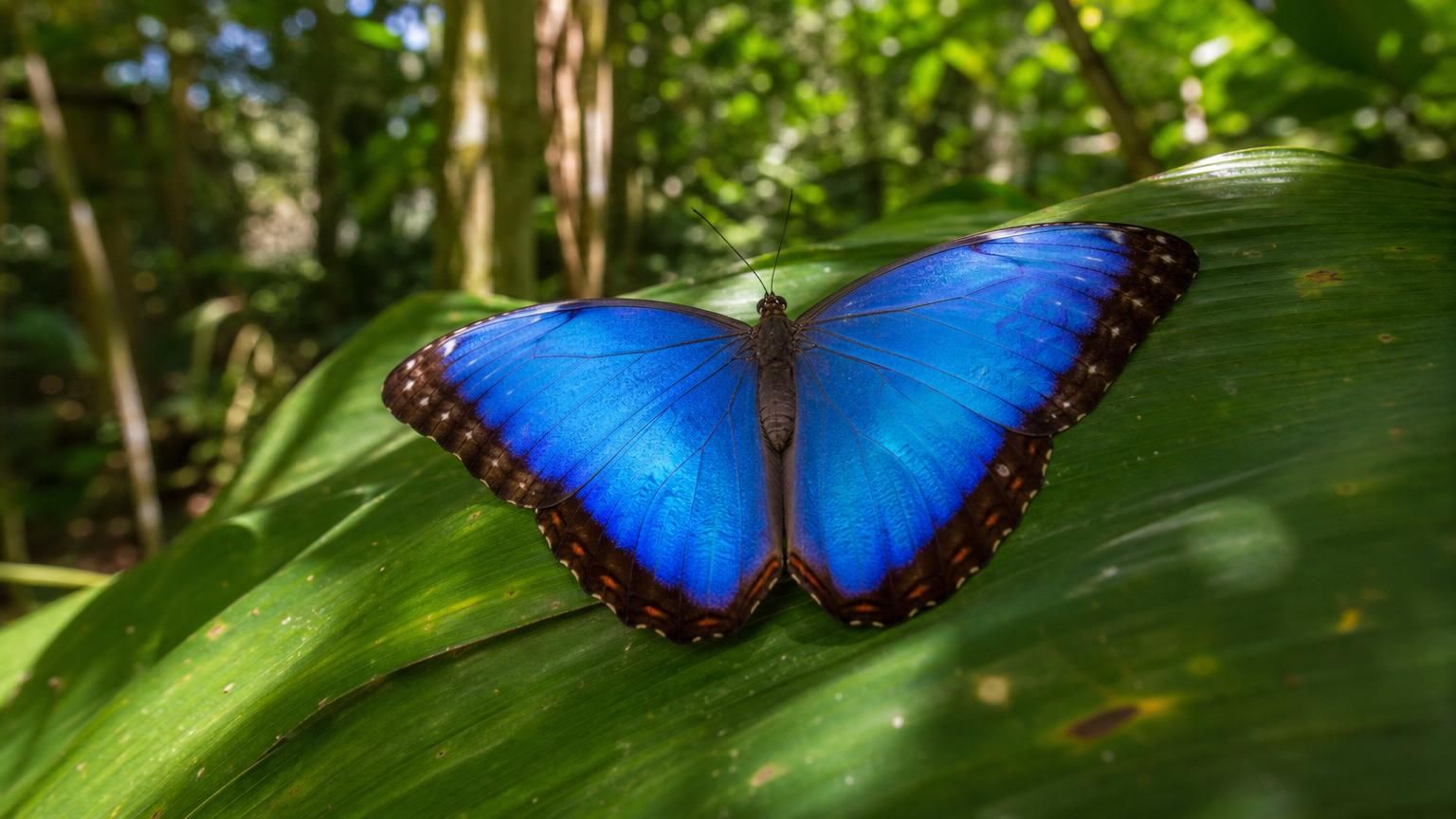
The blue morpho is a tropical butterfly with metallic-blue wings up to 130 mm across. Its iridescent sheen comes from nanostructure, not pigment.
Key facts
- Latin name
- Morpho menelaus
- Family
- Nymphalidae
- Wingspan
- 100-130 mm
- Flight season
- Year-round
- Host plants
- Inga spp., Pterocarpus spp., Various tropical legumes (Fabaceae)
- Conservation status
- NENot Evaluated
Appearance
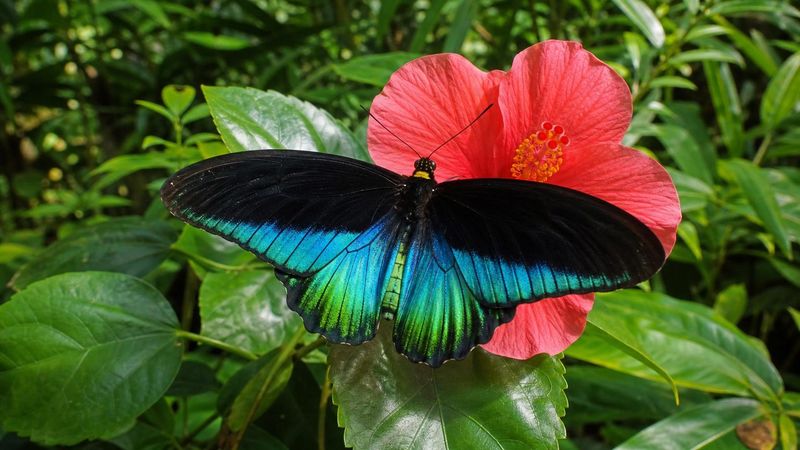
The blue morpho (Morpho menelaus) is one of the largest and most recognizable butterflies in the world. Wingspan 100–130 mm. The upper side of the wings is covered with dazzling blue-metallic scales, whose sheen is visible for hundreds of metres. In flight, flashes of blue and dark alternate at the frequency of the wingbeats, making the butterfly conspicuous from a distance.
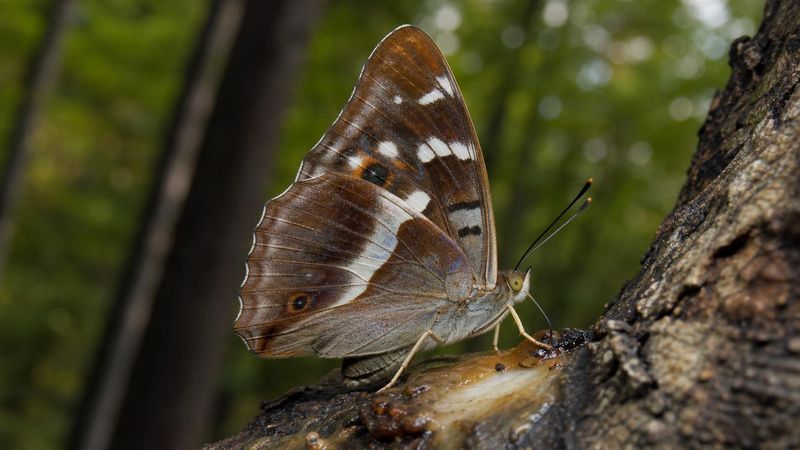
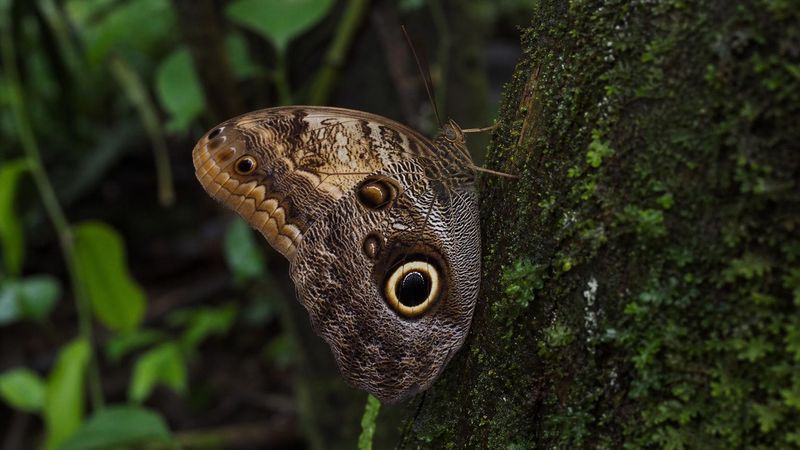
The underside of the wings is the complete opposite: brownish-grey with large "eyespots" (ocelli) precisely imitating owl eyes. When the butterfly settles and folds its wings, it instantly "disappears" — blending with bark or foliage.
The caterpillar is covered with red and green "hairs" and feeds at night, hiding under leaves by day.
Structural coloration
The blueness of morpho wings is not the result of pigment but an optical illusion created by the nanostructure of the scales. Under an electron microscope, each scale bears rows of miniature ridges with lateral cross-ribs — like a fir tree at nanometre scale. This structure interferes with light waves and reflects only the blue range (wavelength ~450 nm), absorbing the rest.
This is why the colour changes with viewing angle: head-on — saturated ultramarine; from the side — fades or shifts to violet. The wing cannot be "painted" blue chemically — structure matters more than pigment.
This principle inspires materials scientists to create structurally coloured paints, fabrics, and displays free of toxic dyes.
Range and habitat
The species lives in low-altitude humid tropical forests of South America: from Venezuela and Trinidad in the north to Bolivia and Brazil in the south. It stays mainly at elevations up to 1,500 m above sea level.
Males are territorial. They occupy forest clearings, stream banks, and sunlit glades, attacking intruding males. Females are more secretive: they keep to the forest canopy and only come into the open to feed.
Feeding and behaviour
Adult morphos lack the ability to drink nectar — the proboscis is too short. They feed on liquids from over-ripe and decomposing fruit, fungi, and secretions of decomposing organic matter. They readily fly to pieces of papaya, mango, banana.
Puddling (drinking from wet soil) is also characteristic of males. From wet mud they extract sodium and amino acids needed for spermatophore production.
In flight the morpho is slow and predictable — it alternates wingbeats and gliding, making it an easy target. However, a predator's attempts to catch a shimmering blue flash above the forest canopy often end in failure: the butterfly unexpectedly "disappears" when it folds its wings.
Reproduction
The female lays eggs singly on the leaves of leguminous trees. The caterpillars of the last few instars are nocturnal, hiding in groups under leaves by day. When disturbed, the caterpillars release an unpleasant-smelling secretion from glands. The chrysalis hangs vertically and outwardly resembles a green leaf with fine veins.
Conservation and threats
There is no global IUCN assessment. Large-scale deforestation in Amazonia is reducing the available habitat. In the past morphos were destroyed in huge numbers for jewellery and butterfly panels. Morpho menelaus itself is not listed on CITES (Appendix III Bolivia covers a different taxon, Morpho godartii lachaumei).
In several tropical countries "butterfly farms" breed morphos for tourist "butterfly gardens," reducing pressure on wild populations.
Interesting facts
- The wing structure of the morpho is studied by NASA and materials scientists for the development of nanocoatings, humidity sensors, and zero-energy displays.
- In flight the morpho is visible from an aircraft — the wing sheen is noticeable from heights of up to 250 metres.
- There are about 30 morpho species; M. menelaus is one of the largest. Another famous species — morpho Peleides — has a pale blue shimmer.
- A single adult male controls a stream-bank territory of up to 200 m² and chases off other males throughout the daylight hours.