Owl Butterfly
The owl butterfly Caligo memnon is a crepuscular nymphalid with large 'owl eyes' on its wing undersides, wingspan to 150 mm, in Central and South America.
Key facts
- Latin name
- Caligo memnon
- Family
- Nymphalidae
- Wingspan
- 130-150 mm
- Flight season
- Year-round
- Host plants
- Banana (Musa spp.), Heliconia (Heliconia spp.), Plantain (Musa × paradisiaca)
- Conservation status
- LCLeast Concern
Appearance
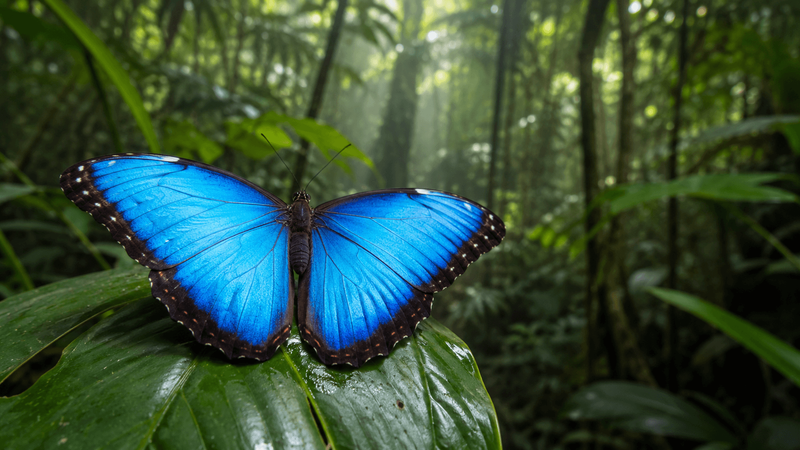
The owl butterfly (Caligo memnon) is one of the largest members of the subfamily Morphinae with a wingspan of 130–150 mm. The upper side of the wings is dark brown with a bluish or purplish sheen at the base and barely visible patterning.
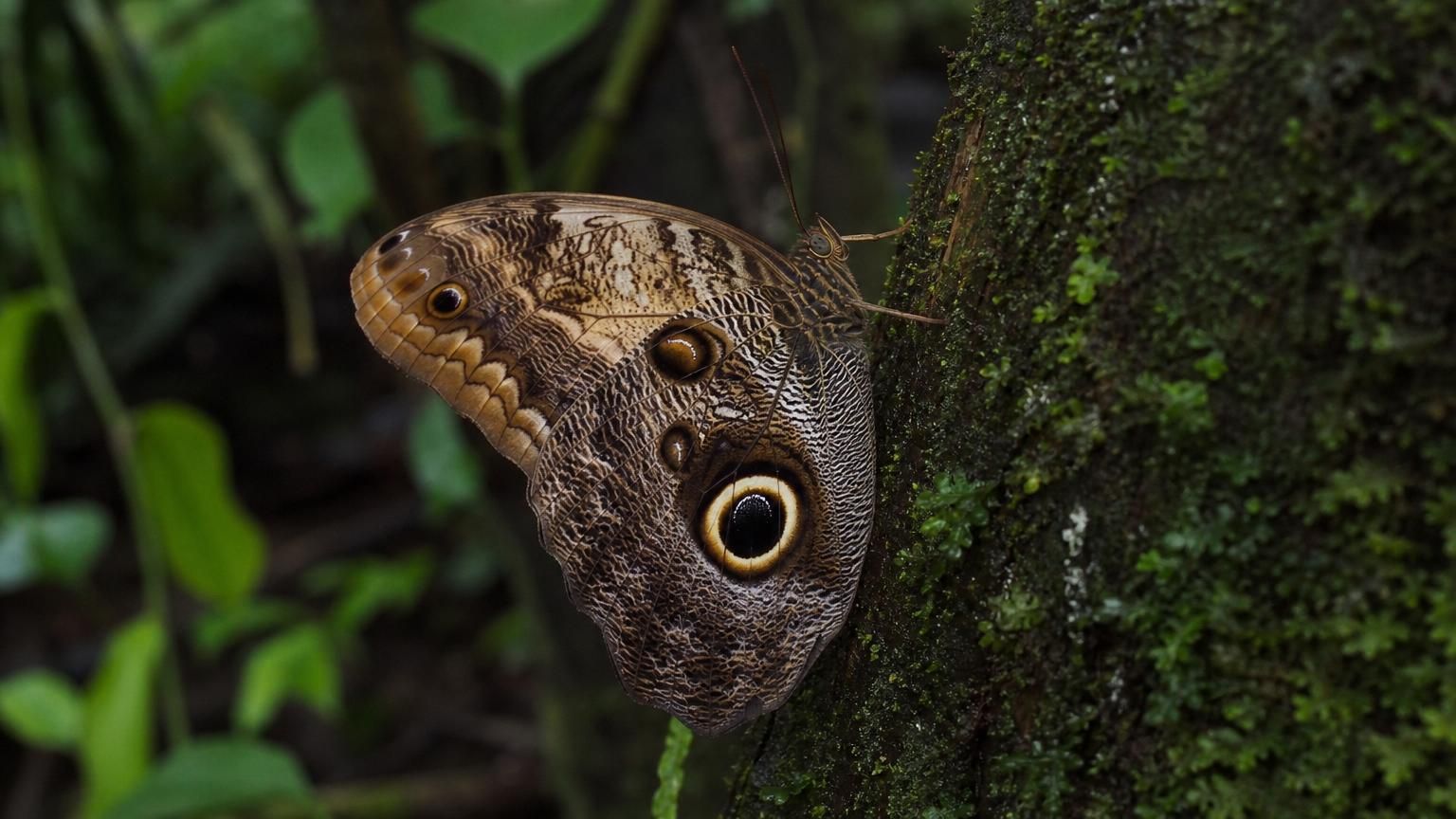
The main feature is the underside of the wings. The hindwings bear a huge pattern of two concentric circles precisely imitating an owl's eye: a yellow iris, black pupil, brown sclera with "lashes" of fine strokes. When the wings are folded, the butterfly camouflages as bark, but under threat it reveals its "owl face."
Defensive behaviour
When a predator approaches the resting butterfly, it abruptly opens its wings to expose a pair of "owl eyes." For a small bird or lizard the sudden appearance of a "predator's face" is a stress signal, forcing retreat. This technique works especially well at dusk, when owls are genuinely active.
Beyond the "eyes," the butterfly can sway from side to side, enhancing the illusion of a living creature. Some researchers believe the pattern primarily disorients the predator rather than frightening it — a large "eye" creates a false impression of the prey's orientation.
Range and habitat
The species is distributed from Mexico to Bolivia and Brazil. It inhabits humid tropical forests, mainly on plains and foothills up to 1,200 m above sea level. It is often found near banana plantations and river floodplains with heliconia thickets.
It stays close to the ground and in the forest understory. It likes shade and moisture — it is rarely encountered in open sunny places.
Feeding
Adult butterflies feed on the juice of over-ripe and rotting fruit. Over-ripe bananas, fermented mangoes, and fallen fruit are particularly attractive. The proboscis is adapted for sucking liquid substrate, not nectar from flowers.
Feeding occurs mainly during crepuscular hours. Groups of 5–20 individuals often gather at a single rotting fruit.
Life cycle
The female lays eggs in batches of 10–20 on the underside of banana or heliconia leaves. Young caterpillars live communally, eating the leaf from edge to centre. The mature caterpillar is large (up to 10 cm), brownish-green with a horn-like projection at the end of the abdomen and a characteristic "horn" on the head. The chrysalis hangs head-down and resembles a rotting leaf.
The full cycle from egg to adult takes about 60–70 days. On banana plantations there are several generations per year.
Tourism and science
The owl butterfly is one of the most popular species in tropical "butterfly houses" worldwide. Its large size, striking pattern, and relatively straightforward breeding have made it the standard of butterfly exhibitions in Europe, the USA, and Southeast Asia.
The "owl eye" pattern has become a classic subject of behavioural ecology research. Experiments have shown that predatory birds significantly less often attack butterflies with large ocelli compared to those whose pattern was obscured.
Interesting facts
- The genus name Caligo means "darkness, gloom" — reflecting the crepuscular lifestyle.
- On Costa Rican banana plantations Caligo memnon periodically erupts in outbreaks that damage crops.
- The closest relatives of the owl butterfly are the morphos: both genera belong to the subfamily Morphinae of the family Nymphalidae.