Orange Tip
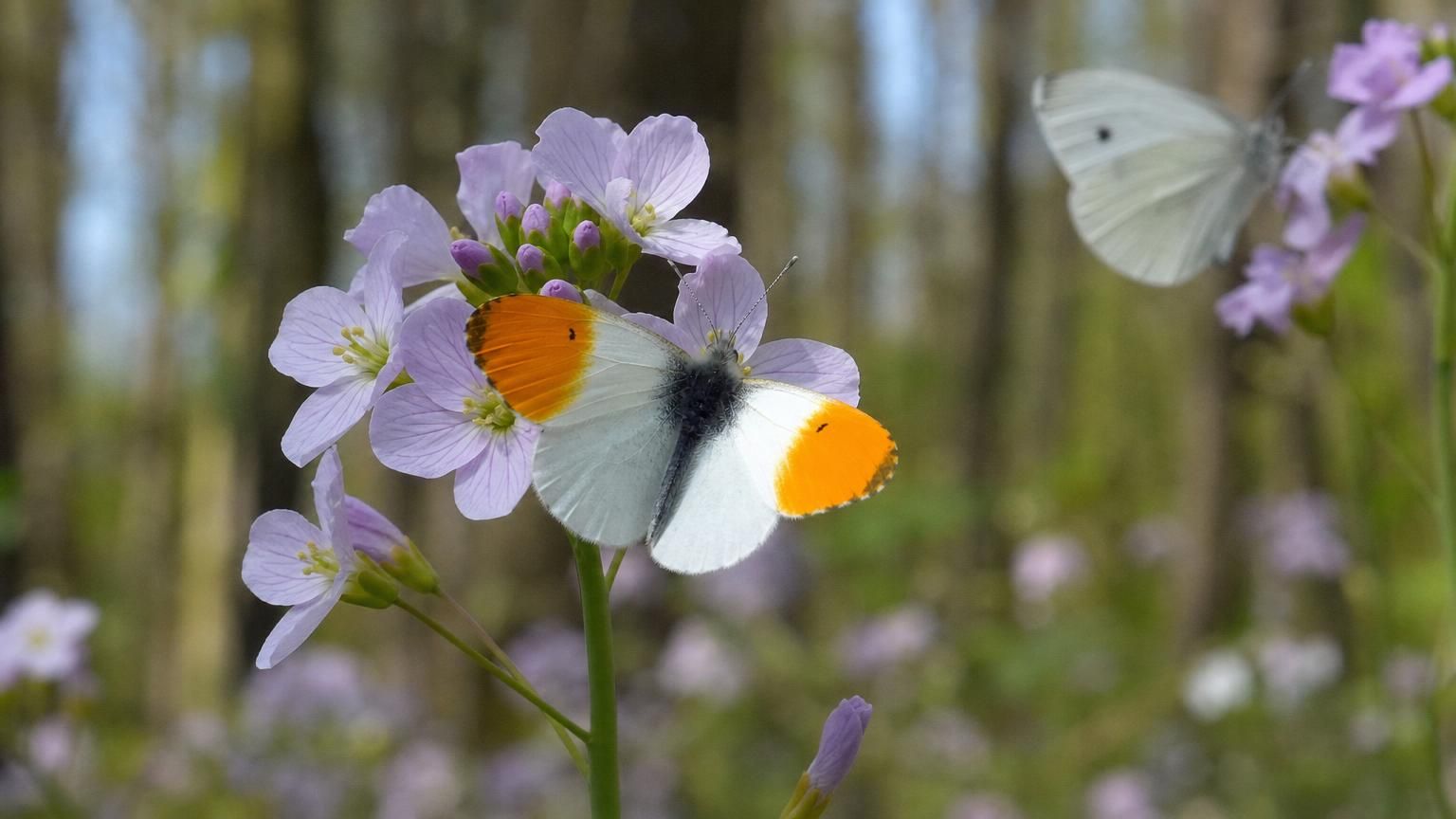
The orange tip is an early-spring white with an orange patch on the male's forewing. One of the first pierids to appear after snow melt.
Key facts
- Latin name
- Anthocharis cardamines
- Family
- Pieridae
- Wingspan
- 38-48 mm
- Flight season
- April — June
- Host plants
- Cuckooflower, Garlic mustard, Charlock, Hedge mustard
- Conservation status
- LCLeast Concern
Appearance
The orange tip (Anthocharis cardamines) is a small white with a wingspan of 38–48 mm. Sexual dimorphism is pronounced.
Male: white wings with a small black spot at the forewing tip and a large bright orange patch covering almost a third of the forewing.
Female: white wings without orange, with a small gray spot at the tip — similar to small white or green-veined white.
The underside of the hindwings in both sexes has a complex green marbled pattern — ideal camouflage in foliage.
Range and habitat
Widely distributed in Europe and temperate Asia. In Russia in forest and forest-steppe zones.
It lives on forest edges, floodplain woods, and along shaded forest roads. Tied to sites where crucifers and cuckooflower grow.
Life cycle
One generation per year. Flight April–June — one of the earliest spring species.
Eggs singly on flowers and ovaries of host plants. Caterpillar green with a white lateral stripe; it feeds on pods and seeds, not leaves. Pupa resembles a broken dry stem. Pupa overwinters.
Interesting ecology
The egg is laid on a flower: the caterpillar first eats the flower, then moves to seed pods. Feeding on seeds avoids competition with other whites whose caterpillars eat leaves.