Oleander Hawkmoth
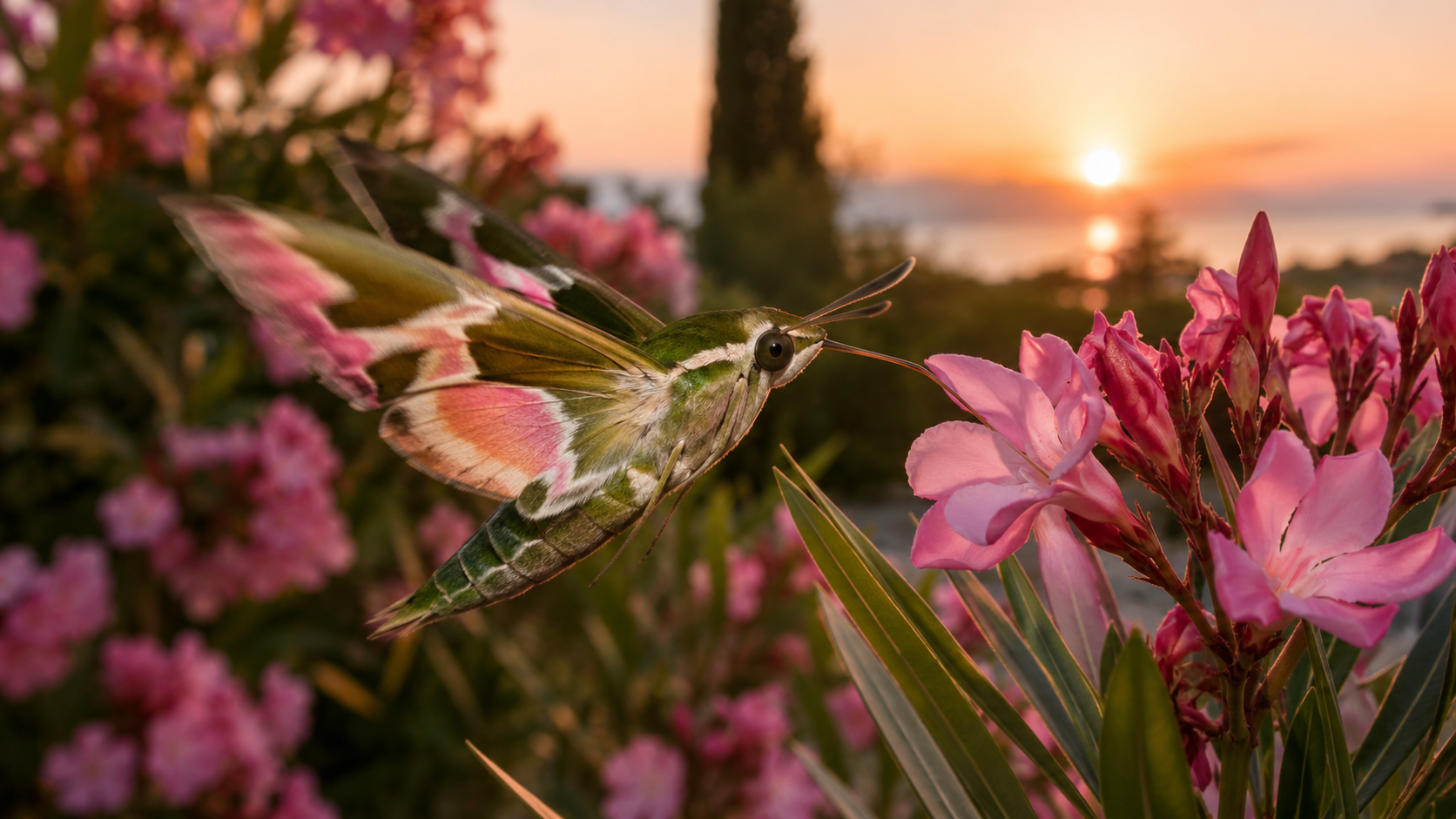
The oleander hawkmoth is a tropical sphingid, apple-green with pink bands, hovering at dusk over oleander. A Mediterranean resident, rare vagrant to Europe.
Key facts
- Latin name
- Daphnis nerii
- Family
- Sphingidae
- Wingspan
- 90-110 mm
- Flight season
- Year-round in tropics; June — September (vagrant)
- Host plants
- Oleander (Nerium oleander), Periwinkle (Vinca major, V. minor), Desert rose (Adenium obesum), Devil's trumpet (Thevetia peruviana)
- Conservation status
- LCLeast Concern
A jewel of the dusk garden
The oleander hawkmoth (Daphnis nerii) is among the most beautiful sphingids in the world. Its apple-green wings banded with pink and white look almost artificial — too vivid for a temperate garden, yet this is a real species, common at dusk around oleander bushes from the Mediterranean to tropical Asia. When it hovers at a flower, wings beating in a blur, the resemblance to a hummingbird is uncanny.
In northern latitudes, every record is an event. The species is a warm-climate resident that reaches central Europe and Russia only as a summer vagrant — but climate warming and the spread of ornamental oleander in gardens are making sightings more frequent.
Appearance and identification
Adult
Wingspan 90–110 mm. The dominant colour is bright green on both wings and body, with:
- A broad pink or buff band across the middle of the forewing
- White streaks along the wing veins and wing margins
- A tan or brown dorsal stripe along the thorax and abdomen
- Hindwings green with a dark border and a small eyespot near the anal angle
The body is streamlined and tapered — classic hawkmoth shape. Antennae are tapering and slightly clubbed at the tip.
In flight at dusk, the green and pink colours are vivid; at rest with wings folded, the moth blends surprisingly well among oleander leaves.
Caterpillar
A spectacular larva up to 100 mm long:
- Bright green body with small white dots
- A large blue "eye" surrounded by a white ring on the first abdominal segments — an aposematic false eyespot
- White diagonal stripes on the sides
- A yellow or orange horn on the final segment (harmless)
The caterpillar's warning coloration reflects its diet: oleander and periwinkle contain cardiac glycosides, which the larva stores and retains into adulthood at lower concentrations.
Distribution and habitat
Daphnis nerii is native to:
- Africa (north and sub-Saharan)
- Southern and Southeast Asia (India, Sri Lanka, Southeast Asia)
- The Mediterranean basin — resident and breeding in Spain, Italy, Greece, Turkey, the Levant, and North Africa
From these bases, adults disperse northward each summer. Regular vagrant records come from France, Germany, Britain, Scandinavia, and the Balkans. In Russia, the species is a rare visitor documented mainly from the North Caucasus, Krasnodar Krai, and the Black Sea coast; isolated records exist from more northern regions in exceptionally warm years.
The species does not overwinter in temperate climates. All northern caterpillars and adults perish in autumn frost.
Habitat
In its resident range, D. nerii inhabits coastal gardens, olive groves, river valleys, and urban plantings where oleander (Nerium oleander) or periwinkle (Vinca) grow. Oleander is widely planted as an ornamental shrub in Mediterranean towns — and increasingly in southern Russian resorts — providing consistent habitat.
Lifecycle
Eggs and larvae
Females lay single green eggs on the underside of oleander or periwinkle leaves. In the tropics and Mediterranean, breeding is continuous — multiple generations per year. In vagrant northern populations, eggs laid in July–August may produce caterpillars that pupate before autumn.
The caterpillar feeds openly, often on the youngest leaves and flower buds. Development through five instars takes three to four weeks in warm conditions. The final instar is conspicuous — gardeners frequently notice the large green larva on oleander before ever seeing the adult.
Pupa and adult
The pupa is smooth, brown, and formed in a shallow underground cell or among leaf litter at the base of the host plant. In resident populations, pupae may overwinter; in northern vagrant broods, the cycle completes in a single summer.
Adults emerge at dusk or after dark. They live two to four weeks, feeding on nectar from a range of flowers — not only oleander but also jasmine, honeysuckle, and other night-scented species.
Behaviour
Hovering flight
Like other sphingids, Daphnis nerii can hover stationary in front of a flower while uncoiling its long proboscis to drink nectar. The wingbeat is rapid and audible — a low hum on quiet evenings. This flight style, combined with the green body, produces the "hummingbird moth" effect that surprises observers unfamiliar with hawkmoths.
Activity period
Primarily crepuscular — active at dusk and dawn, with some night activity. Unlike many dull-coloured noctuids, the oleander hawkmoth's bright coloration is displayed in low light when vertebrate predators are less visually acute.
Attraction to light
Adults come to artificial lights and are sometimes found at windows in Mediterranean towns. Northern vagrant records often involve lighted buildings on warm summer nights.
Oleander and toxicity
Oleander (Nerium oleander) is one of the most toxic common garden plants — all parts contain cardiac glycosides that can be fatal if ingested by humans or livestock. The oleander hawkmoth caterpillar sequesters these compounds, making it distasteful to birds and parasitoids.
This is a classic aposematic system: bright colour (green + blue eyespot) signals unpalatability. Birds that sample a caterpillar typically reject it and avoid similar-looking larvae thereafter.
Adults retain some toxins but at much lower concentration. They are harmless to handle, though handling any wild insect is best avoided.
Comparison with other hawkmoths
| Species | Size | Key feature | Status in Russia |
|---|---|---|---|
| Daphnis nerii | 90–110 mm | Green and pink bands | Rare vagrant |
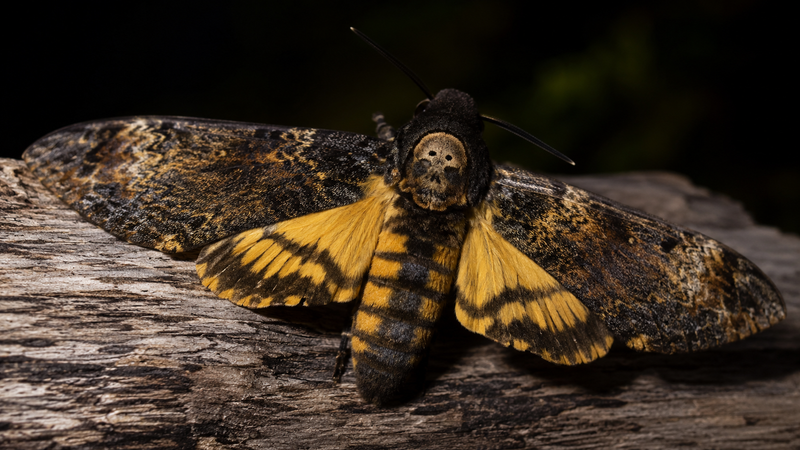
| Acherontia atropos | 90–130 mm | Skull thorax marking | Regular migrant |
| Hyles euphorbiae | 60–70 mm | Olive and pink, spurge feeder | Local resident (south) |
| Deilephila elpenor | 45–55 mm | Pink and olive elephant hawkmoth | Widespread |
The oleander hawkmoth is the largest and most vividly coloured of the regularly reported green hawkmoths in Europe.
Conservation
Daphnis nerii is Least Concern globally — abundant and widespread in its resident tropical and Mediterranean range. It requires no specific conservation measures.
In northern Europe and Russia, the species has no resident population to protect. Its increasing vagrant frequency is linked to climate warming and ornamental oleander planting rather than to local breeding establishment.
Gardeners in southern Europe who wish to support the species can plant oleander or periwinkle — the moth will find them. Pesticide-free cultivation is essential; systemic insecticides on oleander kill caterpillars directly.
Interesting facts
- Daphnis nerii was first described by Carl Linnaeus in 1758 — among the earliest hawkmoths named in modern taxonomy
- The genus name Daphnis refers to a shepherd in Greek mythology; nerii means "of the oleander" (Nerium)
- In India and Sri Lanka, the species is common in gardens and often photographed at oleander — it is one of the most frequently illustrated hawkmoths in Asian field guides
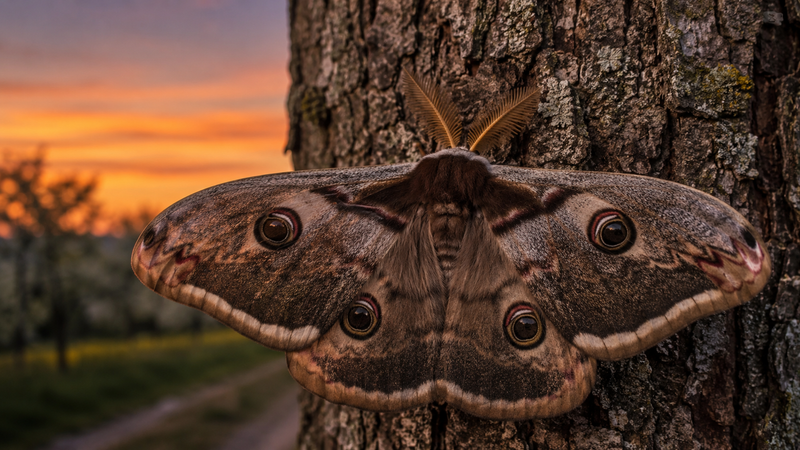
- The blue "eye" on the caterpillar is not a real eye — it is a pigment patch that mimics a vertebrate eye to startle predators (another form of mimicry, like the great peacock moth's wing eyespots)
- Some observers confuse the oleander hawkmoth with the hummingbird hawk-moth (Macroglossum stellatarum) — a much smaller day-flying sphingid common in Europe; the oleander hawkmoth is larger, greener, and active at dusk
- Caterpillars occasionally appear on indoor oleander plants in northern Europe — brought in as eggs on nursery stock from the Mediterranean