Great Peacock Moth
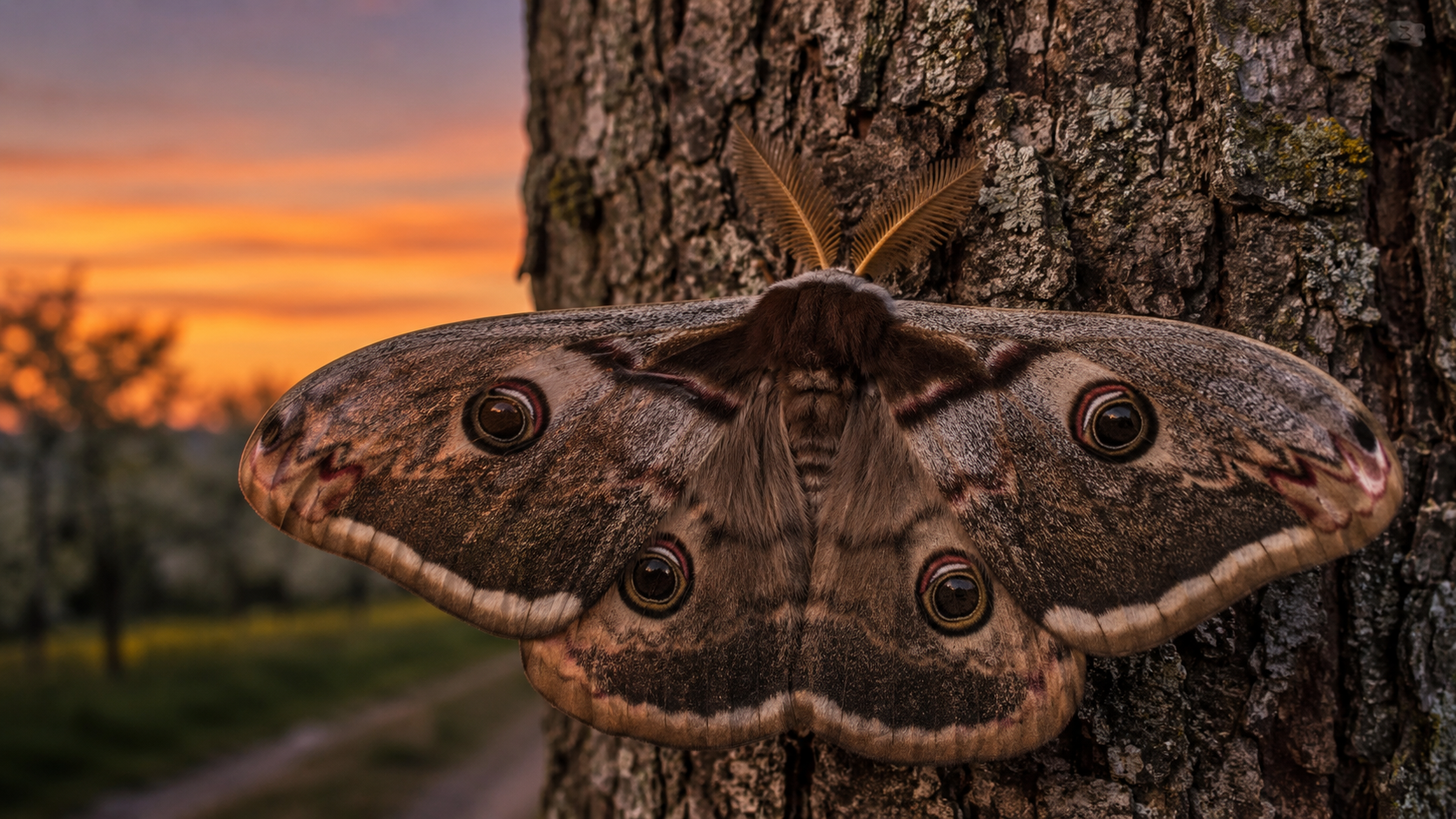
The great peacock moth is Europe's largest nocturnal moth — a saturniid with a wingspan up to 15 cm, striking eyespots, and antennae detecting females afar.
Key facts
- Latin name
- Saturnia pyri
- Family
- Saturniidae
- Wingspan
- 80-150 mm
- Flight season
- April — May (single generation)
- Host plants
- Pear (Pyrus communis), Apple (Malus domestica), Plum and cherry (Prunus spp.), Blackthorn (Prunus spinosa), Hawthorn (Crataegus spp.), Willow (Salix spp.), Ash (Fraxinus excelsior), Privet (Ligustrum vulgare)
- Conservation status
- LCLeast Concern
Europe's largest nocturnal moth
The great peacock moth (Saturnia pyri) holds a straightforward superlative: it is the largest nocturnal moth native to Europe. Females with a wingspan of 15 cm are larger than many songbirds. Males are smaller but equipped with antennae so sensitive that they can detect a female's pheromone plume from several kilometres away — one of the most extreme examples of chemical communication in the insect world.
Despite its size, the species is not rare in suitable habitat. It breeds on common fruit trees and hedgerow shrubs across much of temperate Europe and western Russia, and adults are regularly found at lighted windows on spring evenings.
Appearance and identification
Adult
Sexual dimorphism is pronounced:
| Feature | Male | Female |
|---|---|---|
| Wingspan | 80–120 mm | 120–150 mm |
| Antennae | Large, feathery (bipectinate) | Thread-like, much smaller |
| Abdomen | Slimmer | Bulky, egg-filled |
| Activity | Flies actively at dusk, seeks females | Sits on tree trunk, emits pheromone |
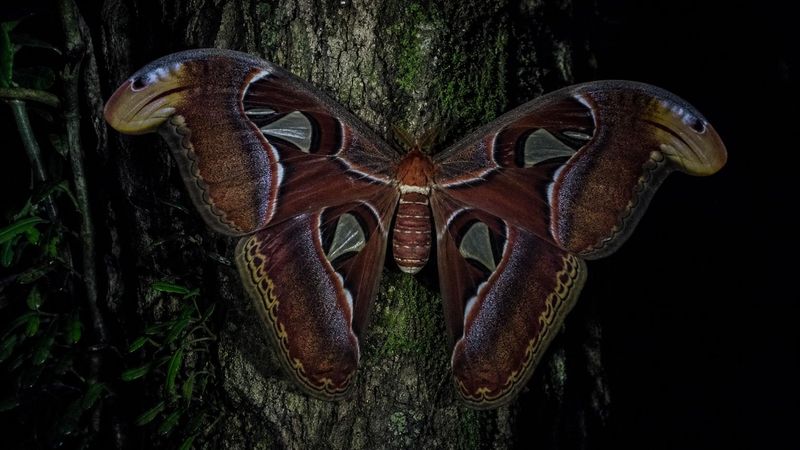
Both sexes share the same wing pattern: grey-brown forewings with wavy darker lines and a large transparent-centred eyespot near the wing tip. Hindwings are orange-brown with a similar eyespot and a pinkish or yellowish outer margin. The body is thick and covered in pale brown fur.
At rest, the moth holds its wings roof-like over the body, hiding the brighter hindwing colours. When startled, it drops the wings flat and exposes all four eyespots simultaneously.
Caterpillar
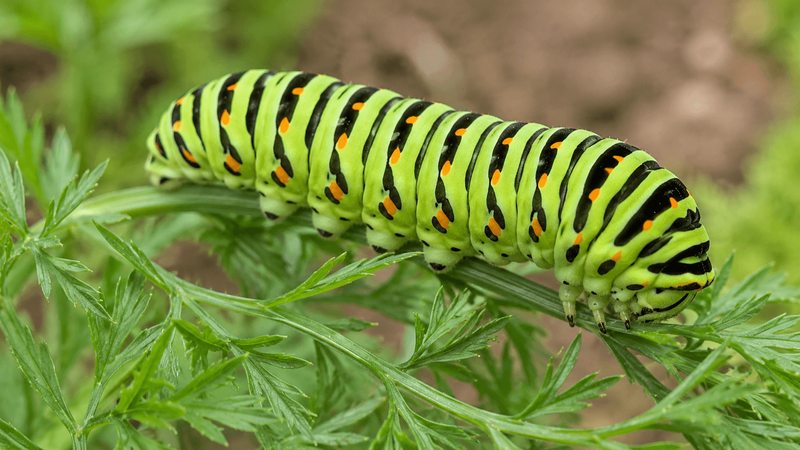
A large, blue-green caterpillar up to 100 mm long, covered with small yellow tubercles each bearing a black bristle. A characteristic feature is a horizontal yellow stripe along each side, often with blue spots within it. The horn on the final segment is short and harmless.
Older larvae are conspicuous on host trees in late summer and autumn — often on pear and apple in orchards, where their presence is noticed by fruit growers.
Distribution and habitat
Saturnia pyri occurs across temperate Europe from the Iberian Peninsula and Britain eastward to western Russia, the Urals, and the Caucasus. It is absent from northern Scandinavia and the far north of Russia.
The species favours mixed landscapes with mature fruit trees, hedgerows, parkland, and river valleys with willow and ash. Orchards, old gardens, and forest edges are prime habitat. In Russia it is most common in the European part — Central Russia, the Volga region, and the south — and becomes scarcer toward the taiga zone.
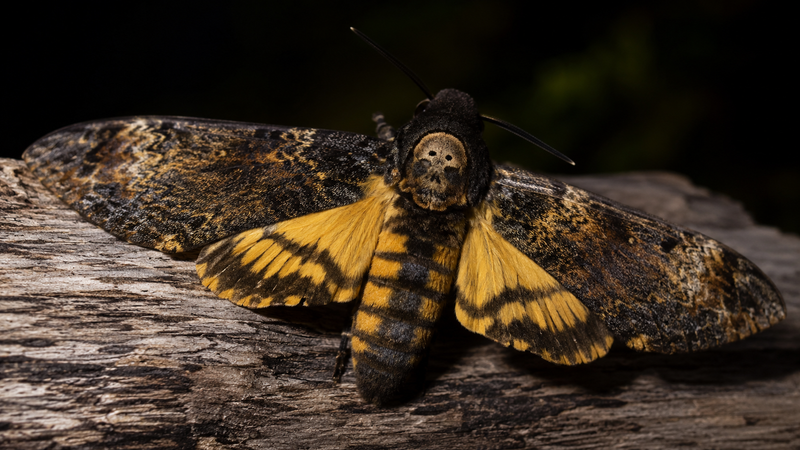
Unlike the migrant death's-head hawkmoth, the great peacock moth is a resident breeder wherever it occurs.
Lifecycle
Timing
A single generation per year in most of the range. Adults fly in April and May — among the earliest large moths of spring. Timing is closely tied to leaf burst on host trees: eggs are laid on fresh foliage, and caterpillars feed through summer and autumn.
Eggs and larvae
Females lay 50–200 eggs in neat rows or clusters on twigs and leaves of host plants. The eggs are oval, white to yellow, and hatch in about two weeks.
Caterpillars feed gregariously in early instars, spreading out as they grow. They pass through five instars from June to October. Before pupation, the fully grown larva descends the tree, spins a tough silken cocoon among leaf litter, in soil crevices, or attached to low vegetation, and pupates inside.
Pupa and adult
The pupa is dark brown and robust, enclosed in the cocoon. It overwinters through frost and emerges the following spring when temperatures rise — typically triggered by a combination of warmth and humidity.
Adult emergence is at dusk or after dark. The moth pumps fluid into the wings, rests briefly, and males begin searching for females. Females remain on or near the emergence site, releasing pheromones that males detect with their feathery antennae.
Pheromone detection
Male great peacock moths have antennae with thousands of sensory hairs (sensilla) tuned to the female's sex pheromone — a single chemical compound, (E,E)-10,12-hexadecadienal. In calm conditions, a male can detect a female from 2–4 km away, flying upwind along the pheromone gradient in a zigzag search pattern.
This system was studied intensively by Nobel laureate Adolf Butenandt and colleagues in the 1950s–60s, who first identified and synthesised an insect sex pheromone using Saturnia and the related silkworm moth Bombyx mori as model species.
Behaviour
Adult activity
Adults are crepuscular and nocturnal. They are strongly attracted to artificial light — many observations come from moths at house windows and street lamps in April and May. Daytime resting sites are tree trunks, fence posts, and walls, where the cryptic folded-wing posture blends with bark.
Because adults do not feed, they invest nothing in finding nectar. Their entire adult existence is devoted to reproduction.
Defensive display
When disturbed, the moth fans its wings to expose the eyespots and may produce a hissing sound by rubbing wing scales against the abdomen — a secondary defence alongside visual startle.
Relationship to orchards
Caterpillars can defoliate branches of pear, apple, and plum, but outbreaks are usually local and rarely cause lasting tree damage. In commercial orchards, populations are often controlled; in biodiversity-rich gardens and traditional orchards, the great peacock moth is valued as a spectacular native species.
In Russia and eastern Europe, old peasant orchards (сад-терем) and hedgerow fruit trees remain important strongholds as intensive agriculture replaces mixed farming.
Conservation
Saturnia pyri is listed Least Concern globally. It remains widespread but has declined in parts of western Europe — Britain, the Netherlands, and parts of Germany — due to orchard loss, pesticide use, and removal of hedgerow trees.
In Russia and eastern Europe, populations appear more stable where traditional orchards and forest edges persist. The species is not protected in most jurisdictions but benefits from pesticide reduction and retention of mature fruit trees in rural landscapes.
Interesting facts
- The specific name pyri means "of the pear tree" — the species' classic host plant noted by Linnaeus
- Despite the name "peacock moth," it is unrelated to the day-flying peacock butterfly (Aglais io) — both share eyespot patterns through convergent evolution
- Cocoons are so tough that they sometimes survive for years in leaf litter; empty cocoons are often found long after the adult has emerged
- In France, the great peacock moth is called paon de nuit ("night peacock") — the same conceptual link between eyespots and peacock feathers
- A single female can lay enough eggs to produce caterpillars that consume several metres of branch foliage — yet the species rarely reaches pest status because natural enemies (parasitoids, birds) limit populations