Europe
Butterflies of Europe: about 500 day-flying species, from the Mediterranean to the Arctic. Alps, Mediterranean, islands — the continent's richest regions.
Butterflies of Europe in numbers
Europe is a small continent with a temperate climate, and its Lepidoptera fauna is considerably poorer than that of the tropics. About 500 species of day-flying butterflies (Papilionoidea) occur across the continent, of which individual countries have 100–200. For comparison: one hectare of Amazon forest often contains more species than all of Western Europe.
Nevertheless, Europe is well studied entomologically — every species is documented, ranges are known to district level, making it an ideal region to begin observing.
Zones of species richness
Species diversity increases sharply from north to south.
Northern Europe (Scandinavia, Finland, Baltic states): 60–100 species. Short summers reduce the season to 3–4 months. Arctic and subarctic species are characteristic: satyrs (Erebia), bog ringlets (Coenonympha tullia), sulphurs.
Central Europe (Germany, Poland, Czech Republic): 130–180 species. Moderately continental climate. The fauna is dominated by meadow whites, nymphalids, and blues; in the Alps and Sudetes — Apollo and high-mountain satyrs.
Mediterranean (southern France, Spain, Italy, Greece, Balkans): 300–400 species. Hot summers and mild winters allow 3–4 generations per year. Most European endemics — species not found outside the region — are concentrated here.
Europe's richest regions
Alps and Pyrenees
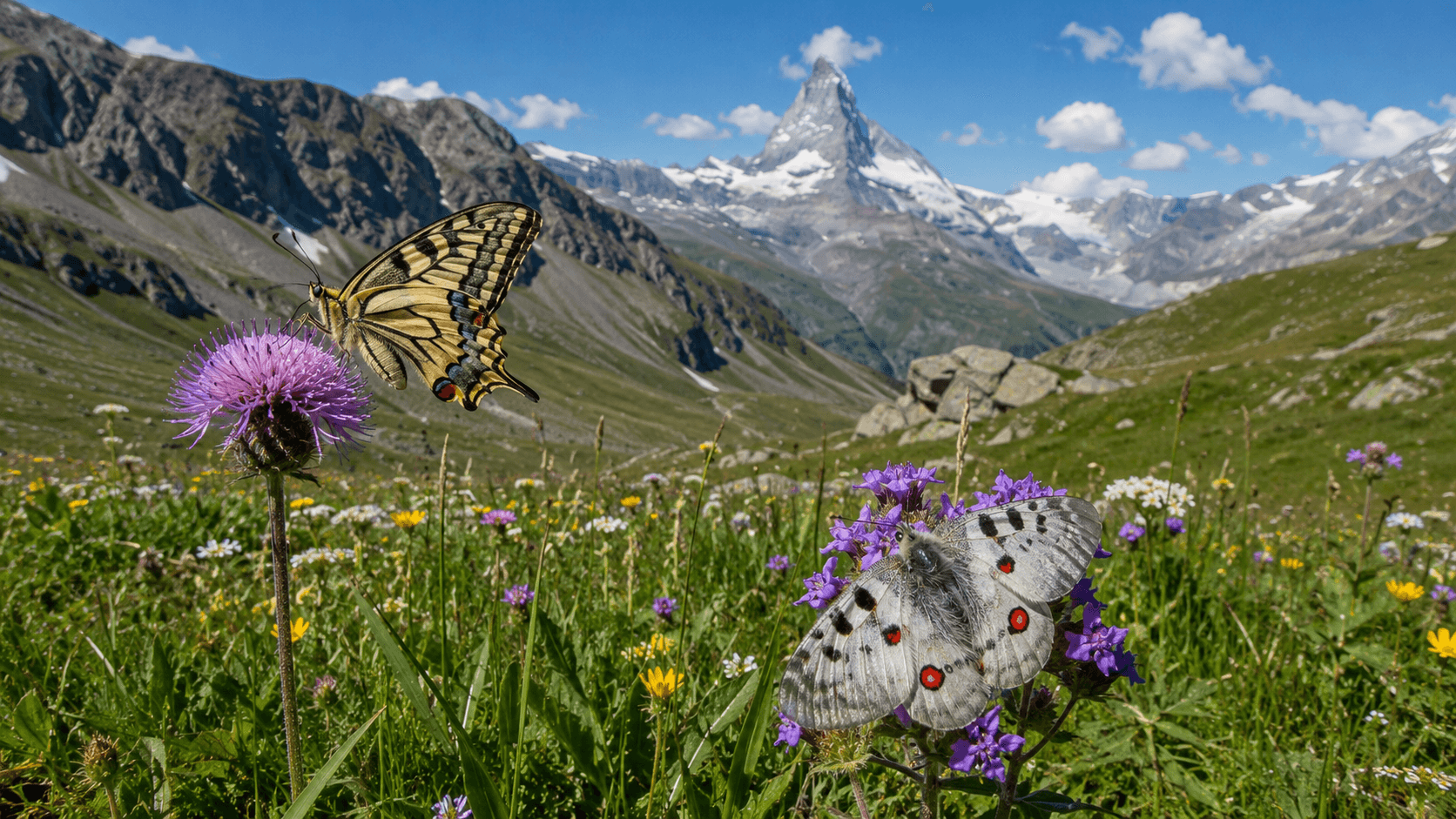
Mountain systems are biodiversity "islands". About 200 species of day-flying butterflies occur in the Alps, including:
- Apollo (Parnassius apollo) — on alpine meadows with stonecrop
- Clouded Apollo (Parnassius mnemosyne) — in subalpine forests with Corydalis
- Numerous satyrs (Erebia) — each altitudinal belt has its own set of species
- Mountain Clouded Yellow (Colias phicomone) — above 1,500 m
- Mountain blues: Polyommatus eros, Agriades glandon, and others
Mediterranean Greece and Turkey
The Balkan Peninsula and Anatolia are a crossroads of European, Middle Eastern, and Central Asian faunas. Up to 400 species occur here, including many endemics. The mountain areas of the Peloponnese and central Greece are among the best places in Europe for observation.
Iberian Peninsula
Spain and Portugal have high endemism: several species of blues, checkerspots, and fritillaries occur only here. Mountain areas are especially rich — the Pyrenees, Sierra Nevada, Cantabrian Mountains.
Carpathians and Balkans
A buffer zone between Central and Eastern Europe. Relatively sparsely populated mountain territories have preserved extensive meadows and old forests. Several East European species rare or absent further west occur here.
Characteristic European species
Black-veined White (Aporia crataegi) — white with dark veins; a common species of gardens and forest edges, forming population outbreaks.
Orange Tip (Anthocharis cardamines) — the first early-spring white; male with a bright orange "spot" on the forewing.
Common Blue (Polyommatus icarus) — the most common "blue" in Europe; male blue, female brown.
Ethiopian Ringlet (Erebia aethiops) — one of the most widespread species of the genus in mountains and foothills.
Red Admiral (Vanessa atalanta) — a migratory species; migrates from North Africa and southern Europe to Central and Northern Europe each spring.
Painted Lady (Vanessa cardui) — the most widely distributed species in Europe and the world; in good years forms enormous migration streams.
European species under threat
Europe has a well-established butterfly monitoring system. According to the European Butterfly Monitoring Scheme (eBMS), butterfly numbers on meadows have declined by 39% over the last 30 years. Meadow specialists have suffered especially.
Large Blue (Phengaris arion) — requires the simultaneous presence of thyme and ants of the genus Myrmica. It became extinct in Britain in 1979 and was successfully reintroduced from Sweden in 1983–84 — one of the clearest examples of successful species recovery.
Clouded Apollo (Parnassius mnemosyne) — disappeared from many areas due to forest encroachment on subalpine meadows.
Marsh Fritillary (Euphydryas aurinia) — sharp population decline due to drainage of wetlands and cessation of mowing on wet meadows.
Islands
European islands have impoverished but often endemic faunas:
- Corsica and Sardinia: several endemic subspecies or species, including Hipparchia neomiris
- Canary Islands: several endemic species; unique environment due to altitudinal zonation in a warm climate
- British Isles: about 60 resident species — very few for Western Europe; explained by isolation and unstable climate
Best time for observations
- Early spring (March–April): overwintered species — Small Tortoiseshell, Peacock, Brimstone, Mourning Cloak
- Late spring (May): peak diversity in Central Europe; in the Mediterranean — already warm
- Summer (June–July): greatest species richness in the Alps and Balkans
- Late summer (August): migrants — Painted Lady and Red Admiral — at peak abundance
For the fauna of Russia as part of the European zone — see the Russia section.
See also