Africa
Butterflies of Africa: about 3,500 day-flying species, from the Sahara to the Congo rainforests. Madagascar, East African Rift, Cape — the richest regions.
Africa — the second richest continent
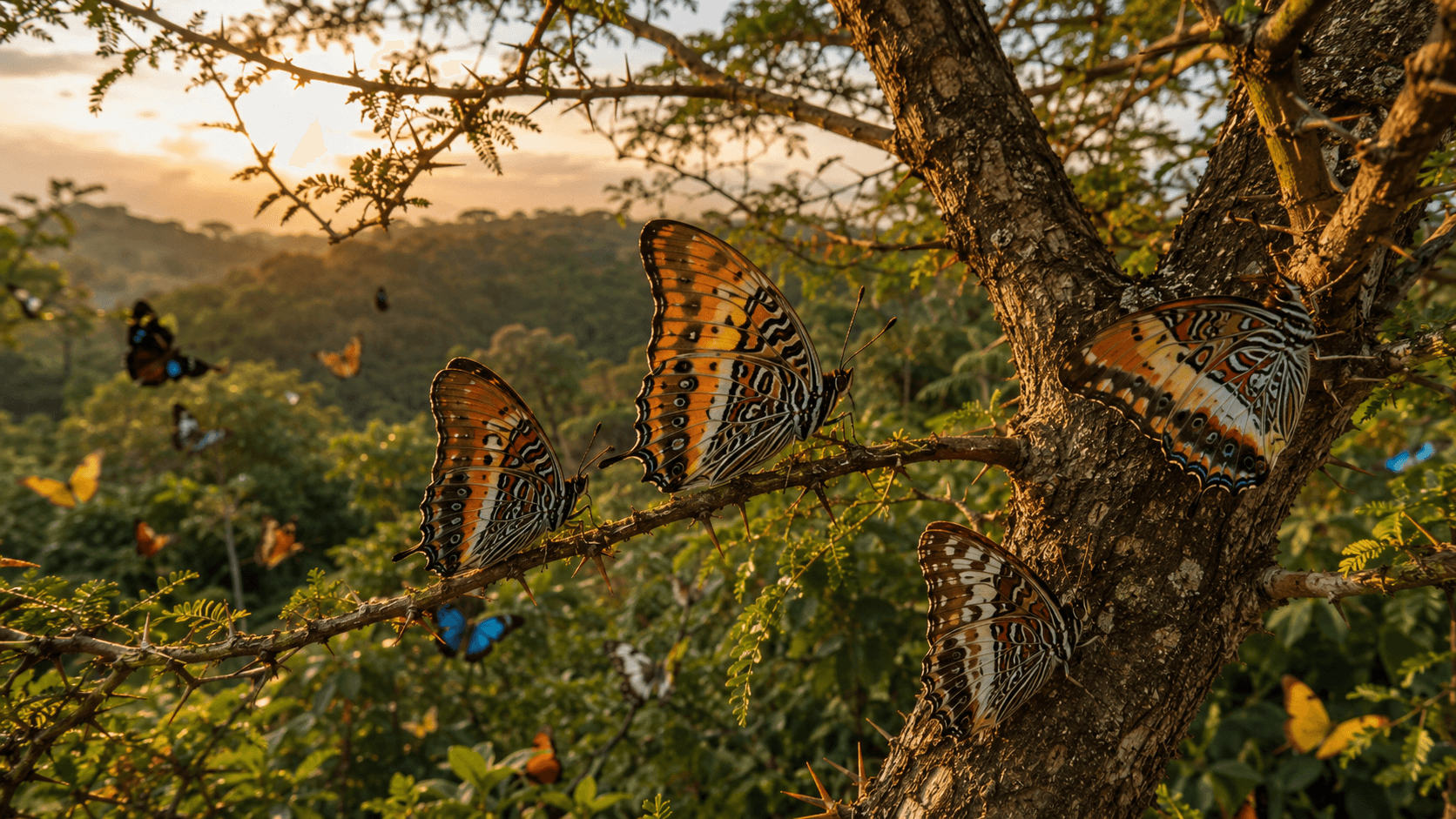
In number of day-flying butterfly species, Africa ranks second only to South America: an estimated 3,000–3,500 species of Papilionoidea, concentrated mainly in the humid tropical forests of the centre and west of the continent. For comparison: all of Europe has about 500 species.
The fauna of Africa is divided into several zoogeographic zones. Tropical Africa south of the Sahara — the Afrotropics — is an independent biome with a high level of endemism. The Sahara is a barrier separating Afrotropical fauna from the Palaearctic (Mediterranean, North Africa). Madagascar is distinguished as a separate zone due to centuries of isolation.
Zones of species richness
Congo Basin and Guinean forests
The equatorial forests of Central Africa are the core of African biodiversity. More than half of all Afrotropical species are concentrated in the Congo Basin. Constant humidity, absence of a dry season, and a multi-layered forest canopy create conditions for specialisation: each species is tied to its own layer, plant, and microhabitat.
Characteristic species:
- Goliath Birdwing — in fact not an African but a Papuan species, but in the Congo several large Papilio with wingspans up to 15 cm occur: Papilio antimachus — Africa's largest day-flying swallowtail (up to 25 cm wingspan), males with narrow elongated black-rufous wings, poisonous
- Charaxes — "rajahs" of Africa: large nymphalids with fast flight, often attracted to carrion and overripe fruit; more than 150 species of this genus in Africa
- Acraea — numerous Afrotropical genus with bright red-white or orange colouration; often poisonous or unpalatable to birds
- Belenois — African "whites", forming mass migrations in the dry season
East African Rift and mountains
The mountain system from Ethiopia to Zimbabwe is a zone of high endemism. The uplifted massifs of Kilimanjaro, Kenya, and Rwenzori act as "islands" isolating populations. The following occur here:
- High-mountain nymphalids of the genera Ypthima and Bicyclus — steppe and montane species
- Endemic swallowtails: Papilio desmondi, Papilio jacksoni — only in the mountain forests of East Africa
- Papilio nireus — "green swallowtail": black with a broad green-blue band; one of Africa's most beautiful species
Madagascar
Madagascar is one of the world's biodiversity hotspots. About 300 species of day-flying butterflies occur on the island, more than half of which are endemics found nowhere else. Isolation of more than 88 million years led to independent evolution of the fauna.
Features of the Malagasy fauna:
- Chrysiridia rhipheus (Madagascan sunset moth) — technically a nocturnal moth, but flies by day; iridescent in all colours of the rainbow; considered one of the world's most beautiful butterflies
- Endemic Papilio — 8 species, 6 of which occur only on Madagascar
- The danaine family (Danaidae) is represented by several local forms, including Amauris — unpalatable species serving as "models" for Batesian mimicry in other butterflies
Cape and southern Africa
The Cape Floristic Region (Fynbos) in southern South Africa is a special biome with unique vegetation. About 650 species of day-flying butterflies are concentrated here — a high density for a temperate climate.
- Aloeides and Erikssonia — small blues, many endemic to fynbos
- Colias electo — African sulphur; widespread across southern Africa
- Junonia octavia — seasonal polymorphism: dry form (orange) and wet form (blue) differ so much they were long treated as different species
Features of African fauna
Mass migrations
Several African species form migrations comparable to the American monarch. Belenois aurota — "African Caper White" — each year in October–November migrates from north to south across eastern Africa in billion-strong streams. In Zimbabwe and Zambia on migration days butterflies form a solid white cloud on the horizon.
Catopsilia florella — "African Migrant" — another mass migrant; crosses the Sahara in both directions.
Danaine-type mimicry
Complex "mimicry rings" form in Africa: unpalatable Acraea and Amauris (danaines) serve as "models", and several species from different families — Papilio dardanus, various nymphalids — evolved as similar "mimics". Papilio dardanus is a classic object of mimicry study: females have up to 14 different forms in different parts of the range, each mimicking a local unpalatable species.
Resource pulses
In savanna and bushveld, the rainy season triggers an explosion of vegetation — and a wave of butterflies follows. Within weeks of the rains starting, thousands of Byblia, Junonia, Precis, and whites appear on clearings. This is "butterfly season" for observers.
Threats and conservation
Deforestation of the Congo rainforests is the main threat. Unlike the Amazon, destruction of Congo forests receives less media coverage, but deforestation rates are high. Species with narrow ranges — especially mountain endemics — are vulnerable to climate change: "islands" of upland forest are shrinking from below.
Papilio antimachus is listed in CITES Appendix II due to collector demand: a trophy butterfly for European and Japanese collectors.
Madagascar has lost about 90% of its primary forest. This is catastrophic for endemic fauna — most Malagasy endemics depend exclusively on primary forest.
What to look for in Africa
Best regions:
- Uganda, Rwanda — highly diverse mountain and foothill forests; combination of forest Papilio and danaines
- South Africa (KwaZulu-Natal) — about 800 species in one province; best location south of the equator
- Madagascar — for endemics; best practice — Ranomafana and Masoala national parks
- Ethiopian Highlands — mountain species unavailable in other regions
Best season: end of the rainy season (in the south — February–March, north of the equator — September–October), when plants are in flower and butterflies are most active.
See also