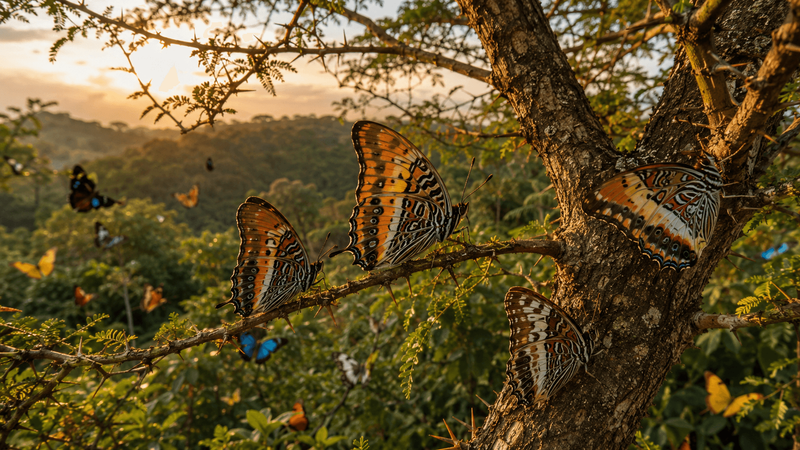
Butterflies of Cameroon
Cameroon — Africa in miniature: mangroves, Sahel scrub, Congo rainforest. Around 900-1,000 species at the junction of West and Central Africa.
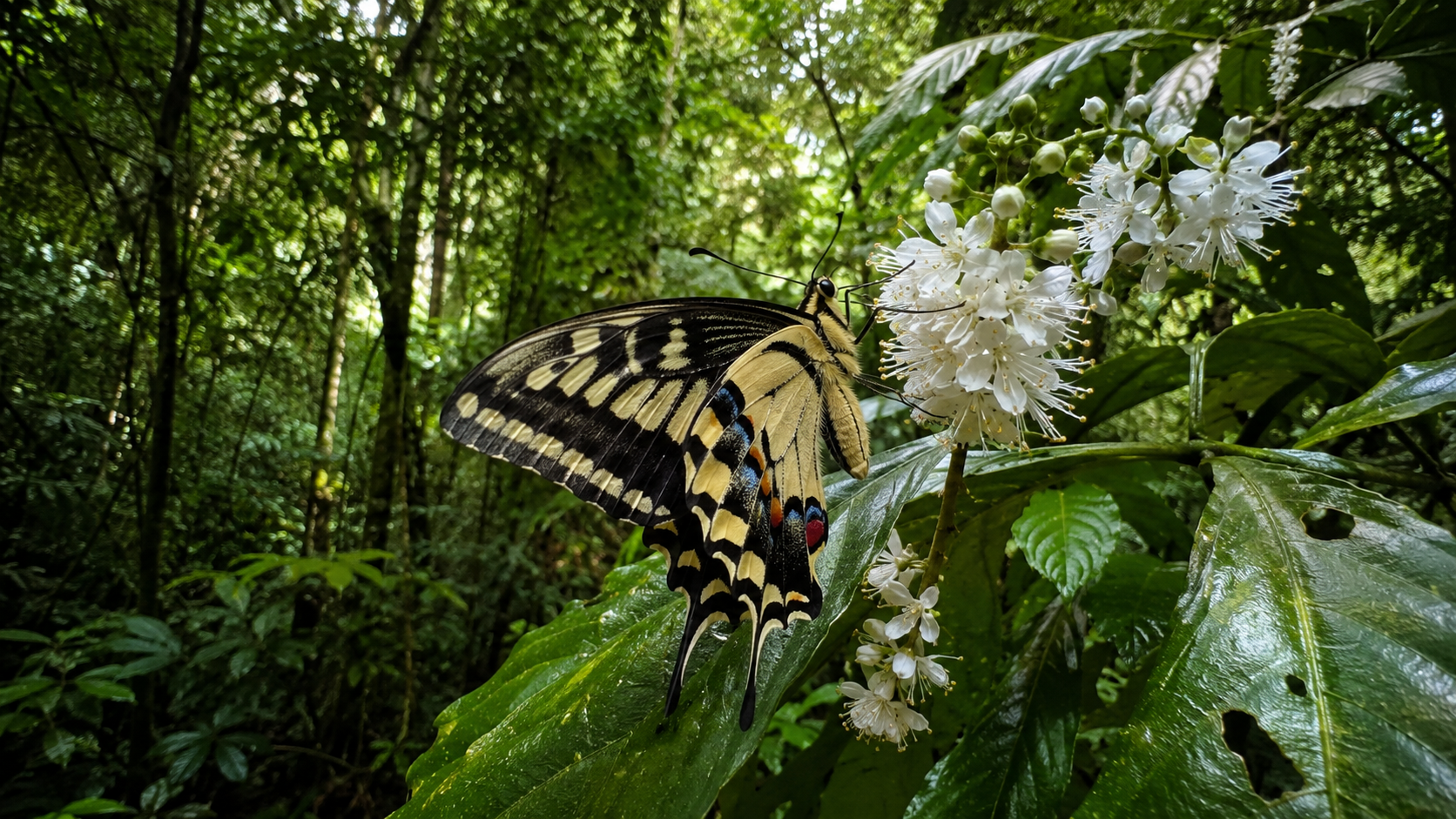
Africa in miniature
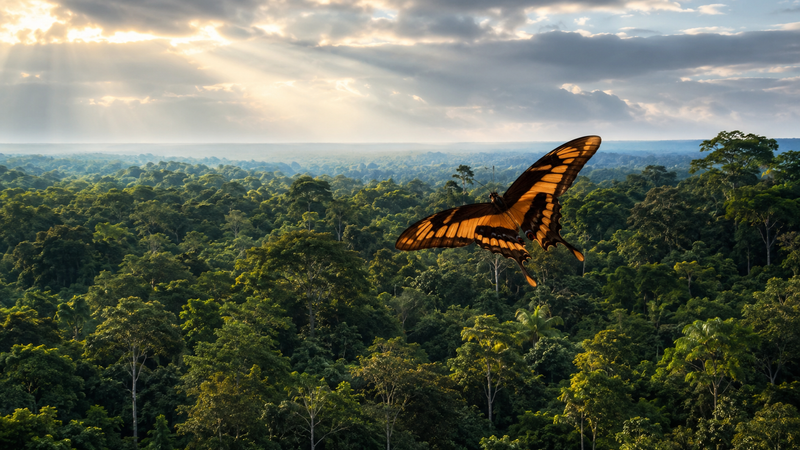
Cameroon's nickname — "Africa in miniature" — reflects one of the most compressed environmental gradients on the continent. Within its 475,000 km², the country transitions from the Atlantic coast and mangrove estuaries, through lowland rainforest, montane cloud forest, forest-savannah mosaic, Guinea savannah, and eventually to the semi-arid Sahel at the northern border with Chad. Each zone has its own butterfly fauna, and the country sits precisely at the junction between the West African and Central African faunal provinces — the meeting point of two of the continent's great butterfly regions.
With approximately 900–1,000 recorded species, Cameroon ranks among the most butterfly-diverse countries in Africa. This figure continues to rise as surveys penetrate previously unexplored areas of the eastern and northern forests.
The West-Central African junction
The biogeographic position of Cameroon is its defining characteristic for butterflies. To the west and north lie the Upper Guinea forests and the savannah corridors that separate them from the Congo Basin; to the south and east, the country merges into the vast Congo Rainforest — the largest tropical forest in Africa and the second largest on Earth after the Amazon.
Many butterfly genera — particularly Cymothoe, Charaxes, Euphaedra, and various Papilio — reach their maximum diversity at this junction. Species from both the West African and Congo Basin lineages co-occur in Cameroonian forests, making comprehensive species lists exceptionally long.
Korup National Park
Korup National Park (1,260 km²) in the southwestern corner of Cameroon is among the most biodiverse nature reserves in Africa and arguably the single most important site for butterfly study in the country. Its forests have never experienced the major climatic disruptions that affected other African forest regions during Ice Age drying events, providing continuity that supported unique and ancient lineages.
Key highlights:
- Cymothoe forest glories: the genus reaches exceptional diversity in Korup, with a dozen or more species co-occurring. Males of different species display brilliant red, orange, blue, or yellow upper surfaces; females are dramatically different. Korup holds several species found nowhere else.
- Charaxes emperors: large, powerful, fast-flying nymphalids with spectacular wing undersides. Korup's Charaxes community is one of the most diverse in Africa; baiting with fermenting fruit at forest clearings is a standard survey technique.
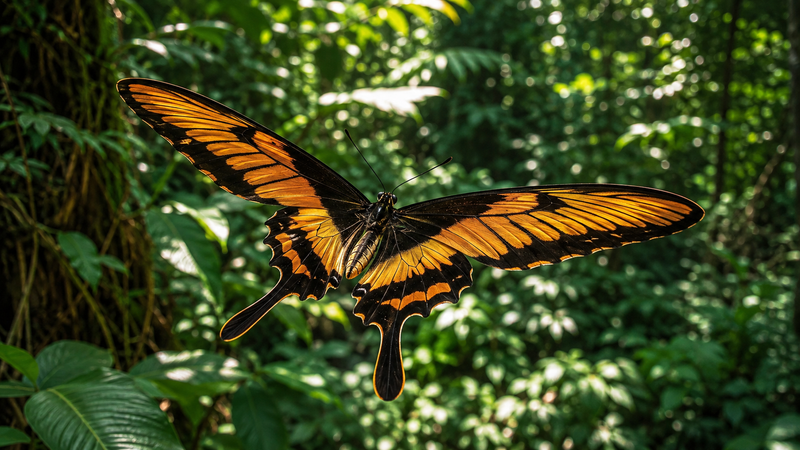
- Papilio antimachus (African Giant Swallowtail): the largest butterfly in Africa; wingspan up to 250 mm in males. Reliable sightings in Korup's intact lowland forest.
- Papilio zalmoxis (Great Blue Swallowtail): magnificent iridescent blue-green hindwings; co-occurs with antimachus in lowland forest.
- Euphaedra species (forest nymphs): a rich and complex genus of medium-sized forest nymphalids; Korup holds exceptional diversity.
Mount Cameroon and the volcanic chain
Mount Cameroon (4,095 m) is the highest peak in West and Central Africa and an active volcano — the last major eruption was in 2000. Its slopes span an enormous altitudinal range and create a transition from coastal rainforest at sea level through montane cloud forest to afroalpine heath above 3,000 m.
The montane butterfly fauna on Mount Cameroon includes several species found only in this highland chain:
- High-altitude Charaxes species restricted to the upper montane zone
- Montane Cymothoe species separate from their lowland relatives
- Alpine-zone satyrs and blues associated with afromontane grasslands
- Species shared with the Cameroon Highlands (Bamenda Highlands, Bamboutos Mountains) to the north, which form part of the same volcanic chain
The Cameroon Highlands are considered a separate biodiversity hotspot within Africa, with high levels of endemism for birds, plants, frogs, and butterflies alike.
Dja Faunal Reserve
The Dja Faunal Reserve (UNESCO World Heritage Site, 5,260 km²) in south-central Cameroon protects a large block of lowland Congo Basin rainforest. Almost entirely surrounded by the Dja River, it is one of Africa's largest and best-protected rainforest areas. Its butterfly fauna, though less surveyed than Korup, includes the full complement of Congo Basin lowland species — large Charaxes, Cymothoe, forest Papilio, and the diverse lycaenid communities that typify the Congo understorey.
Savannah and transition zones
Northern and central Cameroon transitions through the Adamawa Plateau and Guinea savannah into the Sahel. This zone has a completely different butterfly community from the forest south:
- Belenois and Colotis pierids — vivid white and orange-tipped species, characteristic of African savannah
- Junonia pansies — several vivid species common in open habitats
- Acraea/Telchinia — dozens of species of these often-abundant, often-toxic nymphalids
- Danaus chrysippus (African Monarch) — widespread throughout the savannah and Sahel
- Migratory pierids (Catopsilia, Eurema) that move through Cameroon in large numbers during the dry-to-wet season transition
Iconic species
African Giant Swallowtail (Papilio antimachus) — Africa's largest butterfly; male wingspan 230–250 mm; toxic; lowland rainforest only; reliable at Korup.
Great Blue Swallowtail (Papilio zalmoxis) — large; brilliant iridescent blue-green hindwings; lowland forest alongside antimachus.
Forest Glory (Cymothoe spp.) — multiple species; males with vivid structural colours; indicator species for intact forest.
Giant Charaxes (Charaxes castor) — largest Charaxes in Africa; wingspan to 110 mm; vivid orange above; baits readily.
African Forest Queen (Euxanthe wakefieldii) — large black-and-white nymphalid; lowland riverine forest.
Sapho Longwing (Graphium almansor) — large Graphium swallowtail with complex black-and-white pattern; forest interior.
Observation season
The equatorial south (Korup, Dja) has two rainy seasons — March–June and September–November — with butterfly activity peaking at the start of each wet season when new growth provides larval host plants and adults emerge in numbers. The shorter dry season in July–August often brings sunny days and good observation conditions at river sandbars.
The Cameroon Highlands are best visited in the dry season (November–March) when mountain paths are accessible. Montane species are most active on warm, sunny days following clear nights.
Conservation
Cameroon faces severe forest loss pressures: oil palm expansion (particularly along the southern coast and border areas), industrial logging concessions, and subsistence agriculture are the primary drivers. The southern lowland forests — the most butterfly-diverse zone — are under the greatest pressure.
Korup National Park is relatively well-protected by Central African standards, but is surrounded by communities that historically depended on forest products. Buffer zone management and community forestry programmes are ongoing.
The Democratic Republic of Congo border area in eastern Cameroon has seen increased mining and agricultural encroachment, threatening the corridor that connects Cameroonian forest to the Congo Basin core.
Interesting facts
- Cameroon's Mount Cameroon is one of only a handful of places in Africa where you can walk from sea-level tropical rainforest to afroalpine heath in a single day — producing an extreme butterfly turnover with altitude
- The genus Cymothoe (forest glories) is one of the most speciose butterfly genera in Africa; the highest concentrations of Cymothoe diversity in the world are found in the lowland forests of Cameroon and adjacent Congo Basin
- Several new butterfly species continue to be described from Cameroon forests each year; comprehensive surveys of the eastern border regions remain incomplete
- Cameroon was the base for Alfred Russel Wallace's West African collecting expedition (1862–1863), one of the first systematic natural history surveys of the country