Butterflies of Zambia
Zambia is the heart of the Miombo woodland belt, Africa's most extensive dry tropical forest, with around 750 butterfly species and Afrotropical endemics.
Overview
Zambia occupies the high plateau of south-central Africa — an elevated tableland mostly between 900 and 1,500 m altitude, drained by the Zambezi, Kafue, and Luangwa river systems. Its 752,000 km² lie entirely within the tropics, bounded by the Democratic Republic of Congo to the north, Tanzania to the northeast, Malawi and Mozambique to the east, Zimbabwe and Botswana to the south, and Namibia and Angola to the west.
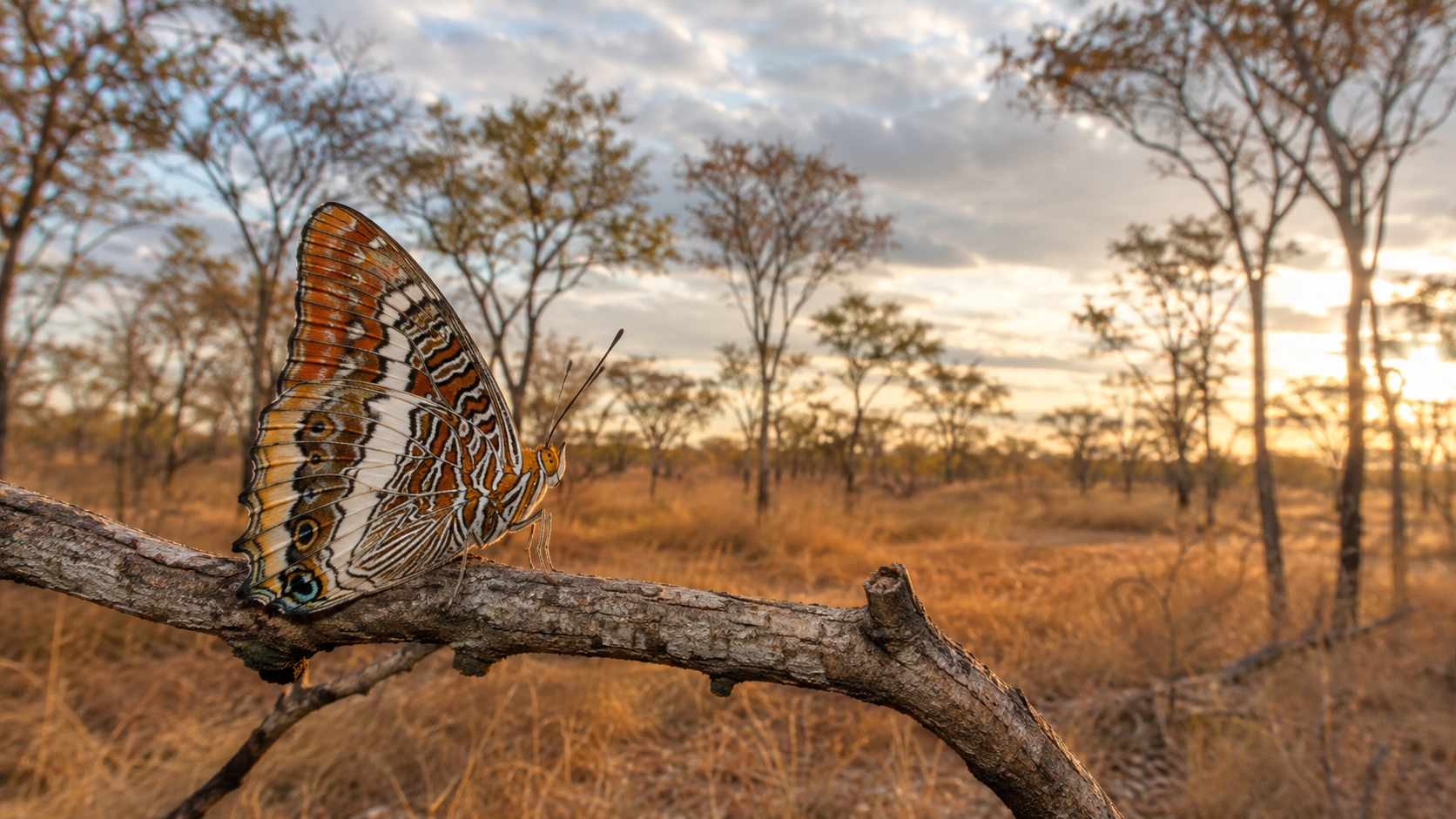
The dominant biome is Miombo woodland — the Brachystegia-Julbernardia dry deciduous forest that extends in a broad arc across the African plateau from Angola through Zambia and Zimbabwe to Mozambique and Tanzania. This ecosystem, covering around 60% of Zambia's land area, is one of the world's most extensive tropical woodlands and supports a butterfly fauna that is distinct from both the Congo rainforest to the north and the lowland savannas to the south.
Habitats and butterfly communities
Miombo woodland
Miombo is characterised by a mosaic of tall deciduous trees with a diverse understorey of grasses, herbs, and low shrubs. The canopy trees Brachystegia and Julbernardia produce synchronised leaf flushes in September–October — before the rains — which are reddish-pink or copper-coloured, contributing to the spectacular dry-season colour display. These new leaves are critical larval food for many specialist Miombo butterflies.
Key Miombo butterfly groups include:
- Acraea — dozens of fritillary-like species, many Miombo specialists
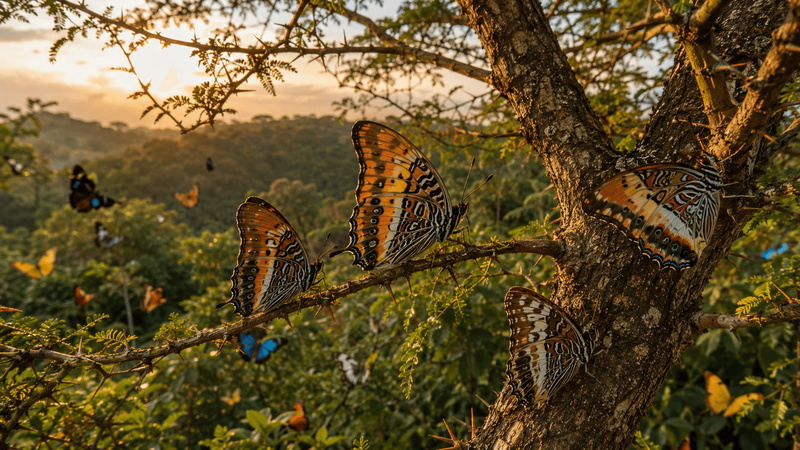
- Charaxes — 40+ species, including the massive C. bohemani and forest-edge species
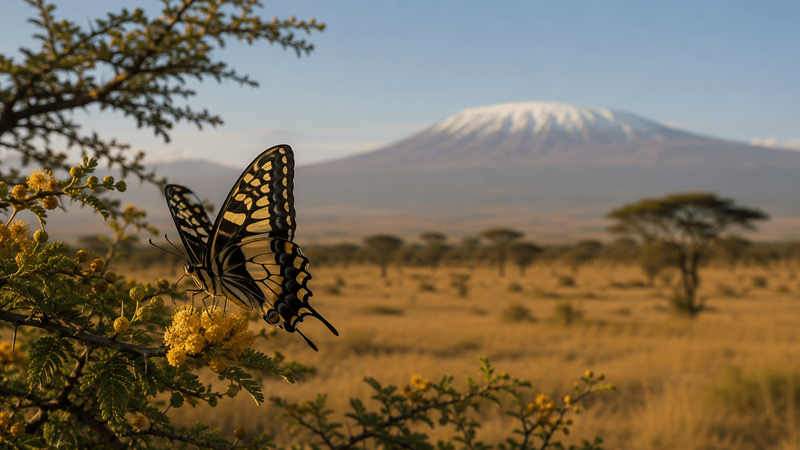
- Papilio — swallowtails using Rutaceae and Apiaceae in the understorey
- Belenois — white pierids whose adults perform spectacular dry-season migrations across the plateau
- Catopsilia florella (African migrant) — strongly migratory, can be seen in thousands during seasonal movements
Riverine forest and floodplains
Along the major rivers — Zambezi, Kafue, Luangwa — a ribbon of tall riverine forest supports a richer and different butterfly community from the surrounding Miombo:
- Charaxes candiope (green-backed charaxes) and other forest-dependent Charaxes at sap runs and rotting fruit
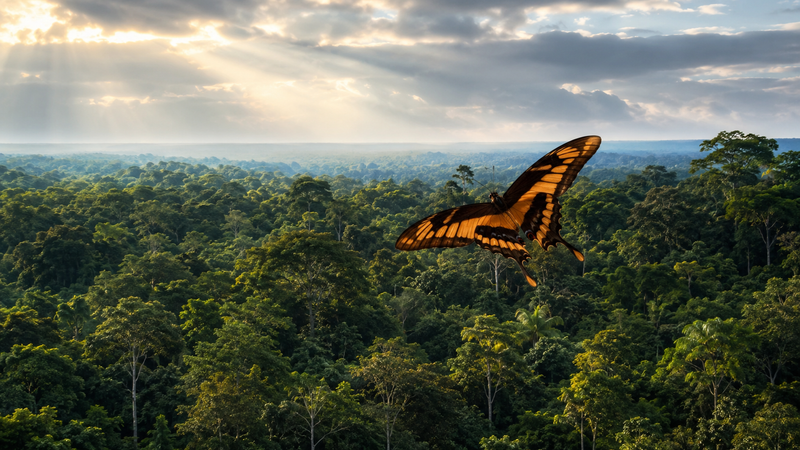
- Forest swallowtails including Papilio ophidicephalus (emperor swallowtail, wingspan to 130 mm) — Africa's largest butterfly in wing area after P. antimachus
- Cymothoe beckeri and related gliders — brilliant orange males of the forest interior
- Euphaedra species — metallic green and blue nymphalids of shaded understorey
Mopane woodland and escarpments
The lower-lying areas, particularly the Luangwa and Zambezi valleys, support Mopane (Colophospermum mopane) woodland — a heat-tolerant, often monodominant tree of low elevations. Mopane woodland has a sparser butterfly community than Miombo but supports:
- Several specialist Lycaenidae whose larvae are attended by ants in leaf litter
- Dry-adapted Colotis orange-tips — vivid white-and-red or orange species of open scrub
- Junonia pansies — common and eye-catching on open ground near woodland edges
The Zambezi corridor and Victoria Falls
The Zambezi River system creates a diverse corridor environment. At Victoria Falls (Mosi-oa-Tunya), the permanent mist zone maintains a patch of ever-green rainforest — the Mosi-oa-Tunya spray forest — which holds a micro-community of moisture-dependent species absent from the surrounding dry woodland. The falls area, accessible and with good tourist infrastructure, is an excellent starting point for Zambian butterfly watching.
Key species
Emperor swallowtail (Papilio ophidicephalus)
One of Africa's most spectacular butterflies, with a wingspan reaching 120–130 mm and bold black-and-yellow banding. Males patrol tall forest edges along the Luangwa and Zambezi, flying rapidly at height. It is one of the most impressive Papilio on the continent.
Giant charaxes (Charaxes bohemani)
A massive Charaxes with a wingspan exceeding 100 mm in large females — the largest Charaxes in Zambia. Found primarily in tall Miombo and riverine forest, males descend to fermenting fruit and animal dung. Its bold orange-and-black upperwing pattern is unmistakable.
African monarch (Danaus chrysippus)
Common across Zambia in all habitats, the African monarch undertakes long-distance movements across the plateau when Asclepias milkweeds are available. It is aposematic (poisonous) and widely mimicked by female Hypolimnas misippus.
Belenois aurota (caper white)
Performs remarkable mass migrations during the dry season — swarms of thousands of adults move across the Zambian plateau in a generally northward direction, roosting in trees at night and resuming flight by day. These migrations are one of the most dramatic natural history spectacles in southern Africa.
African emigrant (Catopsilia florella)
Another strongly migratory pierid, common throughout the year but particularly abundant at the start of the rains. Both sexes are pale greenish-yellow; females have dark-spotted hindwing undersides. A characteristic species of roadsides and riverbanks throughout Zambia.
Regional highlights
South Luangwa National Park
Zambia's premier wildlife destination is also its best butterfly site. The Luangwa Valley creates a funnel for species moving between the Congo basin fauna to the north and the drier southern savannas. Riverine forest along the Luangwa supports forest species; adjacent Mopane and Miombo provide plateau species. Over 500 species have been recorded in the valley and surrounds.
Lower Zambezi National Park
The river corridor below Lake Kariba holds excellent riverine forest butterfly communities. Chiawa Camp and the escarpment above it offer particularly good access to forest-edge swallowtails and Charaxes.
Lochinvar National Park (Kafue Flats)
Lochinvar, on the Kafue Flats, offers a different habitat: seasonally flooded grassland and Acacia savanna with a distinct butterfly community of grassland Acraea, Junonia, and the grassland skippers (Hesperiidae).
Copperbelt plateau
The plateau around Kitwe, Ndola, and Chingola supports some of Zambia's richest Miombo communities, with access to specialist Miombo lycaenids and Charaxes that are harder to find in the valley game parks.
Conservation
Zambia's butterfly fauna is not under acute threat compared to more deforested African countries — much of the Miombo plateau remains intact, and the national park network protects key riverine habitats. The principal pressures are:
- Charcoal production: uncontrolled cutting of Miombo woodland for charcoal, particularly around major urban centres
- Agricultural expansion: conversion of Miombo to maize and soya cultivation on the plateau
- Small-scale gold and gemstone mining: causing habitat destruction in Eastern and Northwestern provinces
Zambia currently lacks detailed systematic survey coverage for most of its territory, and it is likely that additional species remain to be recorded or formally described from interior Miombo regions.