Butterflies of Ethiopia
Ethiopia's altitudinal range, from the Danakil Depression to the Simien Mountains, supports around 650–700 butterfly species, including Afromontane endemics.
An extreme altitudinal range
Ethiopia's geography is defined by its extraordinary topography. The Ethiopian Highlands — the largest continuous highland mass in Africa — rise to over 4,500 m in the Simien Mountains and form a vast plateau dissected by the Great Rift Valley. East of the highlands, the land drops sharply to the Ogaden semi-desert and the Danakil Depression, one of the lowest and hottest places on Earth at 125 m below sea level. To the west and south, forests and savannahs extend toward the Congo Basin and the East African lowlands.
This altitudinal range — spanning over 4,600 m — produces some of the most varied habitat conditions in Africa within a single country, and correspondingly diverse butterfly communities. With approximately 650–700 recorded species, Ethiopia is not the richest African country by total count, but the degree of endemism in its highland fauna is exceptional.
The Ethiopian Highlands
Simien Mountains
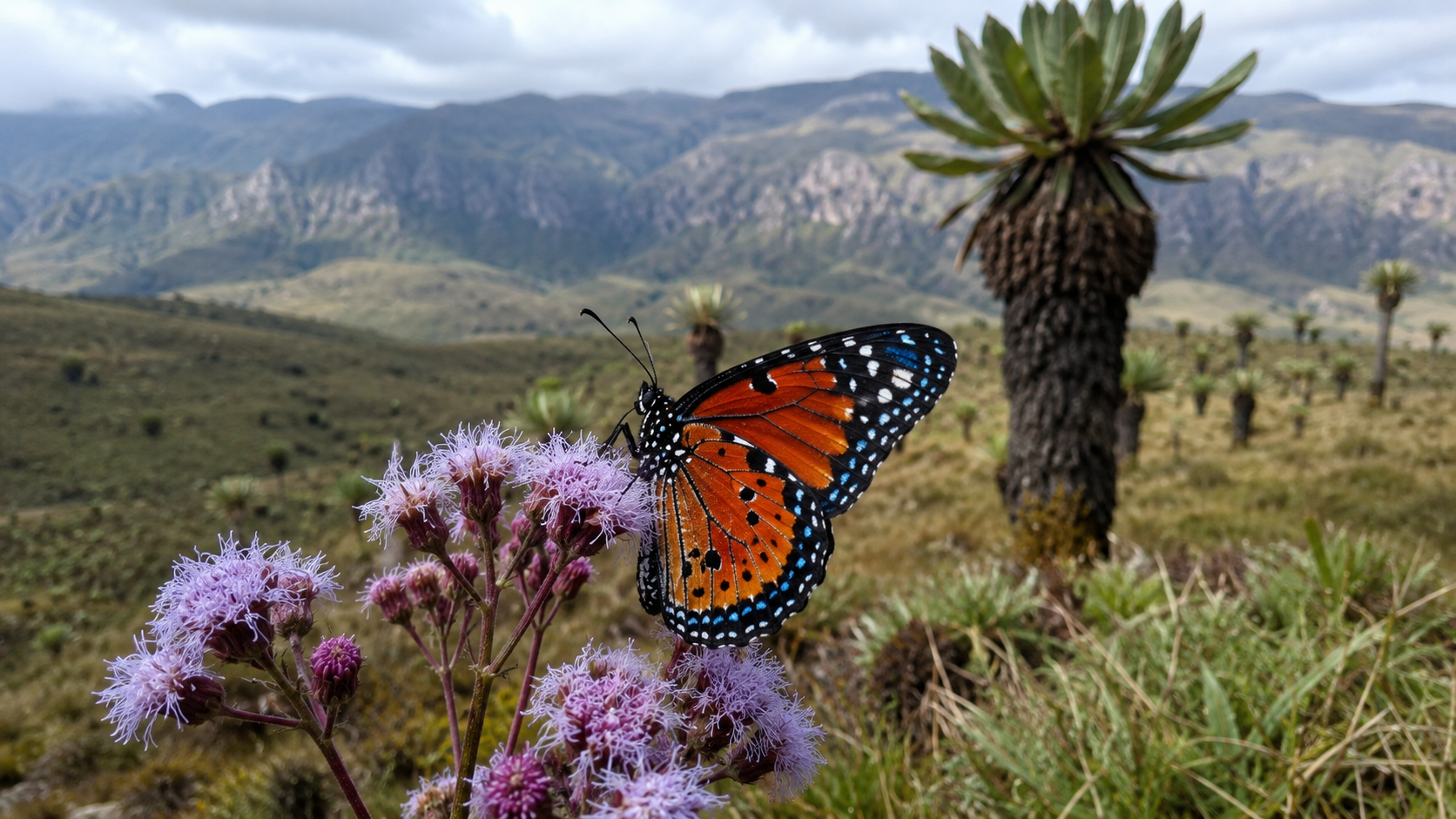
The Simien Mountains in the north (Amhara region) contain the highest peaks in Ethiopia, including Ras Dashen (4,550 m). The Afroalpine zone above 3,500 m is dominated by giant lobelias and heathers — a distinctive vegetation type found only on the highest East and Central African mountains.
The butterfly fauna at this altitude is sparse but distinct: high-altitude coppers, blues, and satyrs adapted to cold and wind. Below the alpine zone, montane grasslands and Afromontane forest patches hold a richer fauna, though surveys here remain incomplete.
Bale Mountains National Park
Bale Mountains National Park (2,400 km²) in the south-central highlands is the most important protected area for Afromontane biodiversity in Ethiopia. The park spans from montane forest at around 1,500 m through a vast Afroalpine plateau (the Sanetti Plateau, largely above 3,800 m) to the Harenna Forest on the southern escarpment.
The Harenna Forest is one of Ethiopia's most significant ecological areas: a moist montane forest on the southern slopes of the Bale Mountains that receives rainfall both from the Indian Ocean and from the Congo basin air masses. Its butterfly fauna is distinct from the drier northern highlands and includes several species at the edge of their East African ranges. Some butterfly species may be endemic to Harenna — surveys are ongoing.
The Sanetti Plateau holds specialist Afroalpine butterflies: certain Acraea species, montane blues, and satyrs that occur at 3,800–4,000 m — among the highest-altitude butterflies recorded in Africa.
The Great Rift Valley
The Ethiopian Rift Valley bisects the highland plateau, creating a biogeographic barrier that has contributed to speciation. The Rift Valley bottom, with its chain of lakes (Ziway, Langano, Abijata, Shalla, Awasa, Abaya, Chamo), supports a dry-adapted butterfly fauna very different from the highland forests on either side.
Rift Valley species include:
- Junonia pansies — common at lower elevations near lake margins and scrub
- Colotis pierids — vivid species adapted to dry thorn-scrub and semi-arid conditions
- Acraea/Telchinia — numerous species in open bush and grassland
- Danaus chrysippus (African Monarch) — abundant throughout open and semi-open habitats in the Rift
Southwestern forests
The Kaffa, Jimma, and Illubabor zones in southwestern Ethiopia preserve some of the country's most extensive remaining natural forest, including the origin forests of wild coffee (Coffea arabica). These moist forests connect ecologically with East African and Congo Basin forest fauna, and their butterfly diversity is the highest in the country.
Key species of the southwestern forests include:
- Forest Charaxes — large, fast-flying emperors baiting to fermenting fruit
- Graphium swallowtails — fast, graceful species along forest rivers and glades
- Forest Papilio swallowtails including species shared with the East African coast
- Numerous forest lycaenids (hairstreaks and blues) associated with specific tree species
Surveys of this region are less comprehensive than in the better-known parks; botanically rich forests near Jimma and around Kaffa Biosphere Reserve deserve further entomological study.
Iconic species
African Monarch (Danaus chrysippus) — abundant throughout Ethiopia; one of the most commonly seen butterflies across all habitat zones.
Charaxes spp. — numerous species from lowland forest emperors to drier-country species in the Rift; Ethiopia has at least 30 recorded Charaxes.
Ethiopian Acraea (Telchinia spp.) — several species found only in the Ethiopian highlands; indicator species for intact Afromontane grassland and forest.
Colotis phisadia (Veined White) — striking dry-country species; white with prominent black venation; common in the Rift Valley and northern lowlands.
Papilio dardanus (Mocker Swallowtail) — widespread Africa-wide; females are extraordinary polymorphic mimics of toxic Danaus and Amauris species; several forms occur in Ethiopia.
*Mylothris spp. (African Jezebels) — white and yellow with bold black borders; forest species in southwest; several species recorded.
Palearctic connections
Ethiopia lies at the northern edge of the Afrotropical region, and its northern highlands and semi-arid zones receive seasonal migrants and wanderers from the Palearctic:
- Colias croceus (Clouded Yellow) and related species reach northern Ethiopia seasonally
- Vanessa cardui (Painted Lady) — abundant in Ethiopia during migration; documented moving through Ethiopia during intercontinental Africa-Europe movements
- Several Pieris and Pontia whites occur in northern Ethiopia in forms connecting with Northeast African populations
This Palearctic-Afrotropical overlap makes Ethiopia valuable for understanding how species ranges respond to seasonal and long-term climate change.
Observation season
Ethiopia has two rainy seasons in most highland areas:
- Belg (short rains): March–May — brings renewed vegetation and good butterfly activity, particularly in the Rift Valley
- Kiremt (main rains): June–September — heavy rain in the highlands; difficult travel conditions but rich larval activity; forest species peak in August–September
The best adult butterfly observation is in October–January, after the main rains, when vegetation is lush, trails are accessible, and adults are at peak numbers following the summer breeding season.
For the Bale Mountains specifically, the dry season (November–April) allows vehicle access to the Sanetti Plateau and trail access in Harenna Forest. The wet season is productive for certain species but access is difficult.
Conservation
Ethiopia has lost a substantial proportion of its original forest cover — estimates suggest less than 5% of the original highland forest remains, concentrated in the southwest and in protected areas like Bale Mountains. The primary drivers are smallholder agriculture expansion, charcoal production, and overgrazing.
The Afroalpine ecosystem of the Sanetti Plateau is relatively intact but warming temperatures are shrinking the suitable altitude band for cold-adapted species. Several Afromontane endemic species have very restricted ranges and may qualify for threatened status when assessed.
Kaffa Biosphere Reserve has made some progress in protecting the wild coffee forest ecosystem, including its butterfly communities. Community forest management in the southwest has become a model for combining conservation and rural livelihoods in the region.
Interesting facts
- Ethiopia is the origin of wild coffee (Coffea arabica) — the Kaffa forests where wild coffee evolved harbour butterfly species associated with coffee-relative plants found nowhere else in the world
- The Gelada baboon, endemic to the Ethiopian Highlands, is one of the few large primates that feeds on grasses; their grazing patterns influence the grassland structure on which many montane butterfly species depend
- Several species of butterfly first described from Ethiopia in the 19th century by European collectors remain known only from the type specimens — the diversity of remote highland forests is still being discovered
- The Great Rift Valley visible from satellites runs through the heart of Ethiopia and has been called the place where Africa is splitting apart — the geological process that created these valleys also isolated highland populations and drove the endemism seen in Ethiopian butterflies today