Butterflies of Nigeria
Nigeria is home to about 1,000 butterfly species, including the African Giant Swallowtail — Africa's largest. Cross River rainforest is a key hotspot.
Nigeria: from rainforest to Sahel
Nigeria is the most populous country in Africa, spanning a dramatic environmental gradient from the equatorial rainforests of the south to the semi-arid Sahel in the far north. This north-south transition — encompassing lowland rainforest, forest-savannah mosaic, Guinea savannah, Sudan savannah, and Sahel — creates strongly contrasting butterfly faunas across the country's 923,000 km².
With approximately 1,000 recorded species, Nigeria's butterfly fauna places it among the more diverse African nations, though it is overshadowed by the Congo Basin countries (Democratic Republic of Congo has over 5,000 species). The key site for exceptional diversity is the southeastern rainforest belt — the Cross River State forests — which form the western extension of the great Guinea-Congo Rainforest biodiversity hotspot.
The African Giant Swallowtail
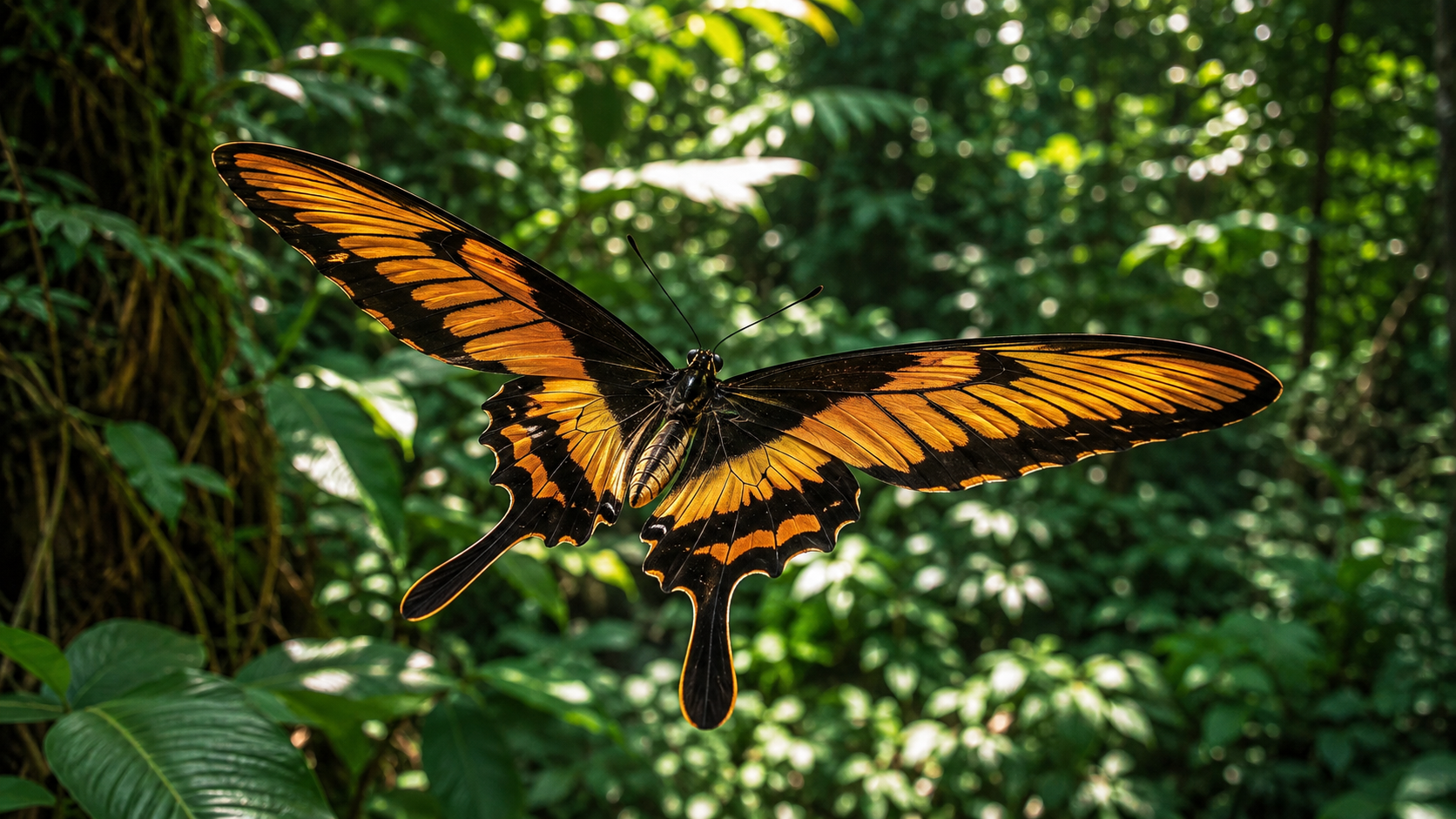
No Nigerian butterfly commands more attention than Papilio antimachus — the African Giant Swallowtail. With a wingspan reaching 230–250 mm in males, it is the largest butterfly species on the African continent and one of the largest in the world. The wings are elongated and narrow — more like a moth silhouette than a typical butterfly — and patterned in vivid russet-orange and black. Flight is strong and direct through the forest canopy, typically high above ground.
The species is toxic and unpalatable, accumulating poisons from larval food plants (Uvariopsis and related Annonaceae). The bold warning pattern deters birds and other predators. Interestingly, females are dramatically smaller (100–120 mm), normally patterned, and lead completely different lives lower in the forest; they are rarely observed.
Papilio antimachus is found only in lowland rainforest, and is sensitive to forest disturbance — it disappears quickly from degraded and secondary forest. In Nigeria it is restricted to the southeastern states where intact lowland rainforest persists.
Cross River National Park
Cross River National Park (3,950 km²) in the southeastern corner of Nigeria is the most important site for butterfly conservation in the country. It consists of two separate forest blocks — Oban Hills (in the south, near the coast) and Okwangwo (in the north, bordering Cameroon) — protecting some of the last undisturbed lowland and montane rainforest in West Africa.
The park's butterfly fauna is exceptionally rich. Highlights include:
- Cymothoe species (forest glories): brilliantly coloured medium-sized nymphalids. The males of many species have vivid structural blue, red, or yellow on the upper surface; females are brown and patterned quite differently. West Africa has the greatest Cymothoe diversity in the world, and Cross River National Park holds numerous species.
- Charaxes emperors: large, fast, and powerful nymphalids with spectacular undersides. Nigeria has dozens of species; the Charaxes community in Cross River is one of the most diverse in West Africa.
- Papilio antimachus: reliable sightings in the Oban Hills division, where intact lowland forest remains.
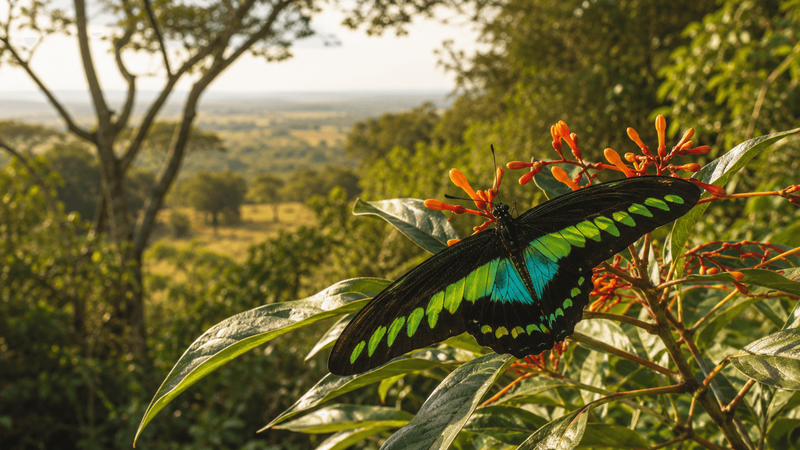
- Papilio zalmoxis: the Great Blue Swallowtail — a magnificent species with vivid iridescent blue-green hindwings; occurs in lowland forest alongside P. antimachus.
Okomu National Park
Okomu National Park (181 km²) in Edo State is a small but important forest remnant 60 km west of Benin City. Despite its relatively modest size, the park holds good diversity for a West African lowland forest site, including several Charaxes species, forest nymphalids, and the locally scarce Cymothoe glories. Okomu is more accessible than Cross River National Park from Lagos (approximately 3 hours by road) and is often the first forest butterfly site visited by observers based in southern Nigeria.
Savannah and forest-savannah mosaic
Central and northern Nigeria transitions through the Guinea Savannah and Sudan Savannah zones, where butterfly diversity drops significantly compared to the forest south but a distinct assemblage of savannah-adapted species takes over. These include:
- Colotis and Belenois species (pierids): vivid white and orange-tipped pierids, characteristic of African savannahs and dry open habitats
- Junonia (pansies): several species of these vivid eyed-nymphalids are common in savannah, including the brilliant Junonia orithya (blue pansy) and Junonia oenone
- Acraea species: over 100 species of Acraea (now reclassified within Telchinia) occur across Africa; Nigeria's savannah zone has many, often in large numbers
- Danaus chrysippus (African Monarch or Plain Tiger): one of Africa's most abundant and widespread butterflies; toxic; mimicry model for numerous other species
Iconic species
African Giant Swallowtail (Papilio antimachus) — Africa's largest butterfly; toxic; male wingspan 230–250 mm; lowland rainforest only.
Great Blue Swallowtail (Papilio zalmoxis) — vivid blue-green hindwings; large; lowland forest; one of Africa's most spectacular swallowtails.
Forest Queen (Euxanthe wakefieldii) — large nymphalid; black-and-white pattern with yellow patch; lowland and riverine forest; wide African distribution.
Charaxes castor (Giant Charaxes) — the largest Charaxes in Africa; wingspan up to 110 mm; vivid orange-brown above; powerful flight.
Cymothoe beckeri — typical West African forest glory; male with vivid red-orange upper surface; dependent on specific forest Flacourtiaceae host plants.
African Monarch (Danaus chrysippus) — orange-and-black; widespread throughout Nigeria; larval host Calotropis (milkweed relatives); mimicry hub species.
Observation season
Nigeria's butterfly season reflects its north-south climatic gradient:
South (rainforest zone): butterflies are present year-round but peak activity follows the two rainy seasons (April–July and September–November). The short dry season in August (the "August break") often brings sunny days and good puddling activity at stream banks. The main dry season (December–February) reduces some forest activity but the forest itself remains lush.
Central and north (savannah and Sahel): peak diversity occurs at the end of the rainy season (September–October) when vegetation is at its most lush and nectar is abundant. The dry season (November–May in the far north) sees dramatic reduction in species activity; some species aestivate or migrate southward.
Conservation
Nigeria's butterfly conservation faces severe pressure from habitat loss. The country has lost the vast majority of its original forest cover — estimates suggest less than 10% of original lowland forest remains, concentrated in Cross River State and Edo State. Rapid population growth, agricultural expansion (oil palm, rubber, cassava), illegal logging, and charcoal production continue to reduce remaining forest fragments.
The African Giant Swallowtail (Papilio antimachus) is protected under Nigerian law and listed on CITES Appendix II, but enforcement in remote forest areas is difficult.
Cross River National Park represents the most important single site for forest butterfly conservation in Nigeria. Increasing ecotourism — including butterfly observation — has been proposed as a way to generate local economic alternatives to forest clearance, with some positive results in park buffer zones.
Interesting facts
- Papilio antimachus was first described to Western science by the botanist Robert Brown in 1806 from a specimen collected on the West African coast; its enormous size so surprised naturalists that early reports were treated with scepticism.
- Nigeria's forest zone is part of the Upper Guinea forests, a biodiversity hotspot separated from the Congo rainforests by the Dahomey Gap — a savannah corridor that has acted as a biogeographical barrier for millions of years, isolating West African from Central African forest species and driving distinct speciation patterns.
- The genus Cymothoe (forest glories) reaches its maximum diversity in the Guinea-Congo rainforest zone; West Africa alone has more Cymothoe species than any other part of the world, and Cross River State is near the centre of this diversity.