Asia
Butterflies of Asia: from the Arctic tundra of Siberia to the tropics of Southeast Asia. The largest continent with 5,000+ species of day-flying butterflies.
Asia — the most diverse continent
Asia is the largest continent, spanning all climate zones from Arctic tundra to the equator. Its entomofauna is correspondingly rich: an estimated 5,000–6,000 species of day-flying butterflies, about 25–30% of the world total.
Asia is unique in that several great faunas border and overlap here: Palaearctic (temperate Eurasia), Oriental (tropical and subtropical Asia), and Australian (southern Papua). This creates special transition zones with high endemism.
Regions and their fauna
Siberia and the Russian Far East
Harsh climate strongly limits diversity: about 100–130 day-flying species in Western Siberia, slightly more in Eastern Siberia. But the Russian Far East is a special case.
Primorye is Russia's richest region for butterflies: more than 300 day-flying species. Manchurian and Far Eastern floras intersect here. Characteristic species:
- Maack's Swallowtail (Papilio maackii) — large, black-blue with green iridescence; one of Russia's most beautiful swallowtails
- Alcinous Swallowtail (Papilio alcinous) — black with red spots; females polymorphic
- Schrenck's Emperor (Apatura schrenckii) — Far Eastern analogue of the Purple Emperor
- Blues of the genus Celastrina — small, characteristically bluish
- Burej's Map (Araschnia burejana) — Far Eastern sister of the Map butterfly
Japanese islands
Japan has about 250 day-flying species; high endemism due to island isolation. Characteristic endemics and sub-endemics:
- Common Bluebottle (Graphium sarpedon) — turquoise-green stripes on a black background
- Matsumura's Copper (Japonica lutea) — endemic blue
- Many Lethe and Neope — woodland browns
On the Ryukyu and Okinawa islands, tropical species from Taiwan and Southeast Asia additionally occur.
China
The richest country of the temperate belt for butterfly species diversity. In southern provinces (Yunnan, Sichuan, Guangdong) — more than 1,500 species, including many endemics. Himalayan and Yunnan biodiversity hotspots:
- Dozens of swallowtail species (Papilio, Troides)
- Rare mountain browns (Erebia, Oeneis)
- Unique blues of the subgenus Plebejus
Indian subcontinent and Sri Lanka
India has about 1,500 species of day-flying butterflies. Sri Lanka, despite its small size, has 245 species, of which about 20 are endemics.
Best-known Indian species:
- Common Tiger (Danaus genutia) — orange-black, close relative of the monarch; migrates across the Indian subcontinent
- Common Crow (Euploea core) — dark blue danaine; one of India's most common tropical butterflies
- Golden Birdwing (Troides aeacus) — large, black-yellow; protected
Southeast Asia (Malaysia, Indonesia, Thailand, Vietnam)
The richest butterfly region of Asia. Borneo and Sumatra each have about 1,000 day-flying species. Papua New Guinea is a transition zone to Australia with a unique fauna.
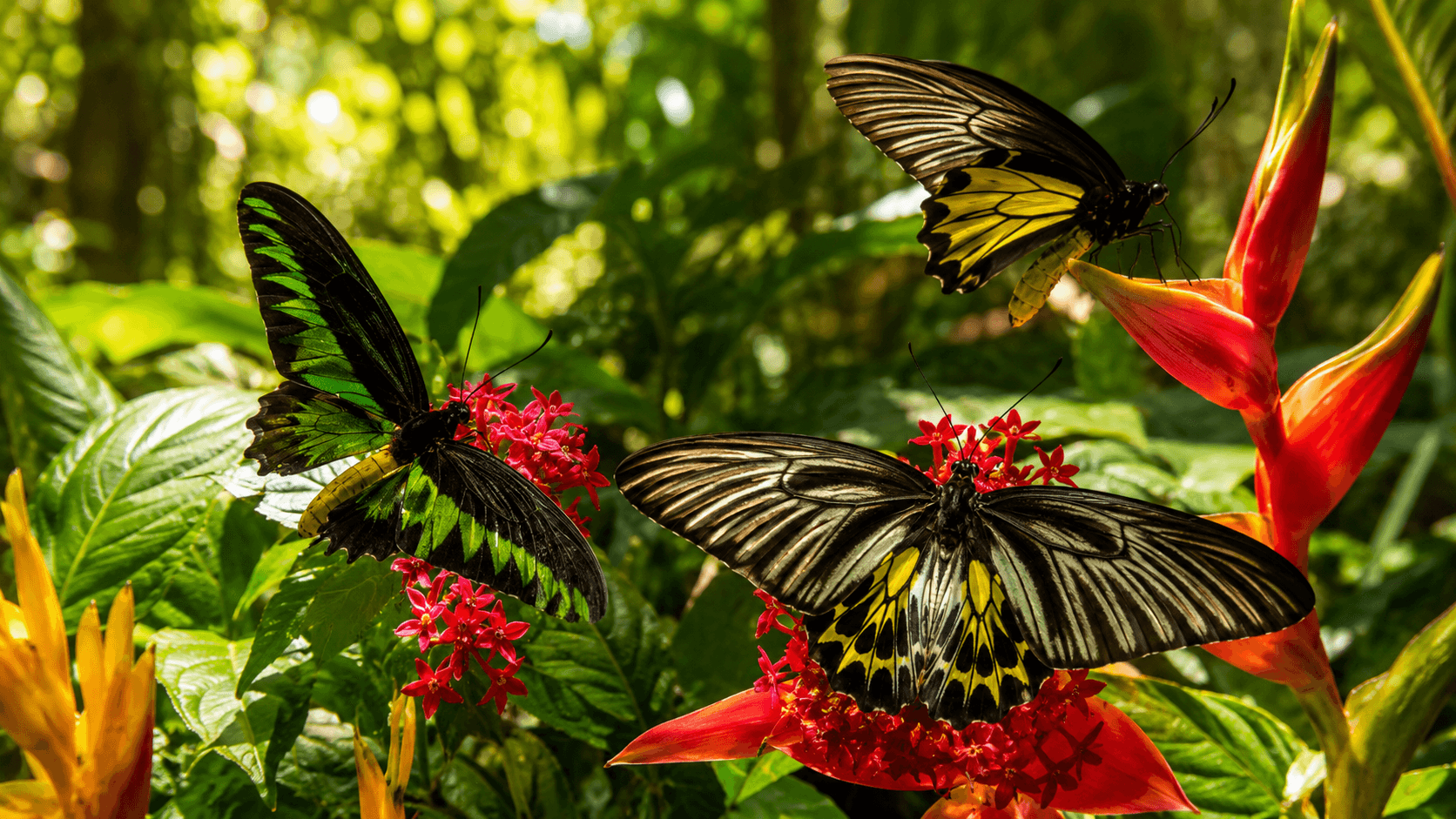
Birdwings — symbol of the region. Giant tropical swallowtails with wingspans of 15–28 cm:
- Queen Alexandra's Birdwing (Ornithoptera alexandrae) — the world's largest day-flying butterfly; females up to 28 cm wingspan; Papua New Guinea; critically endangered
- Rajah Brooke's Birdwing (Trogonoptera brookiana) — black with bright green spots; "Rajah Brooke's Butterfly"; Borneo and Malaysia
- Common Green Birdwing (Ornithoptera priamus) — one of the most widespread species of the genus; male emerald green
Central Asia (Kazakhstan, Central Asia, Mongolia)
Steppe and desert fauna, intermediate between European and Far Eastern. Features:
- Many species of blues, sulphurs, and temperate swallowtails
- High-mountain species of the Tian Shan and Pamir — apollos, mountain satyrs
- Stubendorf's Apollo (Parnassius staudingeri) — Pamir endemic
- Desert species: Zegris, Colotis — unusual whites with bright coloured spots
Middle East and Arabia
Arid climate limits diversity. Nevertheless, mountain areas of Turkey, Lebanon, and Israel contain many Mediterranean and Anatolian species. Israel has about 150 day-flying species in a very small area.
Unique features of Asian fauna
Female polymorphism in swallowtails
In Southeast Asia, females of several Papilio species have several different forms ("polymorphism"), each mimicking a different poisonous butterfly species. Males are monomorphic. This is an example of Batesian mimicry — a harmless species mimics an unpalatable "model".
Seasonal polymorphism
In humid tropics with pronounced rainy seasons (India, Thailand), several species have "rainy" and "dry" forms that look strikingly different. For example, Precis almana: the dry form mimics a dry leaf, the rainy form is bright and contrasting.
Multivoltinism
In tropical Asia without a pronounced winter, many species produce 8–12 generations per year and fly year-round. The concept of "season" is blurred for them.
Threats and conservation
Southeast Asia is losing tropical forests faster than the Amazon. Clearing for oil palm plantations has destroyed thousands of square kilometres of habitat on Sumatra and Borneo. Birdwings are especially vulnerable — they are listed in CITES Appendix II, trade is restricted.
In Russia, Primorye is a buffer zone between Far Eastern species and high poaching pressure in neighbouring countries. Several rare Primorye species are protected in the Lazovsky and Ussuriysk reserves.
Russian Far East — gateway to Asian fauna
For the Russian observer, Primorye is an accessible way to see "Asian" butterflies without travelling abroad. Peak diversity is July, in the broadleaf forests of the Sikhote-Alin. More about Russia — in the Russia section.
See also