Butterflies of Vietnam
Vietnam is home to around 1,500 butterfly species. Its narrow S-shape spans subtropical north to equatorial south, producing exceptional habitat diversity.
Vietnam: three climatic zones, one exceptional fauna
Vietnam's distinctive geography — a narrow S-shaped country stretching 1,650 km from subtropical north to equatorial south — makes it one of the most biodiverse nations in Asia for butterflies. With approximately 1,500 recorded species, it ranks among the richest in Southeast Asia per unit area, despite being smaller than most of its neighbours.
The reason is habitat diversity. The northern highlands (Hoang Lien Son, Ha Giang, Cao Bang) share species with subtropical southern China and the eastern Himalayas. The central Annamite Range — the mountain spine dividing Vietnam from Laos — is a centre of endemism where species from both north and south meet and overlap. The southern lowlands (Mekong Delta, Ca Mau Peninsula) hold equatorial-affinity species shared with Cambodia, Thailand, and Malaysia. All three faunas are represented within a few hundred kilometres.
Northern Vietnam: highland hotspots
Hoang Lien Son and Sapa
The Hoang Lien Son range in Lao Cai Province contains Fansipan (3,143 m), the highest peak in Indochina. The forests around Sapa are famous for rhododendron cloud forest above 2,000 m, where a distinct montane butterfly fauna exists. Species here include several Parnassius (apollo-group swallowtails), high-altitude blues and coppers, and multiple Lethe and Ypthima satyrs (browns). Spring (March–April) brings birdwings to lower elevations as the flowering season peaks.
Ha Giang and the Dong Van Karst Plateau
The Dong Van Karst Plateau Geopark (Ha Giang Province) on the Chinese border is one of Vietnam's least-visited regions and among its most biodiverse. Karst limestone forests interspersed with rice-terraced valleys harbour numerous Graphium swallowtails, Troides aeacus birdwings, and many Lycaenidae associated with specific karst-endemic food plants. Several butterfly species have been described new to science from this region in recent decades.
Central Vietnam: the Annamite divide
Bach Ma National Park
Bach Ma National Park (Thua Thien Hue Province) sits precisely on the main watershed of the Annamite range — the climatic divide between the wet, cloudy north and the drier, sunnier south. Its forests receive extraordinarily high rainfall (up to 8,000 mm per year on the summit), producing lush multi-layered vegetation and exceptional biodiversity. Over 230 species of butterfly have been recorded. The park is particularly important for species at the edge of their ranges, with northern and southern faunal elements co-occurring on the same ridge.
The Hai Van Pass just south of Bach Ma marks a sharp climatic boundary: butterfly assemblages on either side of the pass can differ substantially despite being separated by only a few kilometres.
Phong Nha-Ke Bang
Phong Nha-Ke Bang National Park (Quang Binh Province) is famous for the world's largest cave systems (Son Doong Cave), but the surrounding limestone karst forest is also exceptional for butterflies. Dark understorey species including Amathuxidia amythaon (royal butterfly) and multiple Charaxes occur in the forested karst valleys.
Southern Vietnam: tropical lowlands
Cat Tien National Park
Cat Tien National Park (Dong Nai Province, ~150 km northeast of Ho Chi Minh City) is the most accessible major butterfly site in southern Vietnam. The park's lowland tropical forest — one of the last significant remnants in southern Vietnam — harbours southern lowland species including the Common Birdwing (Troides helena), numerous Papilio and Graphium swallowtails, large Charaxes emperors, and many pierids. The park's mineral-rich stream banks attract puddling aggregations.
Mekong Delta
The Mekong Delta's extensive river systems and mangrove edges support a distinct wetland butterfly fauna, notably numerous Neptis (sailors), Junonia (pansies), and Euploea (crows). Butterfly diversity is lower here than in upland forests but several coastal-specialist species are found only in this zone.
Iconic species
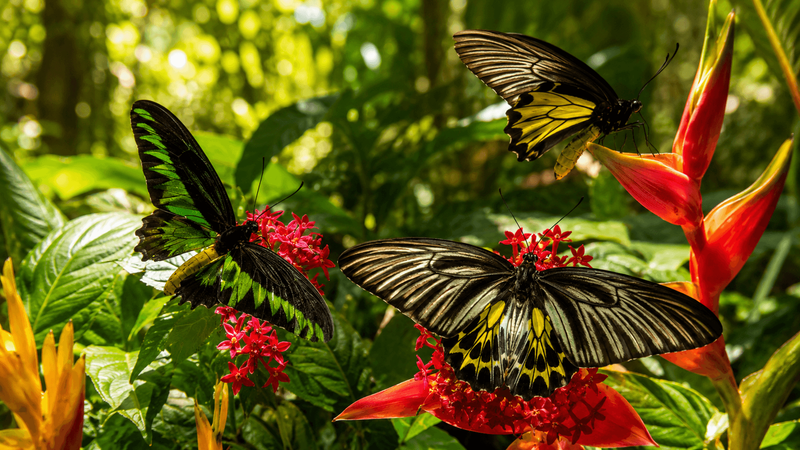
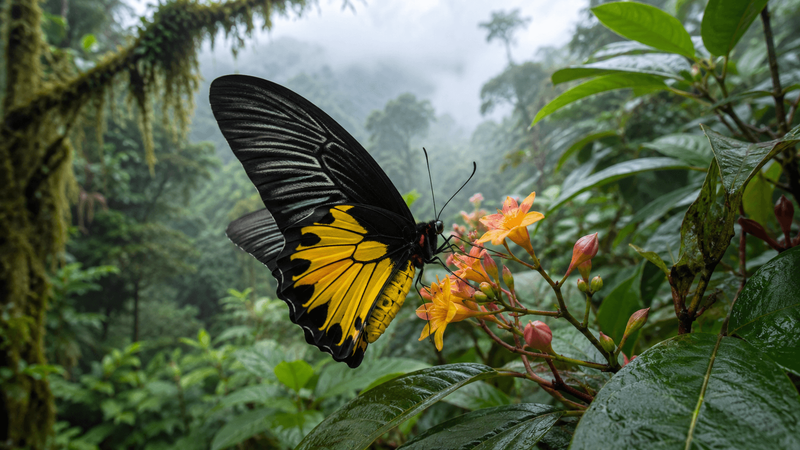
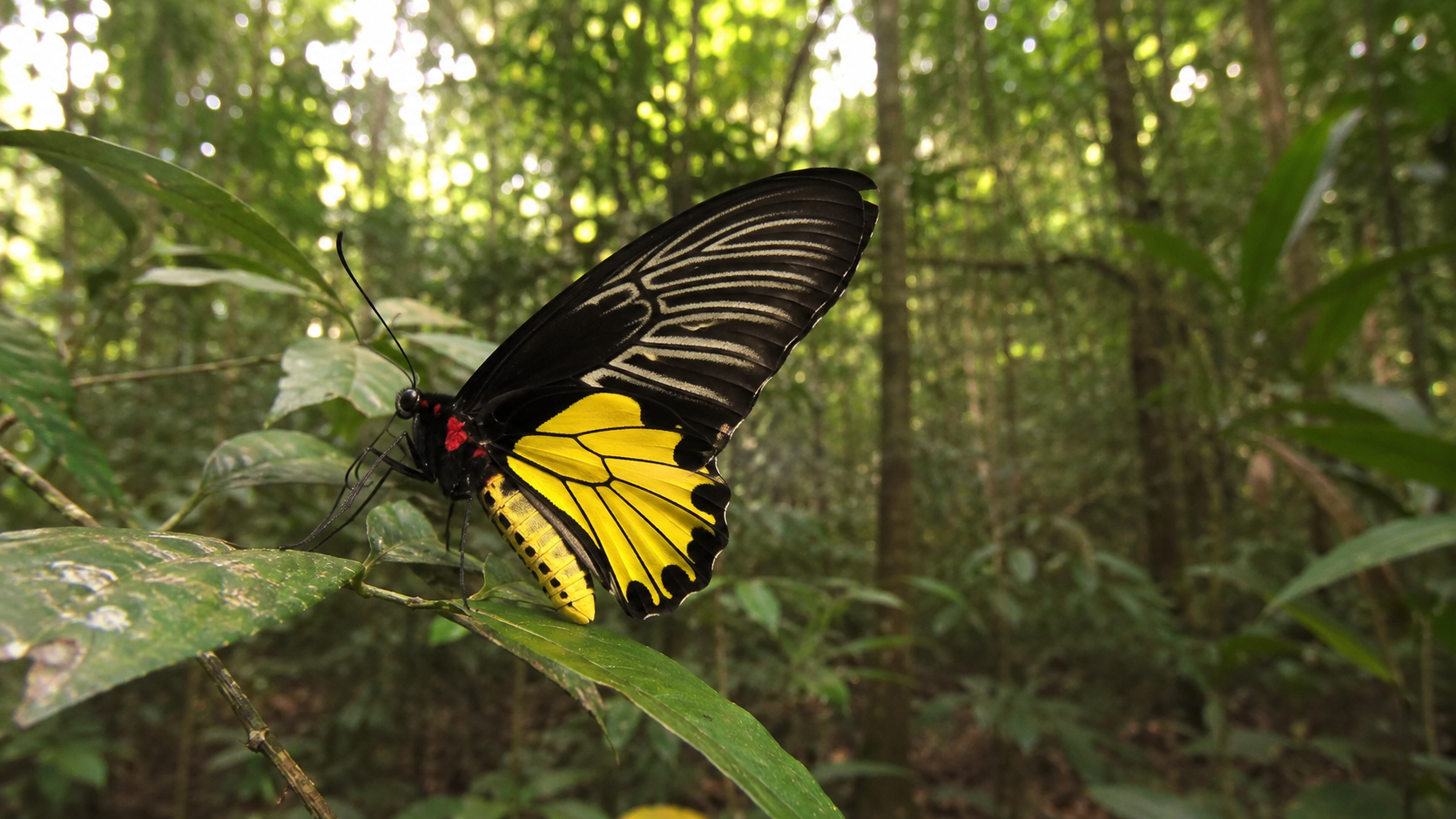
Common Birdwing (Troides helena) — large black-and-yellow swallowtail; widespread in southern Vietnam; larvae on Aristolochia vines; CITES Appendix II.
Golden Birdwing (Troides aeacus) — northern counterpart; more vivid yellow; found in northern highland forests; equally protected.
Great Helen (Papilio iswara) — large black swallowtail with broad white wing patches; forest interior; widespread but not common.
Malayan (Papilio memnon) — large polymorphic swallowtail; females mimic toxic Troides birdwings in different forms; central and southern forests.
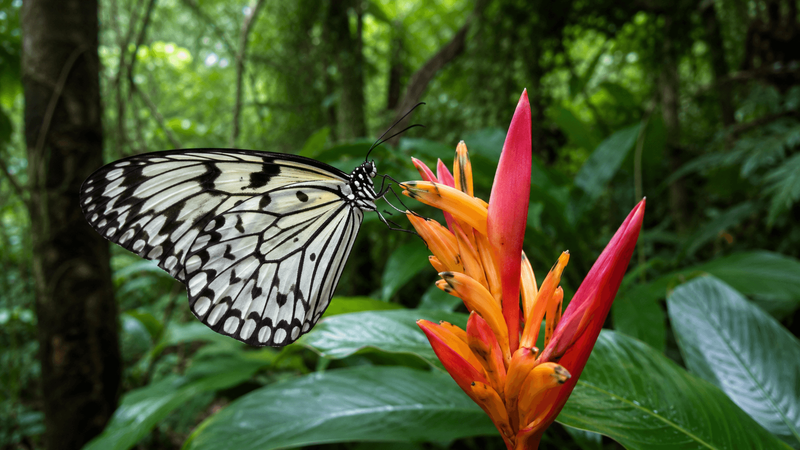
Blue Glassy Tiger (Ideopsis vulgaris) — pale blue-white with black veining; unpalatable; large aggregations in some forest areas.
Tawny Rajah (Charaxes bernardus) — large, fast-flying nymphalid; males orange with dark borders; aggressive territorial behaviour at forest edges; feeds on overripe fruit.
Observation season
Vietnam's butterfly season varies by latitude:
- North (Hanoi, Sapa): best from March to October; peak diversity in May–June and August–September; winter (November–February) brings cold spells above 1,500 m that suppress butterfly activity
- Centre (Hue, Da Nang, Bach Ma): the dry season (February–August) is best; the rainy season (September–January) brings heavy rain to the Annamite slopes
- South (Ho Chi Minh City, Cat Tien): best during the dry season (November–April); the wet season (May–October) reduces trail access but some species peak in the early rains
The single most productive moment is the transition from dry to wet season (April–May in the south, May–June in the north), when flowering plants peak and butterflies reach their highest densities.
Conservation
Vietnam has made significant progress in forest protection since the 1990s, when catastrophic deforestation peaked. However, primary lowland forest — the habitat of highest butterfly diversity — remains heavily fragmented. The Annamite Range is among the most threatened biodiversity hotspots in Asia, with illegal hunting and logging pressure from both Vietnamese and Lao sides.
Several birdwing species are strictly protected under Vietnamese law and internationally through CITES. Butterfly farming is practised on a small scale near tourist sites, but the country has not developed a commercial butterfly farming industry comparable to Papua New Guinea or Malaysia.
Interesting facts
- The Annamite Range between Vietnam and Laos is one of the last places on Earth where large mammals new to science have been discovered in recent decades (saola, 1992; giant muntjac, 1994) — reflecting the ongoing difficulty of surveying these remote forests, which also hold undescribed butterfly species.
- Several butterfly species described from northern Vietnam represent the southernmost known populations of Chinese and Himalayan species — useful biological indicators of how species ranges are shifting with climate change.
- Vietnam's most famous butterfly collection is at the Institute of Ecology and Biological Resources in Hanoi, which holds over 60,000 pinned specimens from systematic surveys dating back to the French colonial period.