South America
Butterflies of South America: more than 3,500 day-flying species, Amazon, Andes. Morphos, heliconiids, ithomiids, birdwings — the richest region in the world.
South America — capital of world diversity
South America is the undisputed world leader in day-flying butterfly species. More than 3,000 species occur in the Amazon Basin alone; the continent as a whole has over 3,500, about 17–20% of the world total. One hectare of Amazon forest can contain more species than all of Europe.
Two main biomes define the fauna: Amazonia — the world's largest tropical forest — and the Andes — the highest tropical mountain system with unique high-altitude ecosystems.
Amazonia
The humid equatorial forests of the Amazon Basin are the core of Neotropical fauna. Year-round humidity, a multi-layered forest canopy, and colossal plant diversity create ecological niches for thousands of species.
Morphos
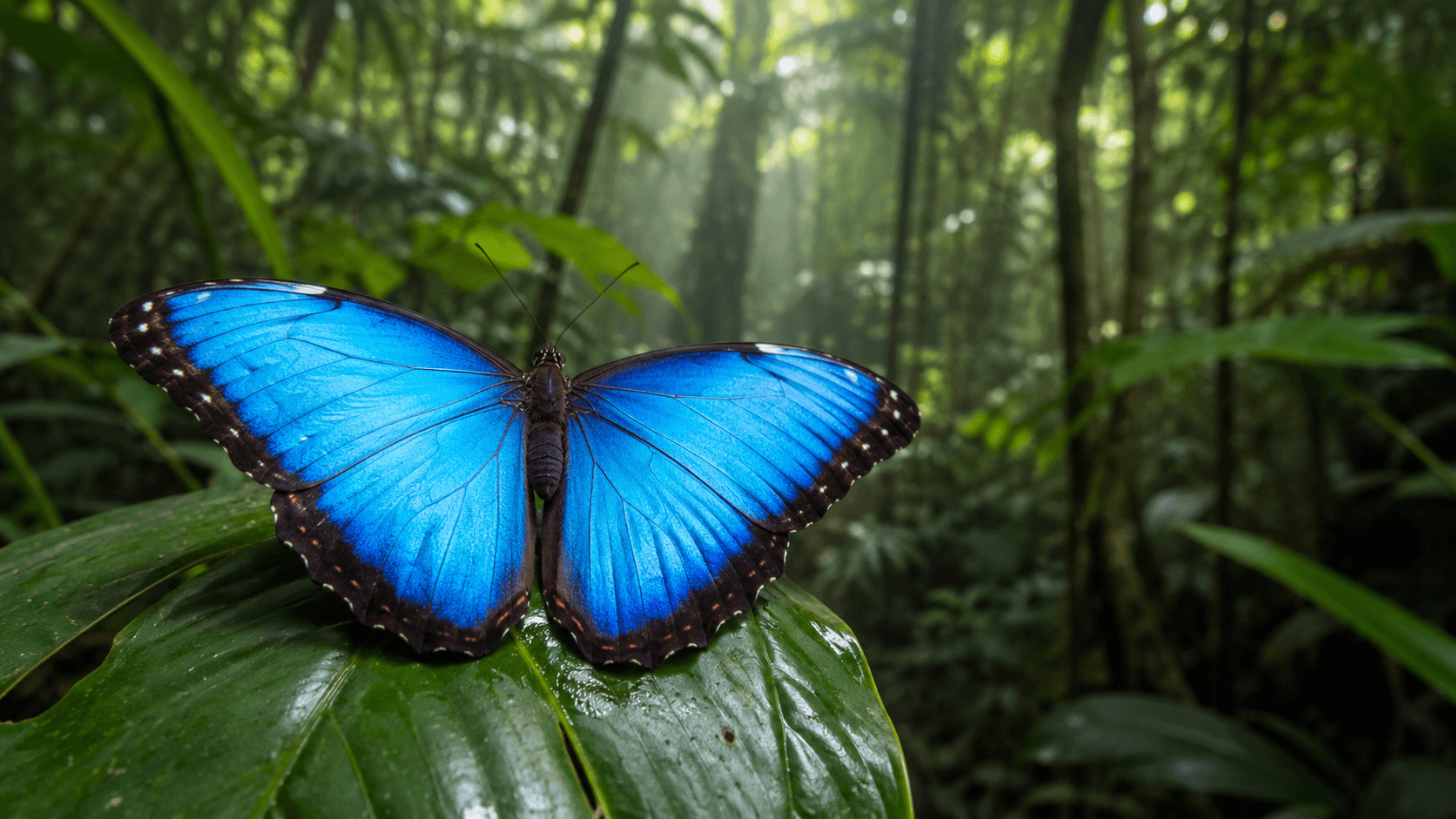
Morphos (Morpho) — symbol of the Amazon and the world's most photographed butterflies. The bright blue colour of males is not pigmentary but structural: nanorelief on scales creates interference and reflects blue depending on viewing angle.
- Morpho menelaus — blue with white border; 10–12 cm wingspan
- Morpho rhetenor — most intense blue; most reflective species
- Morpho helenor — one of the most widespread; from Mexico to Argentina
- Female morphos are usually brown with yellow spots — excellent camouflage
Morphos fly in the canopy and along river edges; they are easier to see in the morning when basking in sun at understory level.
Heliconiids
Heliconiids (Heliconiinae) — bright nymphalids with elongated wings. Caterpillars feed on passionflowers (Passiflora) and accumulate cyanogenic compounds; adults are unpalatable to birds. This makes them "models" for entire "mimicry rings".
- Heliconius melpomene and H. erato — classic Müllerian mimicry pair: two unpalatable species resembling each other; each region has its own geographic colour form
- Heliconius sara — blue with white and yellow spots
- Dryas iulia — bright orange; wide range from Florida to Argentina
Heliconiids are unique in longevity: adults live up to 9 months — a record among day-flying forms. This is linked to feeding on pollen as an additional source of amino acids.
Ithomiids (Neotropical clearwings)
Ithomiines (Ithomiinae) — another nymphalid subfamily of the Amazon; transparent or semi-transparent wings and slow fluttering flight. Unpalatable and participate in mimicry rings together with heliconiids.
- Greta oto — "glasswing"; wings almost fully transparent with orange-black border
- Mechanitis polymnia, Melinaea — rufous with black stripes; mimic heliconiids
In Amazon forests, hundreds of ithomiines and heliconiids gather on wet stream banks — "butterfly puddling" on damp sand.
Neotropical swallowtails
The Neotropics are rich in swallowtails (Papilionidae): more than 300 species for South America. Especially characteristic:
- Birdwings (Ornithoptera, Trogonoptera, Troides) are mainly Asian, but several large Amazon swallowtails reach 15–18 cm: Papilio torquatus, P. thoas
- Battus polydamas — large dark swallowtail without tails; unpalatable; model for mimicry in Papilio
- Parides — several species with red spots; poisonous
Andes
The Andes from Colombia to Patagonia — a 7,500 km mountain chain with diverse altitudinal belts. The tropical Andes are one of the world's biodiversity hotspots: about 40–50% of all plant species are endemic here, and insects in similar proportion.
Altitudinal belts
- Forest belt (1,000–2,500 m) — "cloud forest" (bosque nublado): constant cloud cover, mosses, orchids. Own morpho species (Morpho sulkowski), large swallowtails, unique nymphalids
- Subalpine belt (2,500–4,000 m) — páramo: open grassy plateaus with rich flower meadows. Sulphurs (Colias dimera, C. euxanthe), apollo-like parnassians
- Alpine belt (above 4,000 m) — puna: sparse vegetation, harsh climate. Specialised Tatochila (mountain whites), Phulia
Andean endemics
- Catasticta — mountain whites; more than 100 species, predominantly Andean
- Dione juno — heliconid of mountain forests
- Hundreds of blue species of the genus Polyommatus sensu lato (in the Andean interpretation)
South of the continent: Argentina and Chile
Patagonia is a temperate zone with poor but interesting fauna. About 200 species in Argentina south of 40° S. Characteristic are sulphurs, whites, satyrs of the genus Yphthimoides.
Chilean flora is unique — and specialised butterfly species tied to Chilean endemic plants occur only here.
Threats
Amazon deforestation is the main threat. 10,000–20,000 km² of forest are destroyed annually for farmland (soy, cattle ranching). Species with narrow ranges — especially endemics of isolated mountain valleys in the Andes — disappear faster than science can describe them.
Birdwings and several large swallowtails are listed in CITES Appendix II. Collector demand in the 20th century was significant — now regulated.
Best places for observations
| Region | Features |
|---|---|
| Manaus, Brazil | Centre of the Amazon; high species richness; morphos on river banks |
| Machu Picchu, Peru | Cloud forest + ruins; endemic Andean species + morphos |
| Medellín, Colombia | Andes–Amazon transition zone; one of the world's richest sites |
| Serra da Canastra, Brazil | Atlantic Forest (separate biome from Amazon); own endemics |
| Bolivia (Chapare) | High diversity with relatively easy access |
Best time: dry season (May–October in the Amazon), when butterflies gather at water bodies and hide less from rain.
For adjacent fauna — see North America. More on butterfly life — in the articles role in nature and why butterflies have bright wings.
See also