Butterflies of Ecuador
Ecuador has the highest butterfly species density in the world: about 4,500 species in a country smaller than Germany, spanning Amazon and Andean forests.
Ecuador: the world's butterfly capital by density
Ecuador occupies less than 284,000 km² — roughly the size of Germany — yet it harbours approximately 4,500 species of day-flying butterflies, making it the country with the highest butterfly species density per unit area on Earth. This extraordinary concentration is the product of a unique collision of three entirely different biogeographic worlds squeezed together on the equator.
Three worlds in one country
The Amazon basin (Oriente)
Eastern Ecuador — locally called the Oriente — is part of the upper Amazon basin. The provinces of Napo, Pastaza, Morona-Santiago, and Zamora-Chinchipe are covered by primary lowland tropical forest virtually continuous with the forests of Peru and Brazil.
Yasuní National Park (Napo province) is considered one of the most biodiverse places on Earth across all taxa. Butterfly diversity here rivals Peru: morphos (Morpho achilles, M. deidamia), Agrias, Prepona, Heliconius, and owl butterflies (Caligo) are all common. Puddling aggregations on Napo river beaches can include 50+ species at once.
Andean cloud forests
The spine of the Andes runs through Ecuador at elevations from 500 m to over 6,000 m (Chimborazo). The cloud forest belt between roughly 1,000 m and 2,800 m on both the eastern and western slopes is the primary engine of Ecuador's butterfly diversity. Each ridge and valley tends to have slightly different species assemblages — the result of millions of years of isolation during climate oscillations.
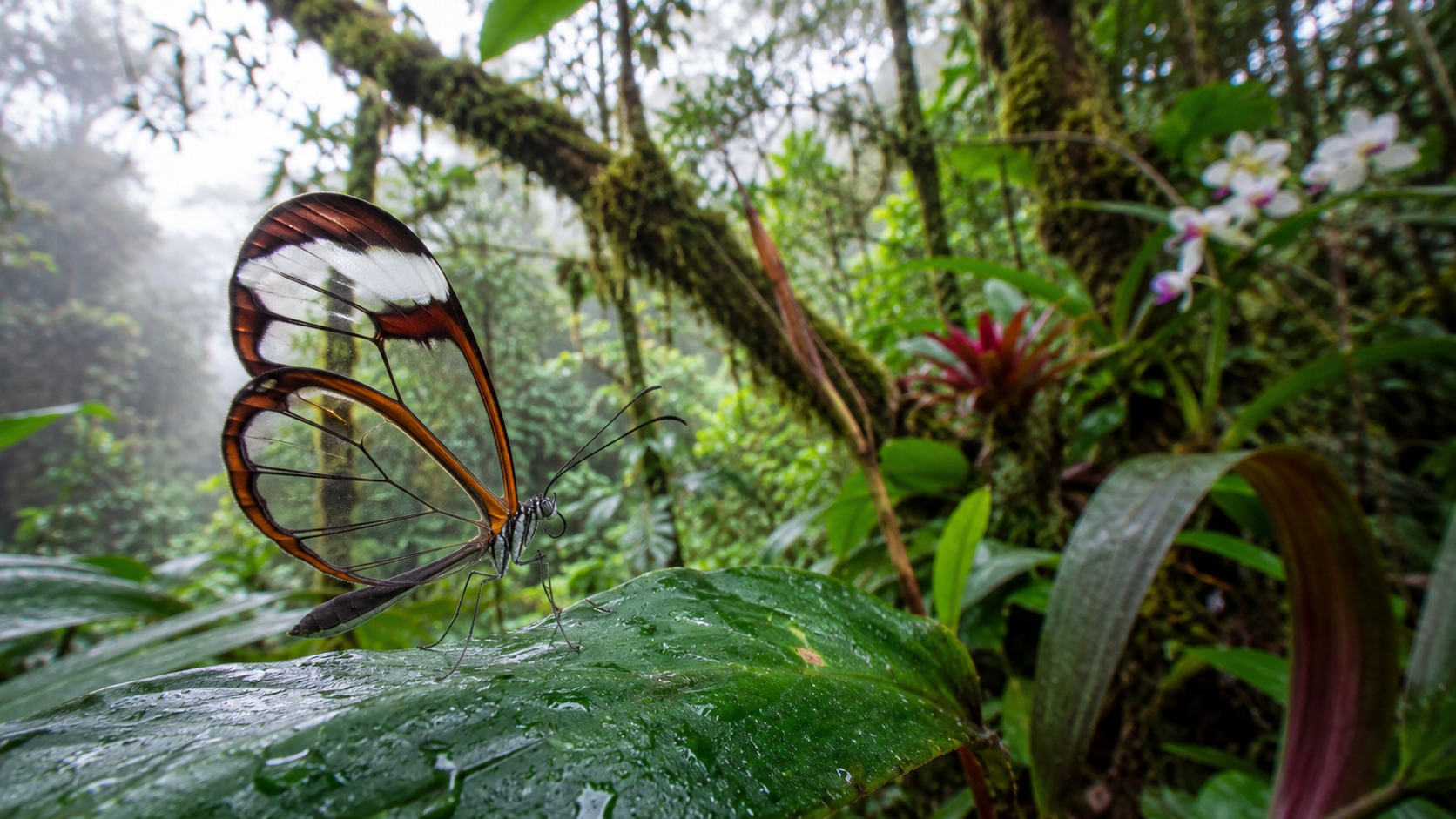
Glasswing butterflies (Greta oto and dozens of related ithomiine species) are the hallmark of these moist forests. Heliconius sapho with its striking black-and-white pattern is another cloud forest icon. Mountain morphos (Morpho sulkowskyi, with pearlescent white wings) replace the blue lowland morphos above 1,500 m.
The Chocó — hotspot of hotspots
The western slope of the Andes in Ecuador and Colombia forms part of the Chocó biodiversity hotspot, one of the most threatened and species-rich regions on Earth. Annual rainfall of 3,000–8,000 mm has maintained unbroken forest cover through ice ages, allowing species to accumulate over millions of years without extinction bottlenecks.
Ecuador's Chocó segment is home to hundreds of endemic butterfly species — many known from just a single valley or mountain slope. The area is also the global centre of diversity for some nymphalid tribes, including the clearwing ithomiines.
Mindo: the accessible window into cloud forest diversity
Mindo is the flagship butterfly destination in Ecuador and one of the most celebrated in all of South America. Located at 1,250 m in the western Andean foothills, the Mindo-Nambillo Protected Forest offers:
- Year-round butterfly activity with peaks in the drier months (June–August and December–February)
- More than 400 species recorded in the valley
- A dozen butterfly farms and botanical reserves with guided tours
- Easy 2-hour road connection from Quito
A single morning walk on the main Mindo trails regularly produces sightings of glasswings, Heliconius, morphos, swallowtails (Parides), and dozens of hairstreaks and blues invisible to the untrained eye.
Galápagos Islands
Ecuador's Galápagos archipelago lies 1,000 km off the Pacific coast. The islands have roughly 25 butterfly species, several endemic at the subspecies or species level. Numbers are modest compared with the mainland — colonisation of oceanic islands by butterflies depends on rare wind-drift events — but every species present tells a story of chance dispersal and local adaptation.
The most notable endemic is Junonia genoveva galapagensis, the Galápagos buckeye, with markings subtly different from its mainland relatives.
Iconic species
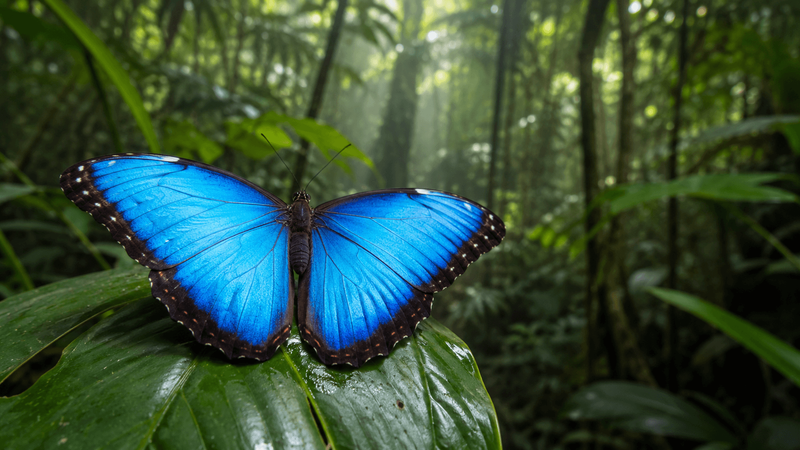
Morpho peleides — the common blue morpho; iridescent blue wings 100–120 mm across. Abundant in lower cloud forests and Amazonian edges throughout Ecuador.
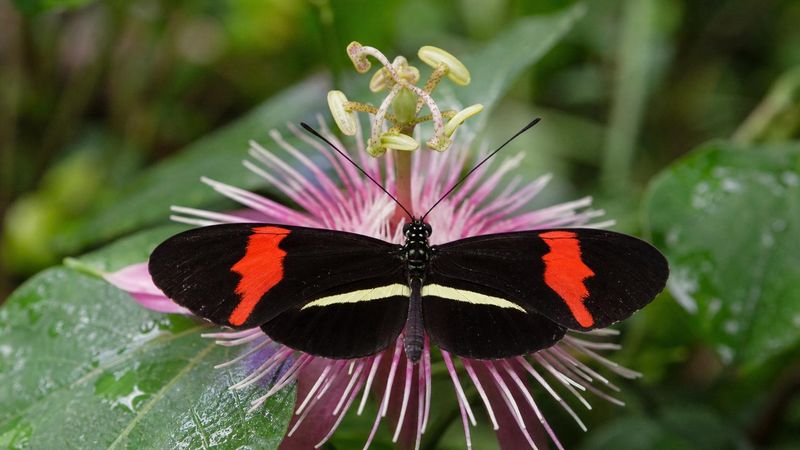
Heliconius sara — a vivid blue-and-black postman butterfly common in Mindo; its bold warning colours signal unpalatability to predators.
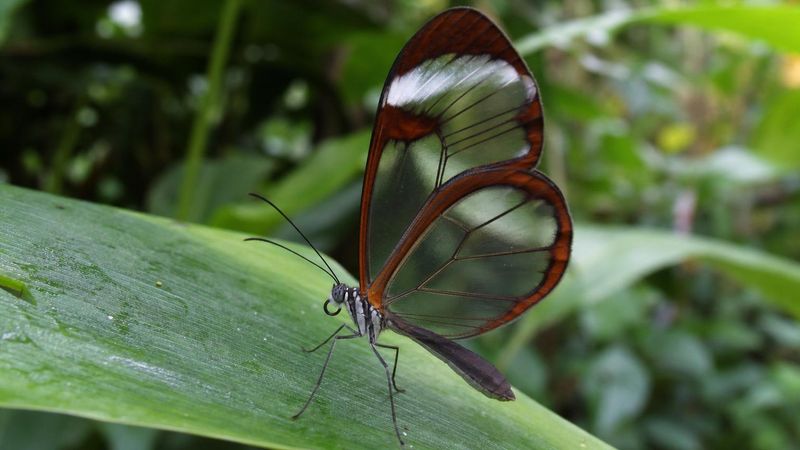
Greta oto — the glasswing butterfly; transparent wings make it nearly invisible at rest among leaves. The primary model for Ecuadorian cloud forest.
Agrias narcissus — a jewel-like nymphalid with a red-blue-green pattern; inhabits primary Amazonian forest and is sought after by collectors and photographers alike.
Parides childrenae — a spectacular swallowtail with velvety black wings and vivid green patches; found in cloud forests of the eastern Andean slope.
Best observation sites
Mindo valley — the classic choice; best infrastructure, widest species range, suitable for all skill levels.
Yasuní National Park (Napo province) — requires a flight to Coca or a long overland journey, but delivers the most complete Amazonian fauna.
Cajas National Park (Azuay province, near Cuenca) — high-altitude páramo at 3,000–4,500 m; specialist fauna of mountain butterflies including Andean whites, fritillaries, and altitude-adapted blues.
Bellavista Cloud Forest Reserve (northwest of Quito) — smaller than Mindo but excellent for Chocó endemics and tranquil observation.
Observation season
Ecuador straddles the equator, so day length is constant year-round. The main seasonal driver is rainfall. In the western slopes and Mindo the drier months (June–August and December–February) are considered optimal: butterflies are more active in sunshine and puddling aggregations are larger. In Amazonia the dry season (roughly July–November) provides better trail conditions. Cloud forests function year-round — the key variable is whether the fog lifts by mid-morning.
Science and conservation
Ecuador is a critical site for evolutionary biology. Studies of Heliconius mimicry rings across Ecuadorian valleys have been central to understanding how warning coloration evolves and how genetic exchange between populations creates geographic variation. The country hosts numerous long-term butterfly monitoring projects.
The primary threat is deforestation on the western slopes (Chocó). Only about 2–4% of the original Chocó forest remains in Ecuador. Many narrowly endemic butterfly species have restricted ranges that could place entire populations at risk from a single logging event.
Interesting facts
- Ecuador's Mindo valley has been counted in Christmas Bird Count data since the 1990s and doubles as a butterfly hot spot: the Christmas Butterfly Count regularly exceeds 300 species in a single day.
- The ithomiine tribe (clearwing nymphalids) reaches its global peak diversity in Ecuador — over 200 species are recorded in the country.
- Several new butterfly species are described from Ecuador each year; the cloud forests of the western Andes remain incompletely surveyed.