Glasswing Butterfly
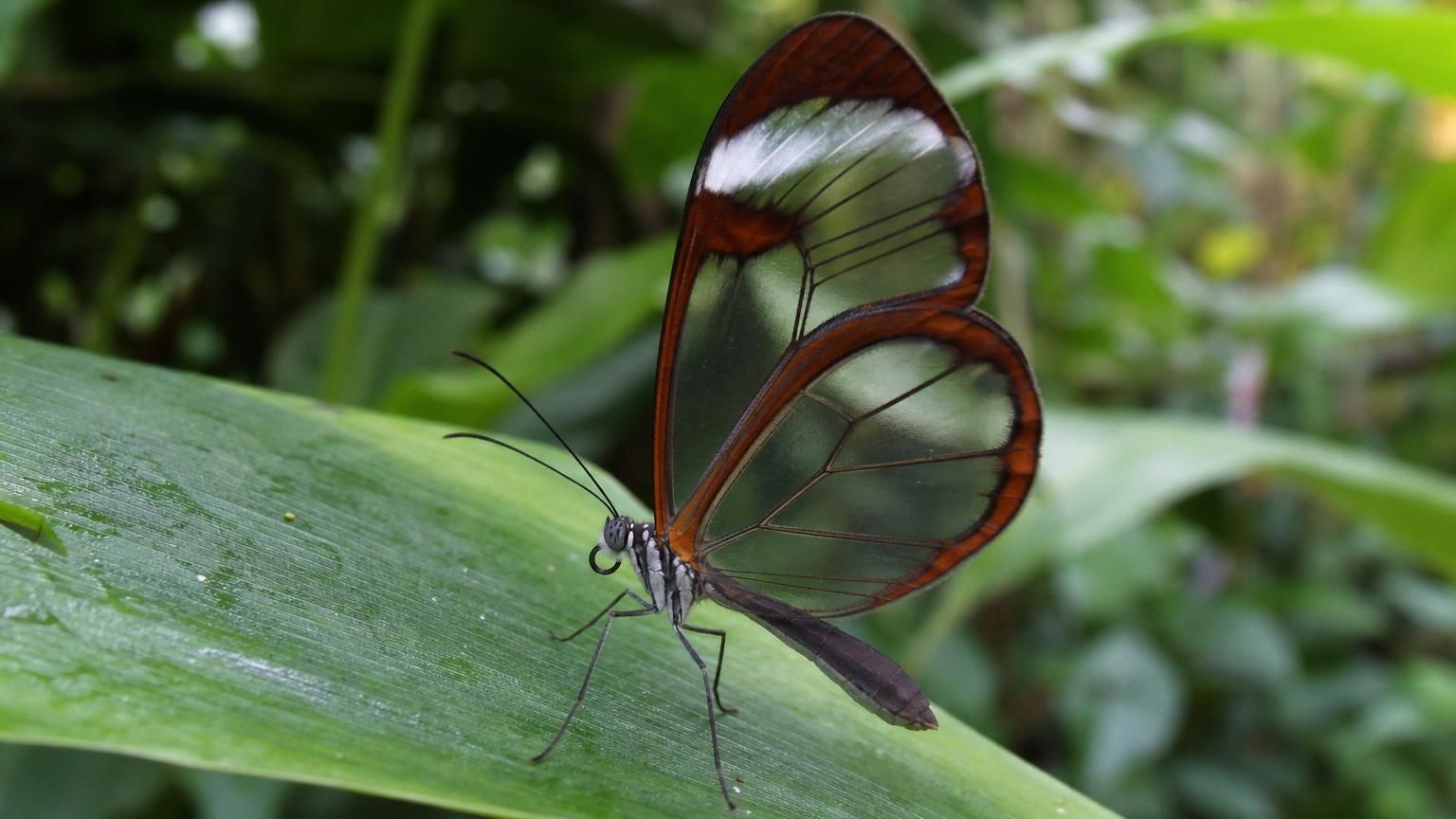
The glasswing butterfly Greta oto is a nymphalid with transparent wings lacking scales in the center — a master of camouflage in Central American forests.
Key facts
- Latin name
- Greta oto
- Family
- Nymphalidae
- Wingspan
- 56-61 mm
- Flight season
- Year-round
- Host plants
- Cestrum spp., Lycianthes lenta, Other Solanaceae species
- Conservation status
- LCLeast Concern
Appearance
The glasswing butterfly (Greta oto) is a small nymphalid with a wingspan of 56–61 mm. Its main feature is transparent wings: the central portion of both pairs of wings lacks pigmented scales, and the background shows through. The wing margins are opaque: brown with white and orange spots.
In flight the glasswing is almost invisible: the body and wing margins move through the air while the "windows" merge completely with the background. On a leaf or branch the butterfly disappears, leaving only the thin wing frame visible.
Mechanism of transparency
Transparency is the result of two simultaneous adaptations. First, the central portion of the wings has almost no scales — empty cells of the wing membrane allow light to pass through. Second, the membrane itself is covered with a nanopillar array about 400 nm high. These outgrowths function as an anti-reflective coating: they scatter reflected light and reduce surface glare from 50% to less than 2%, eliminating the mirror effect.
It is precisely this mechanism — passive "anti-reflection" through nanostructure — that optical engineers study to create anti-glare coatings for screens and solar panels.
Range and habitat
The species lives from Mexico in the north to Colombia and Venezuela in the south. Most common in Costa Rica and Panama. It prefers humid montane forests and cloud forests at 1,000–2,000 m elevation — where constant humidity and diffuse light are especially advantageous for transparent camouflage.
At lower elevations it is less common. It avoids open dry places.
Feeding and chemical defence
Caterpillars feed on leaves of plants in the genus Cestrum and some other Solanaceae. These plants contain pyrrolizidine alkaloids — toxic compounds accumulated in the tissues of the caterpillar and adult. As a result the butterfly is poisonous to most vertebrates.
Adult males purposefully seek alkaloid-bearing plants (often wilted parts of heliotropes, Eupatorium) — these compounds are needed to synthesise pheromones. Males rich in alkaloids are more attractive to females.
Behaviour and migrations
Greta oto is a comparatively slow-moving butterfly. It flies smoothly and slowly, which is unusual for a nymphalid of this size. The slow flight reflects confidence in chemical protection: there is no need to hurry.
The species partially migrates along an altitudinal gradient: in the dry season individuals move to lowland forests, returning to the mountains in the rainy season. In Costa Rica aggregations of up to several thousand individuals have been observed near water sources during the dry season.
It actively participates in mimicry complexes with other transparent butterflies of the tribe Ithomiini — the so-called "ithomiine communities," where dozens of species copy each other's appearance, amplifying the poison signal to predators.
Life cycle
The female lays eggs singly on the underside of Cestrum leaves. The caterpillar is yellowish-green with purple stripes. After several moults it pupates — the chrysalis is shiny, silvery-green with golden spots, hanging vertically. The adult lives for several weeks.
Significance for science and technology
The nanopillar structure of Greta oto's wing has become a model for developing biomimetic anti-reflective coatings. The technology is applied in manufacturing anti-glare screens for smartphones, photovoltaic panels, and optical instruments.
Interesting facts
- The transparency of the wings is achieved without any pigments or dyes — through structure alone and the absence of scales.
- In tropical butterfly gardens Greta oto is one of the most popular exhibits: visitors cannot believe it is a real butterfly until they see it in flight.
- Related transparent species occur throughout Central and South America — Heliconius melpomene from the same ecosystem forms a mimicry complex with Greta oto.