Heliconius Melpomene
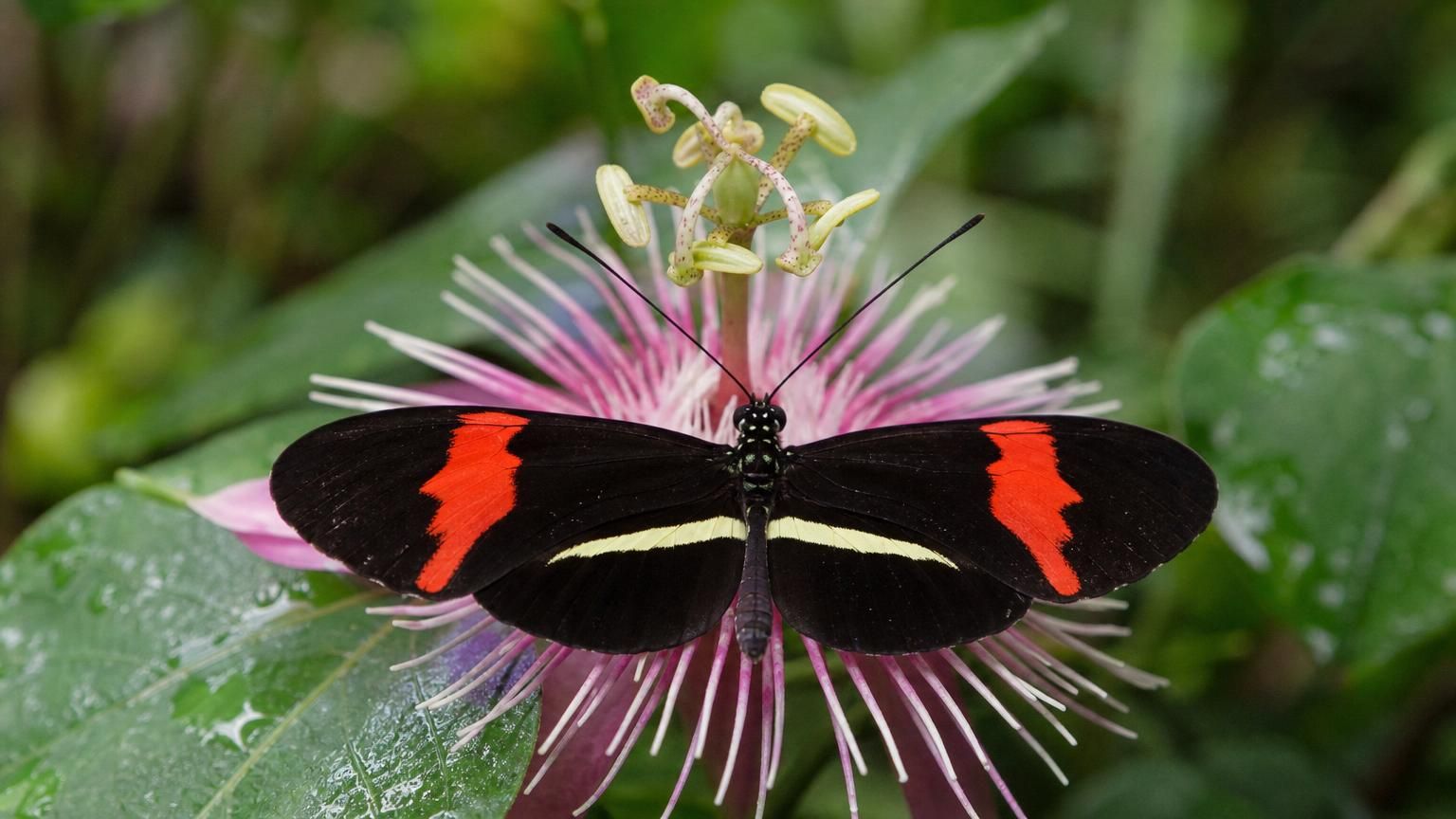
Heliconius melpomene is a tropical nymphalid with red-and-black wings, a classic example of Müllerian mimicry, inhabiting Central and South American forests.
Key facts
- Latin name
- Heliconius melpomene
- Family
- Nymphalidae
- Wingspan
- 52-65 mm
- Flight season
- Year-round
- Host plants
- Passionflower (Passiflora spp.)
- Conservation status
- LCLeast Concern
Appearance
Heliconius melpomene, or the "postman butterfly," is a medium-sized nymphalid (52–65 mm) with elongated narrow forewings. The basic pattern is black with a vivid red transverse band on the forewing and a yellow patch at the base of the hindwing. However, the exact pattern varies: the species has more than 30 geographic races with their own designs.
The name "postman" comes from the characteristic red-and-black "stripes" — like an old postal uniform. The pattern of H. melpomene is virtually indistinguishable from that of a completely different species — Heliconius erato — with which it forms the classic Müllerian mimicry pair.
Range
The species inhabits tropical and subtropical forests from Mexico to Bolivia and southern Brazil. It is most common in Amazonia, Costa Rica, Colombia, and Ecuador. It stays mainly in the understory and at the edges of humid forest, where passionflowers grow.
Pollen feeding — a unique Heliconius trait
Most butterflies feed on nectar, which provides carbohydrates but is poor in protein. Heliconius melpomene has evolutionarily mastered pollen feeding: the butterfly actively visits flowers of certain plants (mainly cucurbits and others), places pollen on its coiled proboscis and moistens it with nectar, forming a "pollen ball." From this, amino acids are gradually released, which the butterfly absorbs.
Pollen provides the female with proteins for continuous egg production. A female Heliconius lays 1–5 eggs per day throughout her life — this contrasts sharply with most butterflies, which lay all their eggs over a few days.
Müllerian mimicry
H. melpomene and H. erato are "doubles" not because of common ancestry but due to parallel evolution: both species independently developed similar patterns in each region. In Costa Rica both are red-and-black, in Ecuador — with yellow stripes, in Peru — differently. This "geographic parallelism" of patterns is considered one of the most compelling pieces of evidence for natural selection.
The mutual benefit of the scheme: if a bird has tasted one poisonous "postman," it memorizes the pattern and avoids both species. The more poisonous butterflies with the same pattern, the faster the predator learns.
Life cycle
The female lays eggs singly on young shoots and tendrils of passionflowers (Passiflora). The caterpillar is white with rows of black spines. The host plant is toxic — the caterpillar accumulates cyanogenic glycosides providing chemical defence. The chrysalis is angular, with spines and spots, mimicking a dry leaf. The complete cycle takes about 3 weeks to adult emergence.
The adult is long-lived: up to 6–9 months — a record among non-tropical nymphalids. Longevity is sustained by protein nutrition from pollen.
Behaviour
Heliconius engage in communal roosting: several individuals (sometimes several dozen) gather on a single branch every night, returning to the same spot repeatedly. This facilitates mate-finding and reduces the risk of nocturnal predation — a group is more conspicuous than a solitary individual.
Each individual's foraging routes are personal and fixed: the butterfly visits the same flowers in the same sequence every day — a phenomenon called "trapline foraging."
Significance for science
Heliconius are the primary model organism for studying speciation and mimicry. The genome of H. melpomene was fully sequenced in 2012; the key gene optix controlling the red elements of the pattern was identified. Manipulations with optix allow "redrawing" of the wing pattern, confirming the genetic basis of mimicry complexes.
Interesting facts
- Heliconius melpomene is one of the few butterfly species with a fully sequenced genome.
- Bees and Heliconius independently evolved pollen feeding — convergent evolution at different levels of Lepidoptera and Hymenoptera.
- Male Heliconius can mate with a female still inside the chrysalis before she emerges — the phenomenon of "pupal mating," found in several tropical nymphalids.
- Together with Heliconius erato the melpomene / erato pair is the "icon" of mimicry in biology textbooks worldwide.