Monarch
The monarch is the world's most famous migratory butterfly, covering up to 4,500 km per season, with orange wings marked by black veins and white spots.
Key facts
- Latin name
- Danaus plexippus
- Family
- Nymphalidae
- Wingspan
- 86-102 mm
- Flight season
- Year-round (in tropics); migrations — March to November
- Host plants
- Common milkweed (Asclepias syriaca), Tropical milkweed (Asclepias curassavica), Other Asclepias species
- Conservation status
- VUVulnerable
Appearance
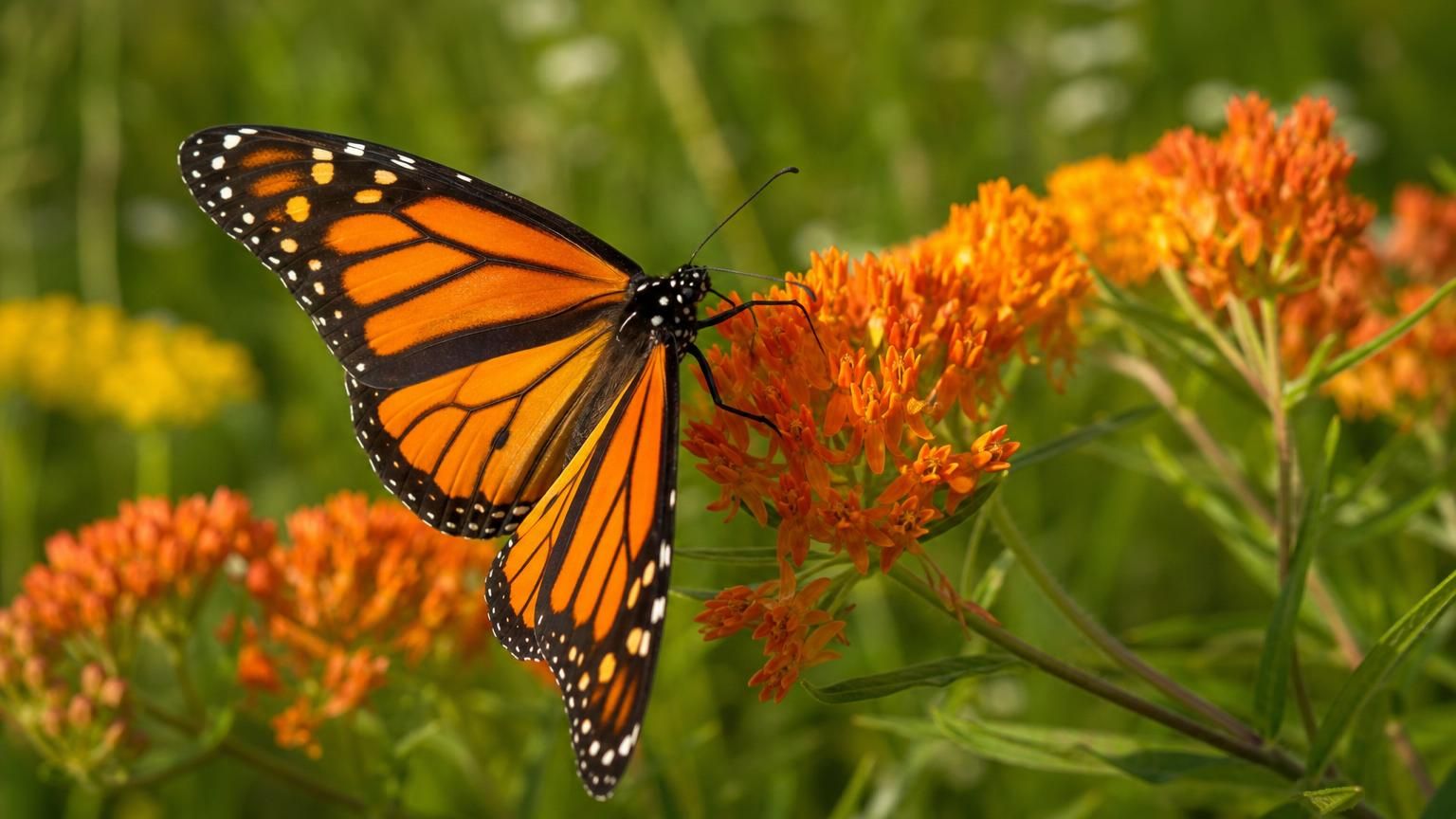
The monarch (Danaus plexippus) is one of the world's most recognizable butterflies with a wingspan of 86–102 mm. The upper side of the wings is a rich orange with a broad black border and white spots along the margins. Black veins clearly divide the wing into cells. The forewings are more elongated and angular than in most nymphalids.
The male is distinguished by scent scales — a dark "androconal patch" on the hindwings. Females are slightly larger with broader black veining. The underside is paler: pale orange with the same white spots.
The young caterpillar is creamy white with black stripes. The mature caterpillar is banded, black and white with yellow rings and a pair of black filamentous appendages front and rear. The chrysalis is vivid green with a golden rim — one of the most beautiful in the world.
Range and habitat
The monarch is native to North and Central America but has spread to almost the entire tropical belt: it lives in Australia, Hawaii, the Canary Islands, Western Europe (rare vagrant), and New Zealand. In North America it breeds from southern Canada to Mexico.
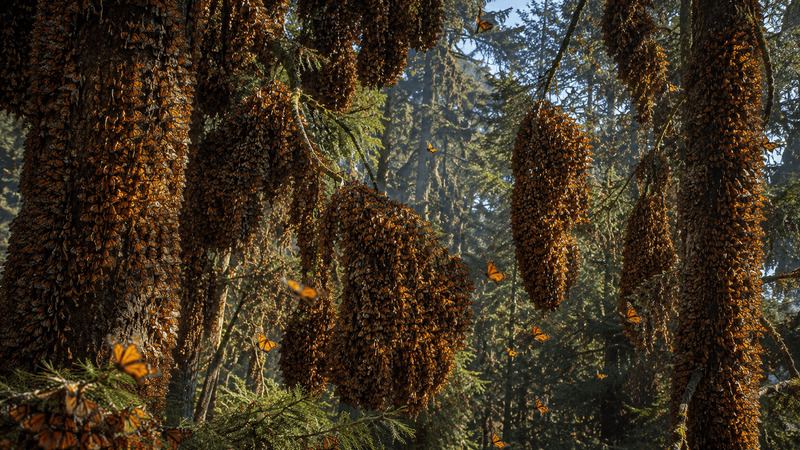
It prefers open areas with milkweed: meadows, clearings, roadsides, gardens. For overwintering it gathers in mountain fir forests of central Mexico at 2,400–3,600 m elevation.
Migration
The monarch's migration is one of nature's greatest spectacles. Every autumn the eastern population (numbering up to several hundred million individuals) flies from Canada and the USA to the mountains of Michoacán state. Butterflies navigate by the position of the sun and the Earth's magnetic field. A single route covers up to 4,500 km.
In spring the butterflies fly north again, but through successive generations: the first generation reaches Texas, lays eggs and dies. The second and third generations continue northward to Canada. In autumn a special "super-generation" with an extended lifespan (up to 8 months) makes the full journey south.
The western population (California, Arizona) overwinters over short distances — hundreds of kilometres, not thousands like the eastern one. These two migratory systems evolved independently over millions of years. The overwintering forests in Michoacán, Mexico, where millions of monarchs gather, have become one of the main ecotourism and research destinations in the North America atlas.
Life cycle
The female lays eggs singly on the underside of milkweed leaves. The caterpillar develops over 9–14 days, passing through 5 instars and consuming large quantities of leaves — along with their toxic cardenolides. The chrysalis hangs for about 10 days, after which the adult emerges. Summer generations live 2–5 weeks; the autumn "super-generation" lives up to 8 months.
Chemical defence
Cardenolides from milkweed make the monarch unpleasant-tasting and toxic to many vertebrates. The vivid orange-and-black coloration is aposematic (warning): predators learn to avoid monarchs after a first attempt to eat one.
The related viceroy (Limenitis archippus) is also unpalatable: its resemblance to the monarch is a classic example of Müllerian mimicry (Ritland & Brower, 1991), not Batesian mimicry.
Conservation
Since 11 December 2023 the migratory population of the monarch has held VU (Vulnerable) status under IUCN — a population assessment, not a species-wide EN listing. Over three decades the wintering eastern population has declined by approximately 85%. The main threats are destruction of milkweed by herbicides on agricultural land in the USA and Mexico, logging of overwintering forests in Michoacán, and climate change.
To conserve the species, programs to plant milkweed along migration corridors are active in the USA and Canada. The overwintering forests in Mexico were designated a UNESCO World Natural Heritage Site in 2008.
Interesting facts
- During autumn migration the monarch travels an average of 80–140 km per day, using rising thermal currents.
- The "super-generation" is physiologically different from summer ones: it has developed fat reserves, suppressed reproduction, and extended lifespan.
- In Australia the monarch lives as a resident: milkweed was introduced there and there is no need to migrate.
- Migratory memory is genetically programmed — butterflies flying south for the first time have never seen the wintering grounds of their ancestors.