Mourning Cloak
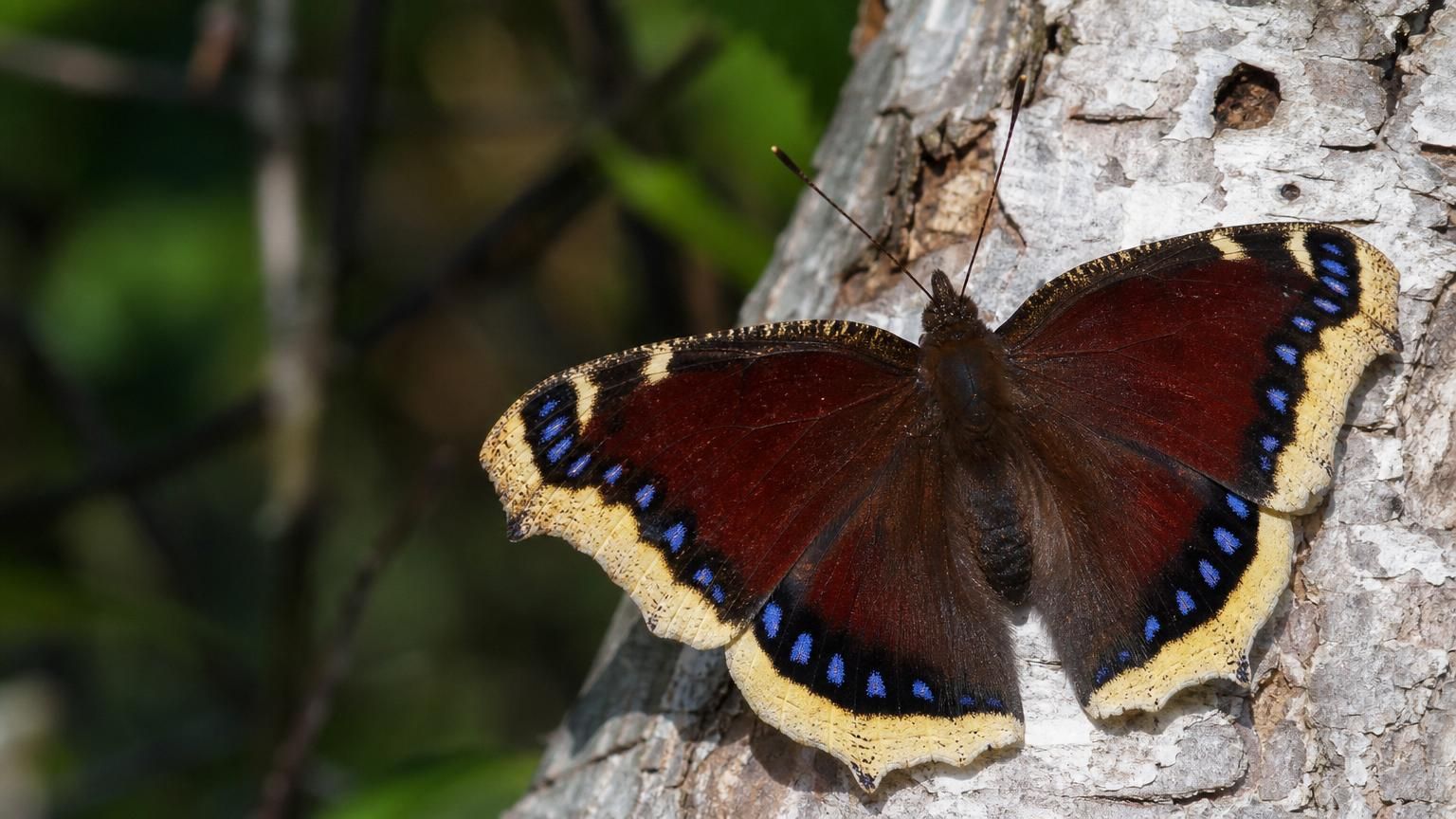
The mourning cloak is a large butterfly with dark chocolate wings bordered by a yellow band and blue spots — one of Europe's longest-lived butterflies.
Key facts
- Latin name
- Nymphalis antiopa
- Family
- Nymphalidae
- Wingspan
- 64-88 mm
- Flight season
- June — October
- Host plants
- Willow, Birch, Poplar, Elm
- Conservation status
- LCLeast Concern
Appearance
The mourning cloak (Nymphalis antiopa) is one of the largest day-flying butterflies in Russia with a wingspan of 64–88 mm. The upper side of the wings is dark chocolate (almost black) with a broad cream-yellow band along the outer margin. Along the inner edge of the yellow band — a row of blue spots.
The underside of the wings is dark grey with fine lighter strokes. The yellow border fades with age to almost white.
A characteristic feature — the jagged margins of the hindwings, creating a 'torn' edge effect.
Range and Habitat
The mourning cloak is distributed through the entire forest zone of Europe and Asia and also in North America. In Russia it occurs from the western border to the Pacific.
It prefers deciduous and mixed forests, river floodplains with willow, and birch groves. It is often found on mountain meadow slopes. In mountains it reaches up to 2,000 m.
Long-lived Butterfly
The mourning cloak holds the record for lifespan among European day-flying butterflies. Imago lives 10–12 months. The butterfly emerges from the pupa in July–August, is active until the first frosts, then enters winter dormancy.
After overwintering it appears in March–April when snow may still lie in the forest. By then the wings are noticeably worn and the yellow border has whitened, but flight ability remains.
Life Cycle
The female lays eggs in rings around thin twigs of willow, birch, or poplar — 150–300 eggs per clutch. Caterpillars are black with red spots and branched spines, living in colonies.
The pupa is angular, brownish grey with orange tubercles. The pupal stage lasts about two weeks. The first adults appear in July.
Overwintering takes place in secluded spots: under bark, in hollows, crevices. Thanks to glycerin accumulation in the haemolymph the mourning cloak survives frosts down to −20 °C.
Behaviour
The mourning cloak is active from early spring until the first frosts. Flight is powerful and fast; the butterfly often glides with half-lowered wings. Males occupy forest glades and often return to the same spot day after day. It feeds on tree sap, fallen fruit, and willow flower nectar. It readily descends to damp forest paths for puddling — taking mineral salts from moist soil.
Reproduction
The female lays eggs in rings around thin willow or birch twigs — up to 300 eggs in one clutch. Caterpillars are black with red spots and branched spines, living in a tight colony and feeding synchronously. Before pupation they scatter singly. The pupa is grey-brown with orange tubercles; the pupal stage is about two weeks. Adults emerge in July.
Overwintering
The mourning cloak overwinters as an adult under tree bark, in hollows, rock crevices, and unused buildings. A unique trait — tolerance of deep freezing: glycerin builds up in the haemolymph, preventing ice crystal formation. Survival at −20 °C has been recorded. In spring the mourning cloak is among the first to wake — often in March while snow has not yet melted.
Interesting Facts
- The mourning cloak lives 10–12 months — a lifespan record among European day-flying butterflies.
- The yellow border fades almost to white by the end of life: this easily distinguishes an old butterfly from a freshly emerged one.
- In North America the species is called Mourning Cloak; in German — Trauermantel.
- The mourning cloak releases pheromones from special glands that deter bats in winter shelters.