Small Tortoiseshell
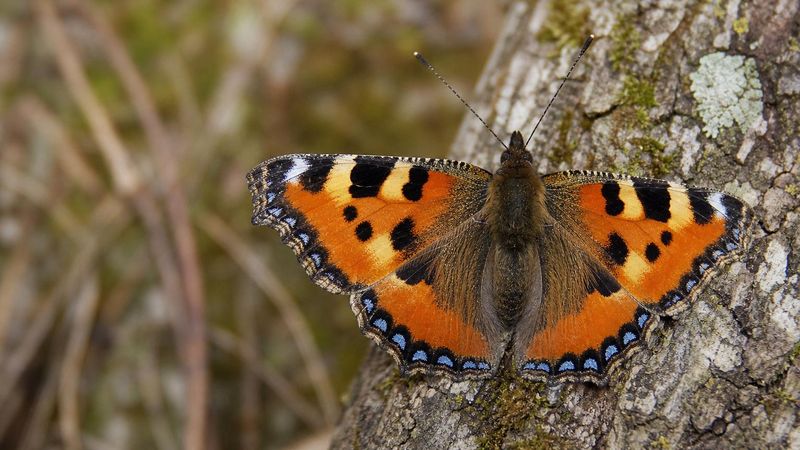
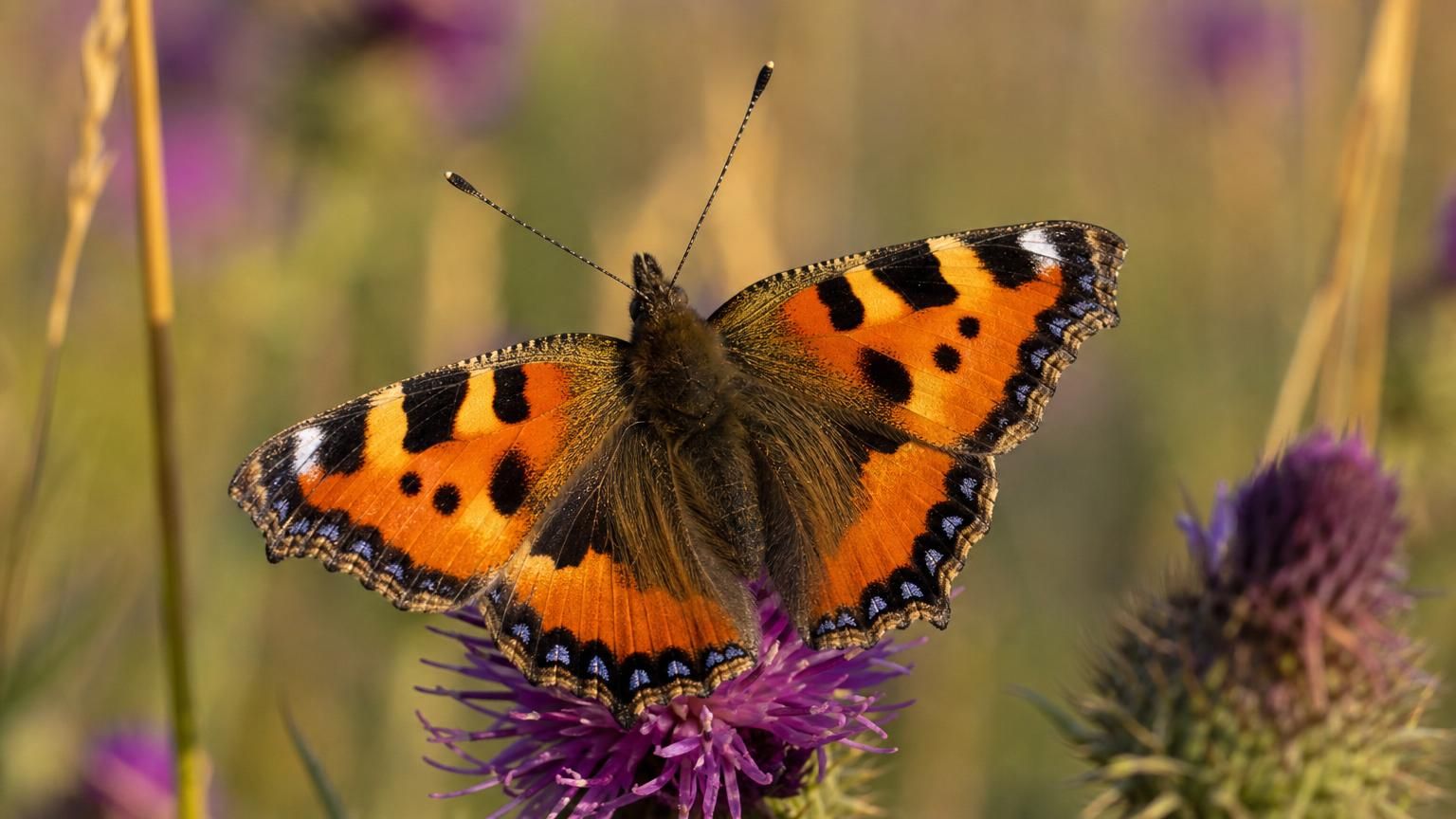
The small tortoiseshell is one of the most common day-flying butterflies of the temperate zone, with bright orange wings, black spots, and blue marginal 'eyes'.
Key facts
- Latin name
- Aglais urticae
- Family
- Nymphalidae
- Wingspan
- 40-52 mm
- Flight season
- March — October
- Host plants
- Stinging nettle, Small nettle
- Conservation status
- NENot Evaluated
Appearance
The small tortoiseshell (Aglais urticae) is a medium-sized butterfly with a wingspan of 40–52 mm. The upper side of the wings is brick-orange with black and white spots along the leading edge. A row of blue "eyespots" on a black background runs along the outer margin of all wings — a reliable field mark.
The underside is cryptically colored: dark brown with a marbled pattern. With wings folded the butterfly resembles a piece of bark or a dry leaf — ideal camouflage during overwintering.
Freshly emerged adults are brighter and more contrasting; wing color fades with age.
Range and Habitat
The small tortoiseshell is one of the most widely distributed species in the world fauna. It inhabits all of Europe and most of Asia from the Atlantic to the Pacific. In Russia it occurs wherever nettles grow: from forest-tundra to semidesert.
Preferred biotopes are meadows, forest edges, river floodplains, gardens, and allotments. The species has adapted well to human settlements: in urban parks and dacha villages it is as common as in wild nature.
Vertically it reaches up to 3,000 m above sea level in mountain regions.
Life Cycle
In central Russia the small tortoiseshell overwinters as imago, hiding in cellars, tree hollows, sheds, and unused buildings. With the first warmth (March–April) overwintered butterflies emerge and begin flight.
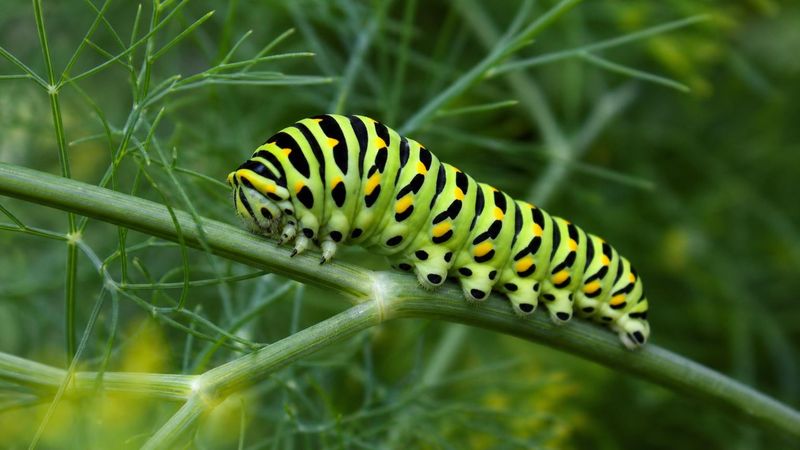
Females lay eggs on the underside of young nettle leaves — in clusters of 100–300. Caterpillars are dark green or black with yellow stripes, living in colonies under a protective silk web.
The pupa hangs head-down from a stem or fence, greenish or brown with a metallic sheen. The pupal stage lasts 10–14 days. In central Russia 2–3 generations develop per year: spring (April–May), summer (July–August), and autumn (August–September) going into winter dormancy.
Behavior
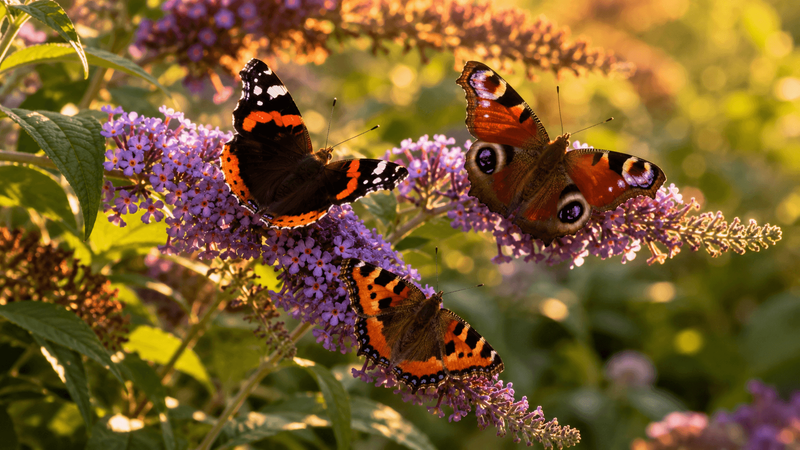
The small tortoiseshell is diurnal, active from early morning until evening twilight. Males occupy sunny glades and defend territory: they rise to meet any passing butterfly and chase it in circles. When threatened the butterfly folds its wings sharply — the dark underside makes it indistinguishable from bark or a dry leaf. It readily visits thistles, buddleia, chervil, willow, and other nectar plants with lilac and purple flowers.
Reproduction
Mating occurs in spring and early summer. Males patrol nettle patches seeking females. The female lays eggs on the underside of young nettle leaves in clusters of 100–300. Eggs are greenish and ribbed. The caterpillar passes through five instars in three to four weeks: in early instars it stays in a colony under a silk web, in later instars — alone. The pupa is suspended head-down on a stem or fence, greenish or brown with golden tubercles. The adult emerges after 10–14 days.
Overwintering
The small tortoiseshell is one of the few European species that overwinters as imago. Before winter it feeds intensively on nectar, building fat reserves. In autumn it seeks shelter: cellar, attic, tree hollow, or gap in a wooden building. Optimal overwintering temperature is 0 to +4 °C. Too warm a winter forces premature awakening, often leading to death. In spring, with stable warming to +10 °C, the butterfly leaves shelter and begins flight.
Interesting Facts
- The small tortoiseshell is among the first to appear in early spring, often flying over snow in February–March.
- Including overwintering, total lifespan can reach 11 months.
- Blue marginal "eyespots" deter birds: predators attack the "eye" rather than the vulnerable body.
- A record long-distance flight of over 1,500 km was recorded in Germany.
- In Britain it is one of the most numerous day-flying butterflies; the German name Kleiner Fuchs ("little fox") refers to the reddish coloration.
Conservation and Significance
There is no global IUCN assessment (NE). Population is stable across the range. The butterfly is an important pollinator of meadow plants. It is among the first spring species to pollinate early-flowering plants.
To attract small tortoiseshells to a garden, leave an unmown patch of nettles and plant nectar sources: buddleia, willow, burdock, clover.