Popular Butterfly Species
The best-known butterflies of the world: swallowtail, red admiral, peacock, Apollo, monarch — descriptions and where to find them.
What Makes a Species "Popular"
Some species everyone knows — even those who have never studied entomology. These are butterflies that fly outside our windows, appear in photographs, and are mentioned in poetry and textbooks. Their popularity comes from size, brightness, wide distribution, or unusual behavior.
Below are 12 species most often found in gardens, meadows, and forests of Russia, plus several world "celebrities."
Swallowtail (Papilio machaon)
Family: swallowtails (Papilionidae)
Wingspan: 65–90 mm
Where: meadows, fields, gardens, river banks — throughout Russia
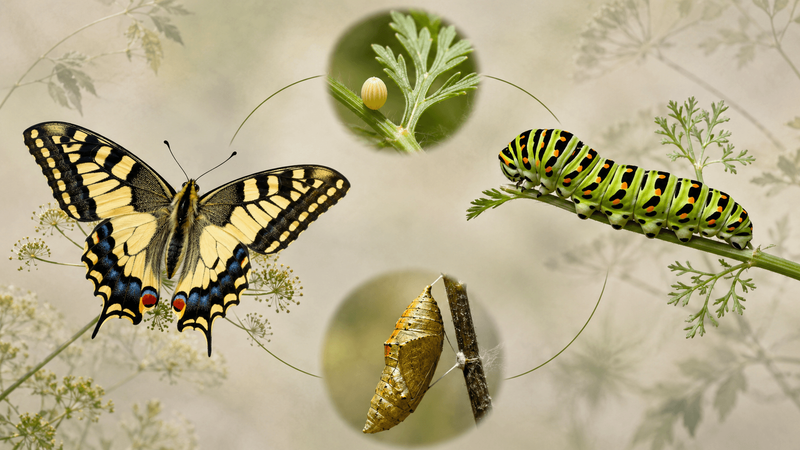
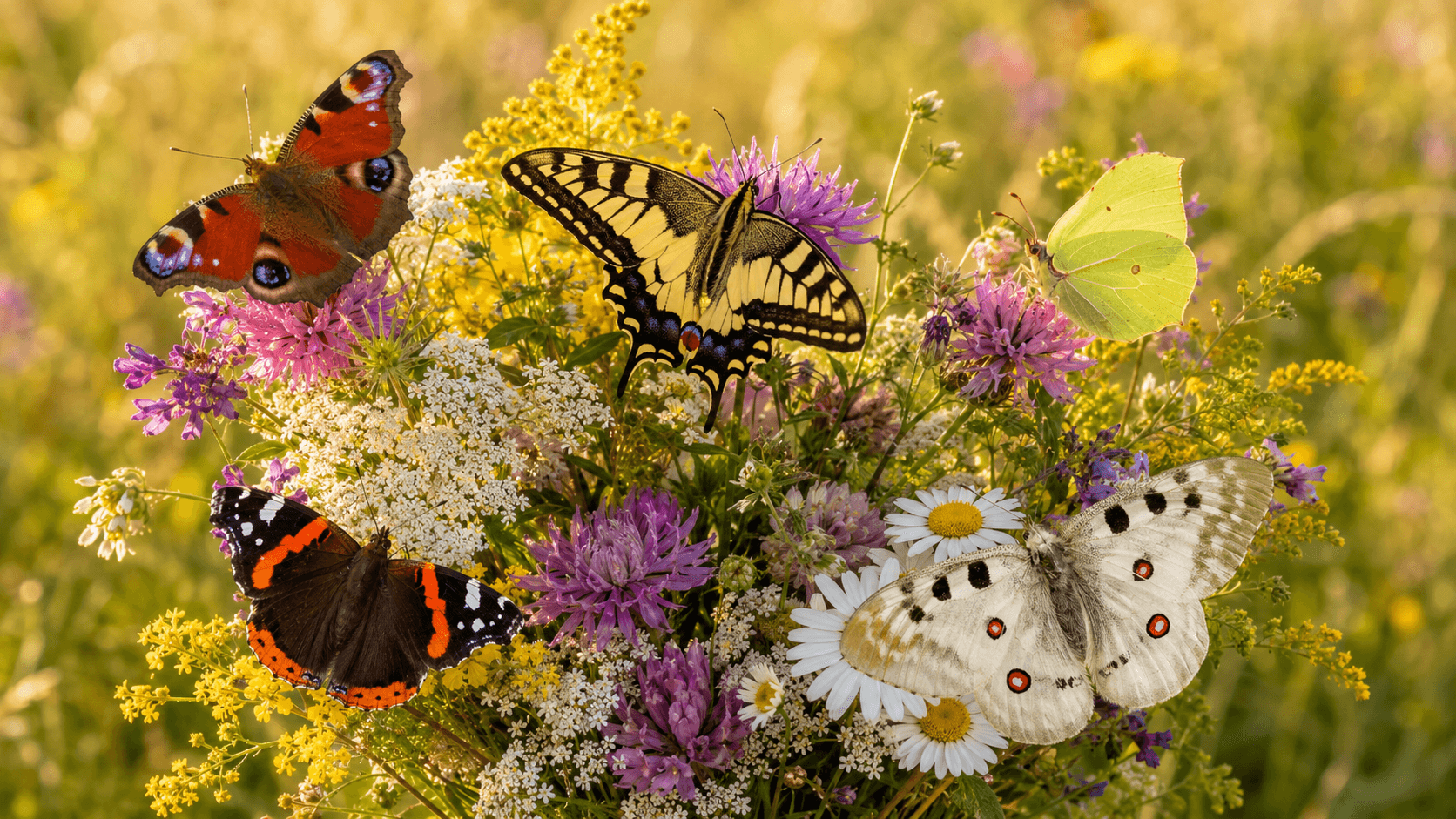
The country's best-known "tailed" butterfly. Yellow wings with black pattern and red-blue spots on the hindwings — unmistakable. Tail extensions moderately broad, about 1–1.5 cm.
Two generations: April–May and July–August. Caterpillar bright green with black stripes and orange spots — one of the most beautiful caterpillars of the temperate zone. Feeds on umbellifers: carrot, dill, hogweed, angelica. When threatened it extends the osmeterium — a forked orange organ with a sharp smell.
Read more — in the swallowtails section.
Peacock (Aglais io)
Family: nymphalids (Nymphalidae)
Wingspan: 50–60 mm
Where: throughout, in gardens, forest edges, parks
Red-brown wings with large blue "eyes" on each wing — one of the most recognizable silhouettes among all European butterflies. Underside dark brown, imitating bark: with wings closed the butterfly becomes nearly invisible.
Overwinters as adult — appears with the first warm days of March. Caterpillar black with spines, lives in groups on nettles. By August–September the second generation accumulates fat reserves and goes into winter dormancy.
Small Tortoiseshell (Aglais urticae)
Family: nymphalids
Wingspan: 40–50 mm
Where: wherever nettles grow
Orange-red with black spots and blue border along the outer edge. One of Russia's most common butterflies — found in cities, villages, forests, fields. Overwinters as adult; caterpillars black with yellow spots, on nettles.
Interesting fact: in years with warm autumns small tortoiseshells often enter homes and overwinter there — in gaps between window frames or behind cabinets.
Red Admiral (Vanessa atalanta)
Family: nymphalids
Wingspan: 55–65 mm
Where: throughout, migrant
Black wings with bright red band on forewings and red border on hindwings, white spots on forewing tips — a contrasting, memorable pattern. In August feeds on overripe fruit and fermented tree sap.
Migrant: arrives from the south in spring, breeds, and in autumn part of the population returns south. In some years unusually abundant. Caterpillar on nettles, solitary, in a tube of rolled leaves.
Brimstone (Gonepteryx rhamni)
Family: whites (Pieridae)
Wingspan: 50–60 mm
Where: forest edges with buckthorn, gardens, parks
Male intensely yellow, female pale greenish, almost white. Angular wing edges imitate a leaf with veins — perfect camouflage when overwintering among ivy or laurel leaves.
One of the longest-lived day-flying butterflies: imago lives up to 10–11 months (from summer emergence through overwintering to the following summer). Caterpillar on buckthorn and alder buckthorn.
Painted Lady (Vanessa cardui)
Family: nymphalids
Wingspan: 45–60 mm
Where: throughout, active migrant
Rusty orange with black and white spots — similar to small tortoiseshell, but pattern more complex and symmetrical. The most widely distributed butterfly in the world: found on all continents except Antarctica.
Makes large-scale migrations across the Mediterranean and North Africa. In "good" years waves of migrants cover all of Europe. Caterpillar on thistles, knapweed, burdock.
Mourning Cloak (Nymphalis antiopa)
Family: nymphalids
Wingspan: 65–80 mm
Where: forest edges, floodplains with willows
One of the largest nymphalids of the temperate zone. Dark brown, almost black, with a broad pale yellow border along wing edges and a row of blue spots near the border. Underside imitates dark bark.
Overwinters as adult in bark crevices. Emerges very early — sometimes in late February at the first thaw. Caterpillar black with red spots and spines, on willow, birch, poplar.
Scarce Swallowtail (Iphiclides podalirius)
Family: swallowtails
Wingspan: 65–85 mm
Where: forest edges with blackthorn, gardens, south of central zone and southern Russia
Pale yellow or almost white with parallel dark stripes and very long, almost thread-like tail extensions. Slow, gliding flight. Comes to flowering blackthorn, cherry, sweet cherry.
Rarer than swallowtail in central Russia; common in the south. Listed in regional Red Data Books of several regions.
Apollo (Parnassius apollo)
Family: swallowtails
Wingspan: 60–90 mm
Where: mountain meadows with stonecrop, limestone slopes
White with red eyespots in black borders on hindwings. Slow, gliding flight. Listed in Russia's Red Data Book.
Strictly tied to mountain meadows with stonecrop (Sedum) — the caterpillar's only host plant. After mating the female carries a sphragis on her abdomen — a waxy plug the male attaches, preventing remating. Read more — in the article rare butterflies.
Comma (Polygonia c-album)
Family: nymphalids
Wingspan: 40–50 mm
Where: forest edges, gardens, shrub thickets
Ochre-brown with dark spots and deeply scalloped, "torn" wing edges — imitation of a damaged dry leaf. Underside resembles bark with a small white "C" (or comma) mark on hindwings — hence the name.
Overwinters as adult among leaves or in bark crevices. One of the "autumn" butterflies — found until October. Caterpillar on nettles, raspberry, hop.
World Celebrities
Monarch (Danaus plexippus)
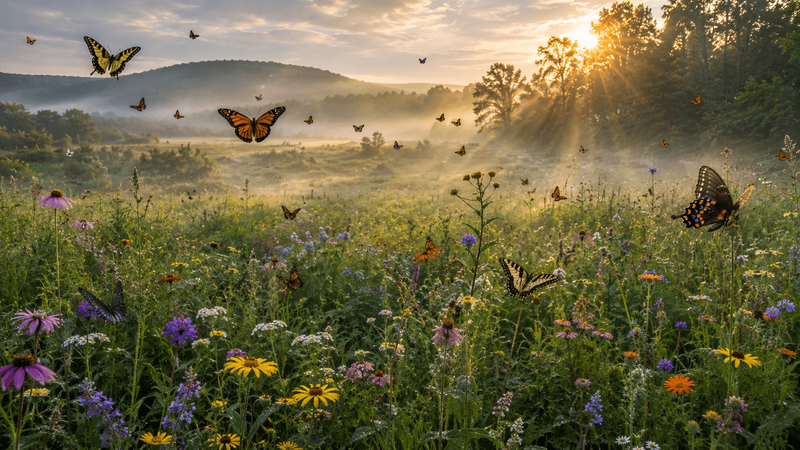
A large orange-black butterfly of North America, famous for record migrations: the eastern monarch population flies up to 4,500 km each year — from Canada to wintering grounds in the Michoacán mountains, Mexico. In winter millions of butterflies cover trees in a small mountain region.
Not found in Russia, but a rare vagrant on the Azores and Canary Islands.
Morpho (Morpho)
Tropical butterflies of South America with dazzling blue wings. Blue color is structural — no pigment; nanostructures of scales scatter light (like a diffraction grating). Wingspan up to 20 cm.
Queen Alexandra's Birdwing (Ornithoptera alexandrae)
The world's largest day-flying butterfly: females reach a wingspan of 28 cm. Papua New Guinea. Species on the brink of extinction; strictly protected.
How to Watch Famous Species
Most popular species can be found without leaving the city:
- In the garden: plant nettles (for small tortoiseshell and peacock), buddleia and thistles (for red admiral and painted lady), dill and carrot (for swallowtail).
- On a meadow: June–July — peak species diversity.
- At a forest edge with blackthorn: in May — scarce swallowtail and orange tip.
- At flowering thyme and savory in the mountains — Apollo.
Detailed seasonal guide — in the identification guide by season. Families covered in detail in the butterfly families section.
See also