Butterflies of Malaysia
Malaysia harbours around 1,300 butterfly species across Peninsular Malaysia and Bornean Sabah and Sarawak. Rajah Brooke's Birdwing is the national butterfly.
Malaysia: Sundaland butterfly paradise
Malaysia straddles two of the world's great biogeographical regions. Peninsular Malaysia forms the southernmost tip of continental Southeast Asia, while the states of Sabah and Sarawak occupy the northern third of Borneo — the world's third-largest island. Both are part of Sundaland, an ancient landmass that was connected at lower sea levels during the Pleistocene ice ages, creating shared faunal elements across what is now separated by the South China Sea.
The result is a butterfly fauna of approximately 1,300 recorded species, spanning every ecological zone from mangrove coast to cloud forest above 3,000 m. Malaysia is one of the world's top destinations for butterfly observation, combining extraordinary diversity with relatively good road access to forest interiors.
Rajah Brooke's Birdwing
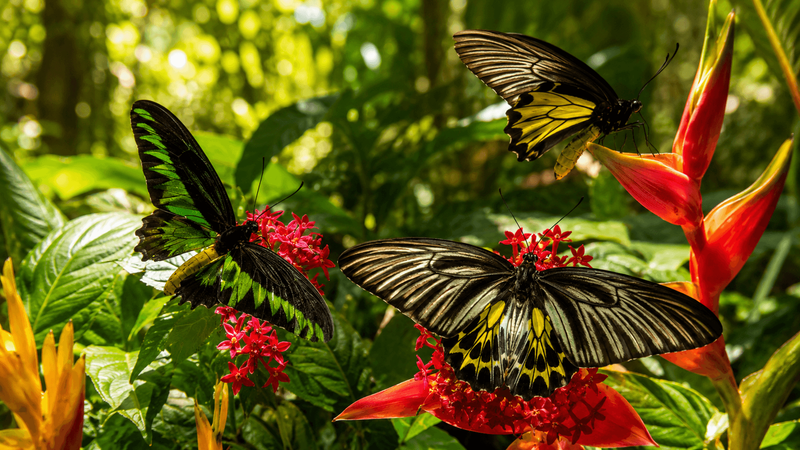
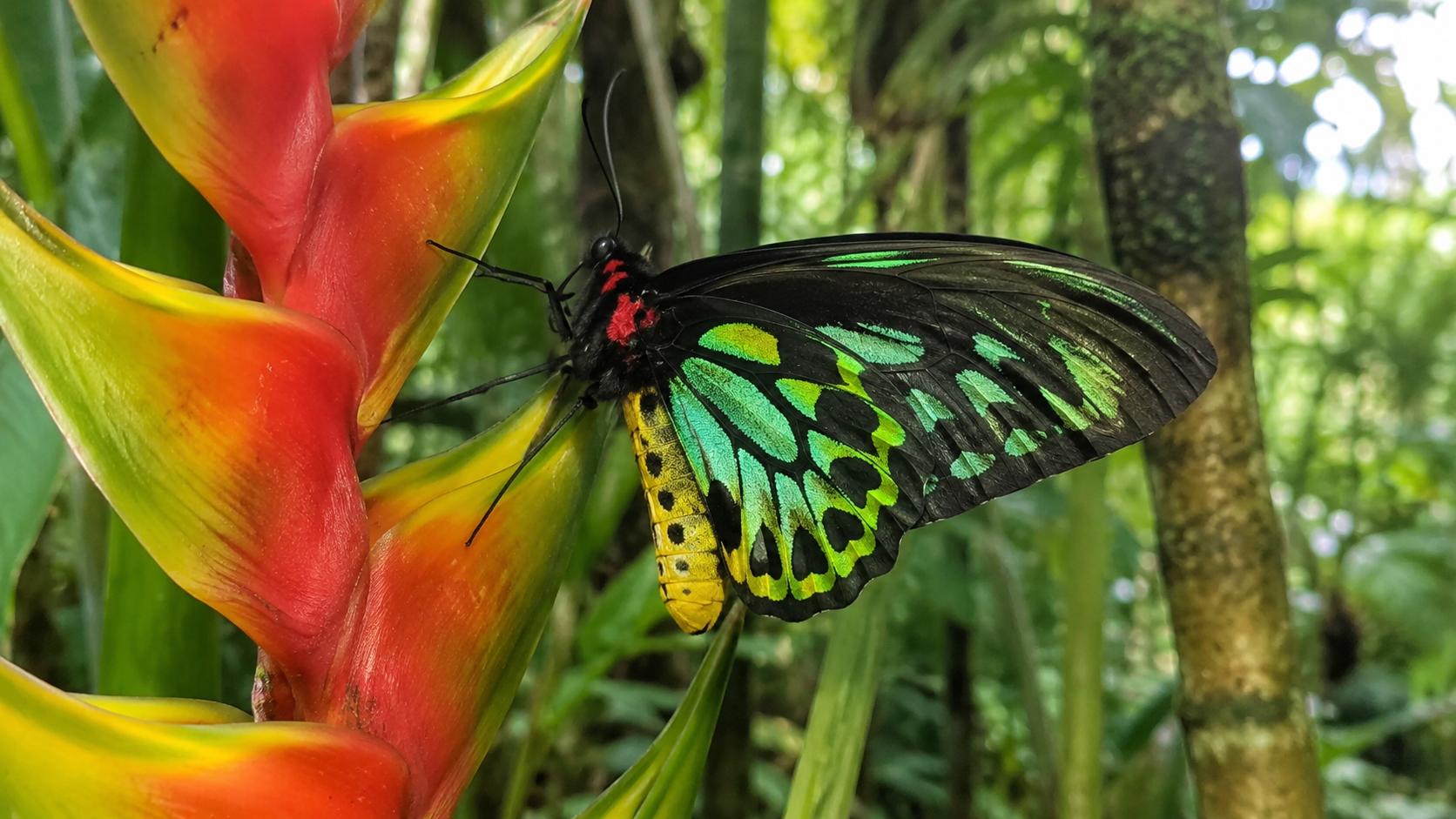
No species defines Malaysia's butterfly identity more completely than Rajah Brooke's Birdwing (Trogonoptera brookiana). The male is immediately recognisable: velvety black wings carrying a row of triangular patches in vivid electric green, angled along the forewing like a row of arrowheads. In flight the green catches the light differently at each angle, shifting from emerald to lime to almost yellow.
The species congregates at mineral seeps and river sandbars where males may gather in groups of 10–50, drinking mineral-rich water. These aggregations — called puddling parties — are one of the great spectacles of tropical entomology. Females, larger and less flamboyant, spend most of their time in the forest canopy, and are rarely seen except near their larval host plant (Aristolochia vines).
Rajah Brooke's Birdwing was declared Malaysia's national butterfly in recognition of its uniqueness and its role as a flagship for forest conservation. It is legally protected in both Malaysia and Indonesia.
Borneo: Kinabalu and beyond
The Bornean component of Malaysia's butterfly fauna is distinct from the Peninsular fauna. Sabah and Sarawak share the island with Indonesian Kalimantan, and Borneo as a whole is one of the world's most important centres of butterfly endemism.
Kinabalu National Park
Mount Kinabalu (4,095 m, Sabah) is a UNESCO World Heritage Site and one of the best-studied sites for biodiversity in Southeast Asia. Its altitudinal gradient supports dramatically different butterfly communities at each elevation:
- Lowland dipterocarp forest (below 600 m): the greatest diversity, including birdwings, large swallowtails, and numerous Lycaenids
- Hill and lower montane forest (600–1,800 m): peak richness for many groups; characteristic species include Papilio karna and various Graphium swallowtails
- Upper montane forest and cloud forest (1,800–3,000 m): fewer but more specialised species; several endemic Satyrids found only on Kinabalu
- Summit zone (above 3,000 m): very few butterfly species; mainly wind-dispersed vagrants
Danum Valley
The Danum Valley Conservation Area (438 km², Sabah) is among the best-preserved patches of lowland Bornean rainforest. Undisturbed by agriculture, it represents the original forest that once covered most of Borneo. Puddling aggregations of birdwings, glasswings, and swallowtails at stream edges are exceptional. Research has identified over 500 species at the site.
Peninsular Malaysia
Taman Negara
Taman Negara ("National Park" in Malay) covers 4,343 km² of forest on the Malay Peninsula. The park's lowland forest is estimated to be around 130 million years old — far older than the Amazon rainforest — making it one of the world's most ancient continuous ecosystems. Butterfly diversity here is concentrated at river banks, flowering trees, and the famous canopy walkway, where species from different forest layers can be observed.
Cameron Highlands
The Cameron Highlands (900–1,800 m, Pahang) offer a very different experience: cool montane grasslands and tea plantations interspersed with patches of cloud forest. Highland species found here include several Troides birdwings (at lower elevations), the endemic Papilio slateri, and numerous Delias species. The Cameron Highlands is particularly good for observing highland Lycaenids feeding on mistletoes.
Fraser's Hill
Fraser's Hill (1,200–1,500 m) is an accessible highland resort with extensive forest. The road up to the summit passes through progressively higher forest and provides excellent casual observation. Several regional endemics are recorded in the montane zone here.
Iconic species
Rajah Brooke's Birdwing (Trogonoptera brookiana) — national butterfly; vivid green and black; puddling behaviour.
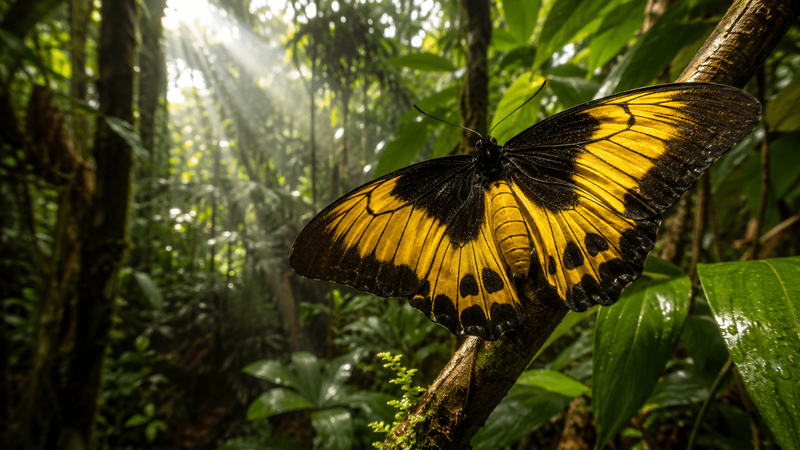
Golden Birdwing (Troides aeacus) — large black-and-gold swallowtail of hill and lower montane forests; larvae feed on Aristolochia.
Common Birdwing (Troides helena) — the most widespread birdwing of the lowlands; males shining yellow and black; females brown with yellow patches.
Banded Peacock (Papilio palinurus) — emerald-green swallowtail of Borneo's rainforest edges; also on the Malay Peninsula and Sumatra.
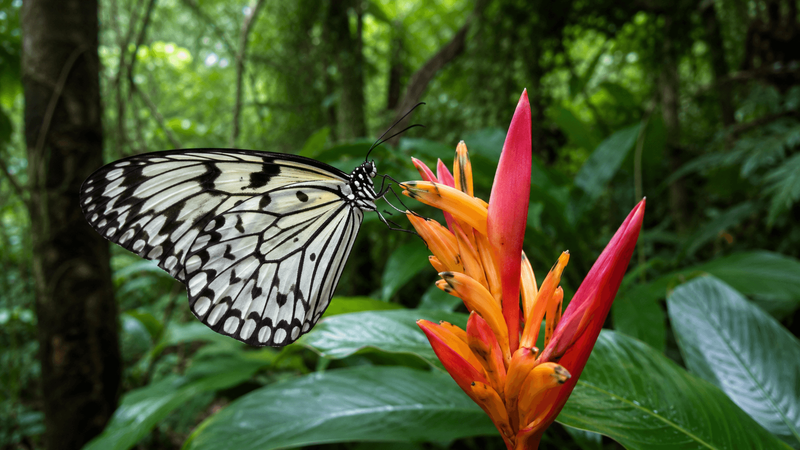
Paper Kite (Idea leuconoe) — large, slow-flying nymphalid with translucent white wings veined in black; poisonous and unpalatable.
Cruiser (Vindula dejone) — a large orange nymphalid; males brilliant orange-brown, females with blue-green structural colour; common at forest edges.
Observation season
Malaysia is tropical and butterflies fly year-round. The most productive periods are during transitions between monsoon seasons:
- March–May: dry season in Peninsular Malaysia; excellent for puddling aggregations at low river levels
- October–December: shoulder period in Sabah and Sarawak before the northeast monsoon
The northeast monsoon (November–March) brings heavy rain to the east coast of the Peninsula but leaves the west coast (Kuala Lumpur, Penang, Langkawi) relatively drier. Sabah's dry season (April–October) is generally better for forest trails. Cloud forest sites are productive in any month but most rewarding in the clearer mornings of the dry period.
Conservation
Malaysia's primary butterfly conservation challenge is deforestation: oil palm plantations have replaced large areas of lowland forest in both Peninsula and Borneo, particularly in Sabah and Sarawak. Lowland dipterocarp forest — the habitat of highest butterfly diversity — is the most heavily affected.
Several birdwing species are listed under CITES Appendix II, regulating international trade in specimens. Malaysia operates butterfly farms for tourism, notably in Kuala Lumpur's Butterfly Park (one of the world's largest indoor butterfly enclosures), which also plays an educational role.
Interesting facts
- Malaysia's butterfly diversity is roughly equal to that of all of Europe and North America combined, despite being far smaller in area.
- Trogonoptera brookiana was named by Alfred Russel Wallace — co-discoverer of the theory of evolution — who encountered it on his travels through Borneo in the 1850s.
- The Danum Valley has been studied continuously for over 40 years, making it one of the world's longest-running tropical forest monitoring programmes.