Rajah Brooke's Birdwing
Rajah Brooke's birdwing — national butterfly of Malaysia: electric-green wings up to 175mm, Bornean rainforests. CITES-listed, spectacular flier.
Key facts
- Latin name
- Trogonoptera brookiana
- Family
- Papilionidae
- Wingspan
- 150–175 mm
- Flight season
- Year-round
- Host plants
- Aristolochia species (Aristolochia foveolata, A. obliqua, and related species)
- Conservation status
- LCLeast Concern
Appearance
Rajah Brooke's birdwing is one of the world's most instantly recognisable butterflies.
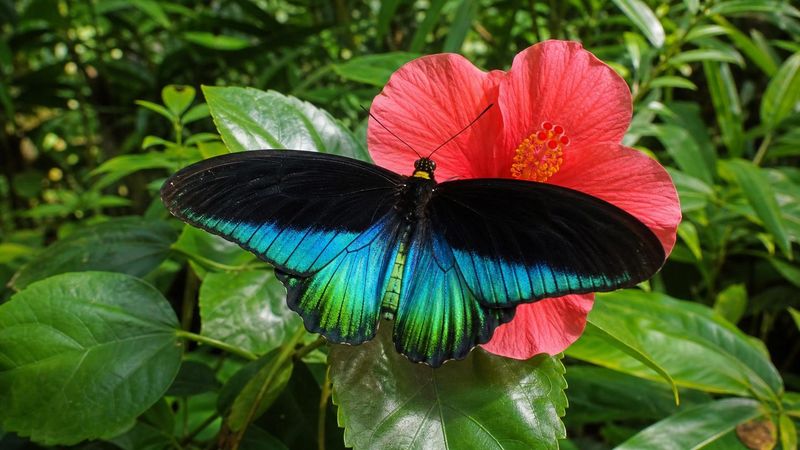
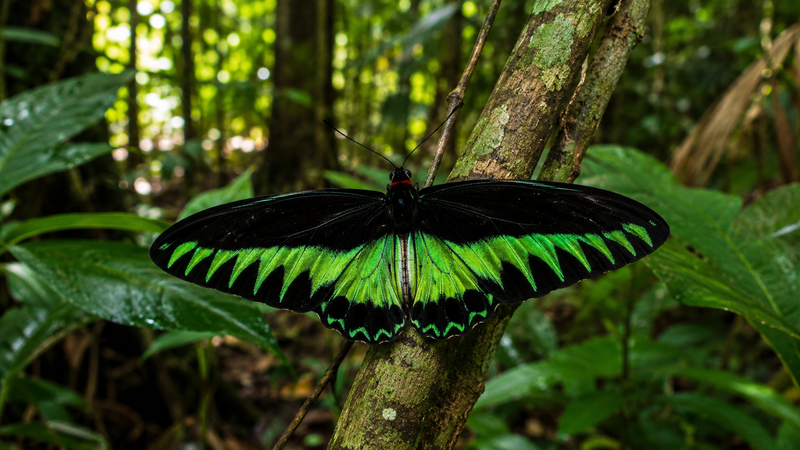
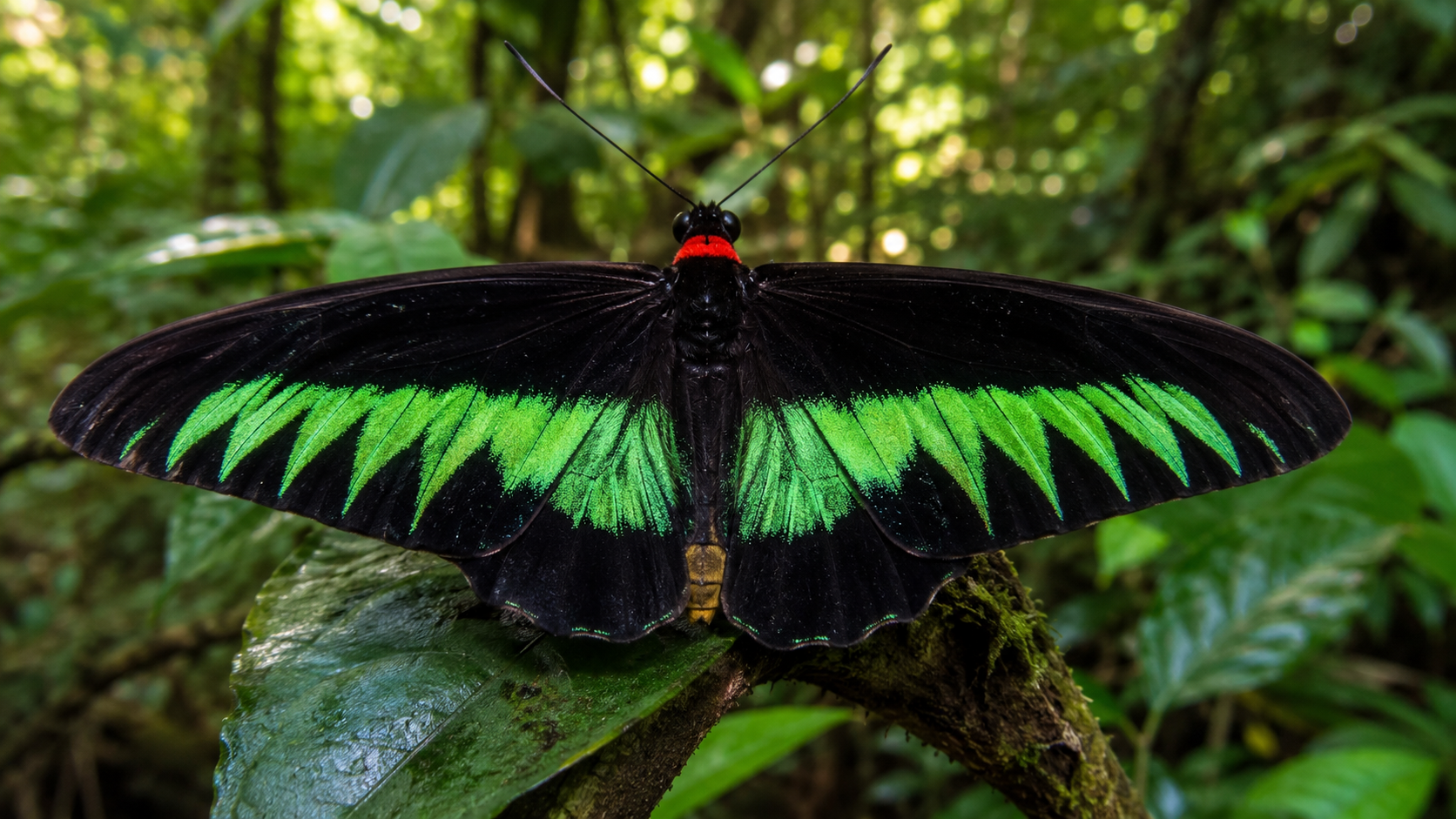
Male: The wings are jet-black, both above and below, with a series of large, sharply defined triangular spots of electric iridescent green running along the forewing from the leading edge toward the apex. These green patches catch the light with a vivid metallic sheen — not a surface pigment but structural colour produced by nanoscale ridges on the wing scales that cause constructive interference of specific light wavelengths. The green shifts subtly with viewing angle, flashing and dimming as the butterfly moves. At the base of the wings, behind the head, the thorax carries a prominent crimson-red collar — a patch of vivid red fur contrasting dramatically with the black and green of the wings. The hindwing is entirely black with a scalloped, slightly pointed outer margin.
The wingspan ranges from approximately 150 to 175 mm in males; larger females may reach 190 mm but lack the dramatic male colouration.
Female: The female is considerably larger than the male and entirely different in appearance — brown or dark grey-brown with irregular white spots on the forewings and paler, less defined markings throughout. The bold iridescent green of the male is entirely absent. This extreme sexual dimorphism — the male and female of the same species looking utterly unlike each other — is characteristic of birdwings generally and represents a divergence of selection pressures: females are selected for camouflage while foraging and egg-laying; males are selected for conspicuousness in mate attraction and possibly for warning signals derived from larval sequestration of Aristolochia toxins.
Subspecies: Several subspecies are recognised across the range, differing principally in the width and intensity of the green forewing markings and the extent of the red collar. The nominate subspecies brookiana brookiana of Borneo is the most widely illustrated. Subspecies albescens (Malay Peninsula and Sumatra) has slightly paler, more yellowish-green markings.
Range and habitat
Rajah Brooke's birdwing is distributed across the major islands and peninsulas of western Sundaland:
- Borneo (Sabah, Sarawak, Brunei, and Kalimantan) — the core range; most populations are Bornean
- Sumatra — present in the north and west, but distribution is patchier than in Borneo
- Malay Peninsula — present from southern Thailand south through Peninsular Malaysia; generally less common than in Borneo
The species is obligately associated with lowland tropical rainforest — specifically, with intact or near-intact lowland dipterocarp forest below approximately 900 m altitude. It is not a forest-edge or secondary forest species; populations require continuous primary or high-quality secondary forest to persist. This habitat requirement makes it a reliable indicator of forest integrity.
Behaviour and ecology
Mud-puddling
Males are among the most spectacular of all mud-puddling butterflies. They congregate in groups at mineral-rich seepages, riverbanks, and streams — sometimes in assemblages of 20–50 individuals or more — where they extract sodium, potassium, and amino acids from the wet mud. At these sites, the combined effect of multiple large, iridescent males feeding together is overwhelming — a cascade of black-and-green wings flashing in the dappled forest light. These congregations are the most reliable way to observe the species, and the best known mud-puddling sites in Sabah and Sarawak are famous among butterfly enthusiasts globally.
Males are most active in the morning (approximately 08:00–11:00), flying high through the canopy and descending to mud-puddle sites in the warmer mid-morning. Afternoons see reduced activity.
Host plant and larval biology
The caterpillars feed exclusively on Aristolochia vines — woody climbers of the genus that contains the aristolochic acids responsible for the toxicity of many birdwings. The caterpillars sequester these compounds, retaining them through metamorphosis into the adult stage. Adults are therefore chemically defended, and the bold black-and-green male colouration may function partly as aposematic warning coloration in addition to its sexual signalling role.
Eggs are laid singly on young Aristolochia leaves. Caterpillars are dark-coloured with fleshy tubercles. Pupae are attached to twigs and adopt a characteristic hanging posture typical of Papilionidae.
Canopy flight
Outside of mud-puddling, adults spend much of their time flying through the upper forest canopy at heights of 15–30 m, visiting canopy flowers for nectar. This canopy-flying habit, shared with birdwings generally, makes them difficult to observe except at mud-puddling sites or where canopy flowering trees bring them to lower levels.
Conservation and trade
CITES protection
Trogonoptera brookiana is listed on CITES Appendix II — meaning trade in wild-caught specimens is regulated (not banned) and requires permits. The species is also fully protected under Malaysian and Indonesian law, and collecting or trading live or pinned specimens without permits is illegal throughout most of its range.
Despite this protection, the species appears regularly in the illegal international butterfly trade, where large males command high prices among collectors. Farming operations in Malaysia and Indonesia produce legally traded captive-bred specimens, which partly satisfies commercial demand while reducing pressure on wild populations.
Forest loss
The primary conservation threat is deforestation — particularly conversion of lowland Bornean dipterocarp forest to oil palm plantation. Lowland forest, which the species requires, is also the zone most intensively converted for agriculture, timber, and settlement across Borneo and Sumatra. Large-scale habitat loss has fragmented the species' range, though it remains present in significant numbers in protected areas such as Danum Valley, Maliau Basin, and Mulu National Park.
Current status
Trogonoptera brookiana is assessed as Least Concern (LC) globally by IUCN — reflecting its wide range and presence in multiple protected areas. However, this assessment does not preclude significant local population declines in the most deforested parts of its range. As with all lowland Bornean forest specialists, its long-term status is closely tied to the trajectory of forest conservation in Malaysia and Indonesia over the coming decades.
Wallace and the discovery
Alfred Russel Wallace collected the first specimens of Trogonoptera brookiana in Sarawak in 1855 — three years before he would co-publish the theory of natural selection with Darwin. His description of first seeing the species, published in Proceedings of the Entomological Society of London, conveys the impact it made:
"I could not restrain an exclamation of delight as the glorious creature came floating past me, and when I saw it settle I could not help feeling that good fortune had indeed favoured me."
Wallace named it in honour of James Brooke, the White Rajah of Sarawak, under whose patronage he was working in Borneo — a naming that links one of the most significant figures in the history of evolutionary biology to one of history's most unusual political arrangements in one of the world's greatest rainforests.