Butterflies of Myanmar
Myanmar lies at the crossroads of the Indo-Malayan and Indo-Chinese faunal zones, with an estimated 900–1,000 butterfly species — one of Asia's richest.
Overview
Myanmar occupies a pivotal position in the biogeography of Asia. Bordered by India and Bangladesh to the northwest, China to the north and northeast, and Laos and Thailand to the east, the country spans from the Eastern Himalayan foothills at over 5,000 m to tropical coastal lowlands barely above sea level. This extraordinary altitudinal and latitudinal range, combined with the convergence of three major biogeographical zones — the Indian subcontinent, the Himalayan highlands, and the Indo-Chinese peninsula — produces one of the richest butterfly faunas in the world.
An estimated 900–1,000 species of day-flying butterflies have been recorded, with many areas still incompletely surveyed. Large intact forest blocks remain in the Kachin, Shan, and Chin states, preserving communities that have largely disappeared from neighbouring countries with heavier deforestation pressure.
Biogeographical zones
Himalayan north (Kachin and Chin States)
The northern ranges, draining into the Irrawaddy and Chindwin, carry a predominantly Himalayan-affinity fauna — species shared with Bhutan, Sikkim, and Yunnan:
- Bhutan glory (Bhutanitis lidderdalii) — high-altitude forest, one of the most spectacular swallowtails
- Kaiser-i-Hind (Teinopalpus imperialis) — montane ridges above 2,000 m
- Himalayan swallowtail (Papilio Lernaeus) — forest clearings in the foothills
- Juniper hairstreak and other montane Tajuria species — oak and rhododendron forest
The Hkakabo Razi area (Myanmar's highest peak, 5,881 m) remains almost entirely unsurveyed by lepidopterists.
Central lowlands and Irrawaddy basin
The dry central zone around Mandalay and the Irrawaddy floodplain has a drier, more open vegetation and a correspondingly different fauna of open-country species:
- Common jezebel (Delias eucharis) — widespread in parks and gardens
- Plain tiger (Danaus chrysippus) — open scrub and agricultural margins
- Lemon emigrant (Catopsilia pomona) — a powerful migratory pierid
Shan Plateau and Tenasserim hills
The Shan Plateau (900–1,500 m) and the long Tenasserim (Tanintharyi) range reaching south toward peninsular Malaysia hold the greatest diversity:
- Paris peacock (Papilio paris) — bright turquoise-centred swallowtail, common in montane forest
- Common windmill (Byasa polyeuctes) — black with crimson patches
- Malayan lacewing (Cethosia hypsea) — forest clearings with vivid orange and black pattern
- Golden birdwing (Troides aeacus) — lowland and lower montane forest
Tenasserim coast and Myeik Archipelago
The southernmost region, geographically part of the Thai-Malay peninsula, adds Sundaland species reaching their northern limit:
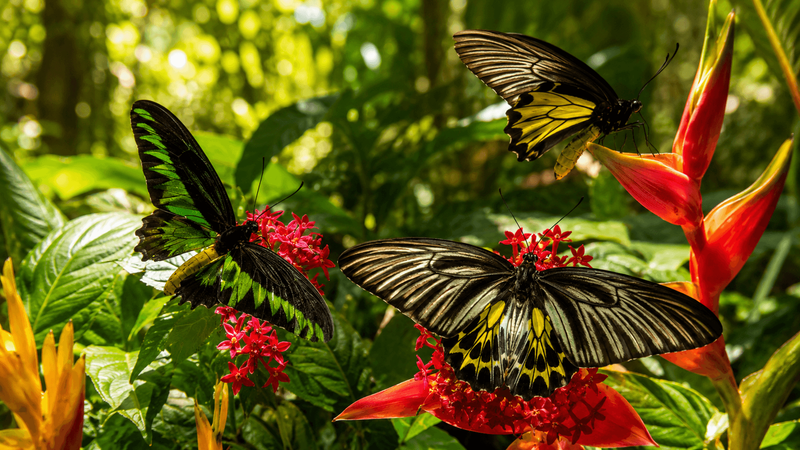
- Rajah Brooke's birdwing (Trogonoptera brookiana) — the most striking butterfly of the Malaysian subregion, with brilliant emerald-green wing tips on velvety black
- Mangrove skipper and other coastal forest specialists
- Chocolate Albatross (Appias lyncida) — common in coastal forest
Key habitats
| Habitat | Characteristic species |
|---|---|
| Lowland tropical rainforest | Golden birdwing, lacewings, Charaxes species |
| Montane forest (1,000–2,000 m) | Paris peacock, Kaiser-i-Hind, jezebels (Delias) |
| High montane (above 2,000 m) | Bhutan glory, montane Erebia, Apollo relatives |
| Dry central forest | Plain tiger, pioneers (Catopsilia), open-country whites |
| Coastal and mangrove | Mangrove specialists, Papilio demoleus, emigrants |
Seasonality
Myanmar's butterfly season is governed by the monsoon. The southwest monsoon (June–October) brings heavy rain to western and southern regions, suppressing butterfly activity at low elevations. The dry season (November–May) is the main observation window in most areas; montane sites above 1,000 m remain productive through much of the year. The period from January to April is typically the best for combining warm dry weather with abundant nectar sources.
Conservation
Myanmar retains among the highest forest cover of any country in mainland Southeast Asia — approximately 42% of land area remains forested. However, logging rates have accelerated since the 1990s, and road construction into previously remote highland areas is opening formerly pristine forest to commercial extraction. Several globally protected butterfly species — including Troides birdwings found in the region — are monitored by CITES and national legislation, but enforcement is inconsistent. The Hukawng Valley Wildlife Sanctuary in Kachin State, one of the largest protected areas in Southeast Asia, preserves critical lowland forest habitat.