Butterflies of Sri Lanka
Sri Lanka's compact geography, split between wet southwest and dry northeast, supports around 245 butterfly species, including 25+ endemics.
An island of contrasts
Sri Lanka is a small island — roughly 430 km long and 220 km wide — lying off the southern tip of India, separated from the mainland by the shallow Palk Strait. Despite its modest size, Sri Lanka contains one of the highest levels of endemic biodiversity of any island in Asia, a consequence of its long partial isolation and the extreme diversity of habitats produced by its topography and two-monsoon climate.
The island is broadly divided into two ecological zones that define its butterfly fauna:
The wet zone — the southwestern quarter and central highlands — receives abundant rainfall from the southwest monsoon. Here, dense rainforest, montane cloud forest, and mist-shrouded peaks harbour the majority of Sri Lanka's endemic species.
The dry zone — the north, east, and north-central plains — is drier and more seasonally predictable, dominated by dry deciduous forest, scrub, and agricultural land. The butterfly fauna here is less endemic but connects broadly with the dry-country fauna of southern India.
With approximately 245 resident species including around 25–27 endemics, Sri Lanka punches well above its weight in terms of butterfly diversity relative to its area.
Sinharaja Forest Reserve
Sinharaja is the centrepiece of Sri Lankan butterfly conservation. This 111 km² UNESCO World Heritage Site (inscribed 1988) in the southwestern lowlands preserves one of the last substantial areas of primary lowland rainforest on the island. It is arguably the richest single butterfly site in South Asia per unit area.
Key species of Sinharaja include:
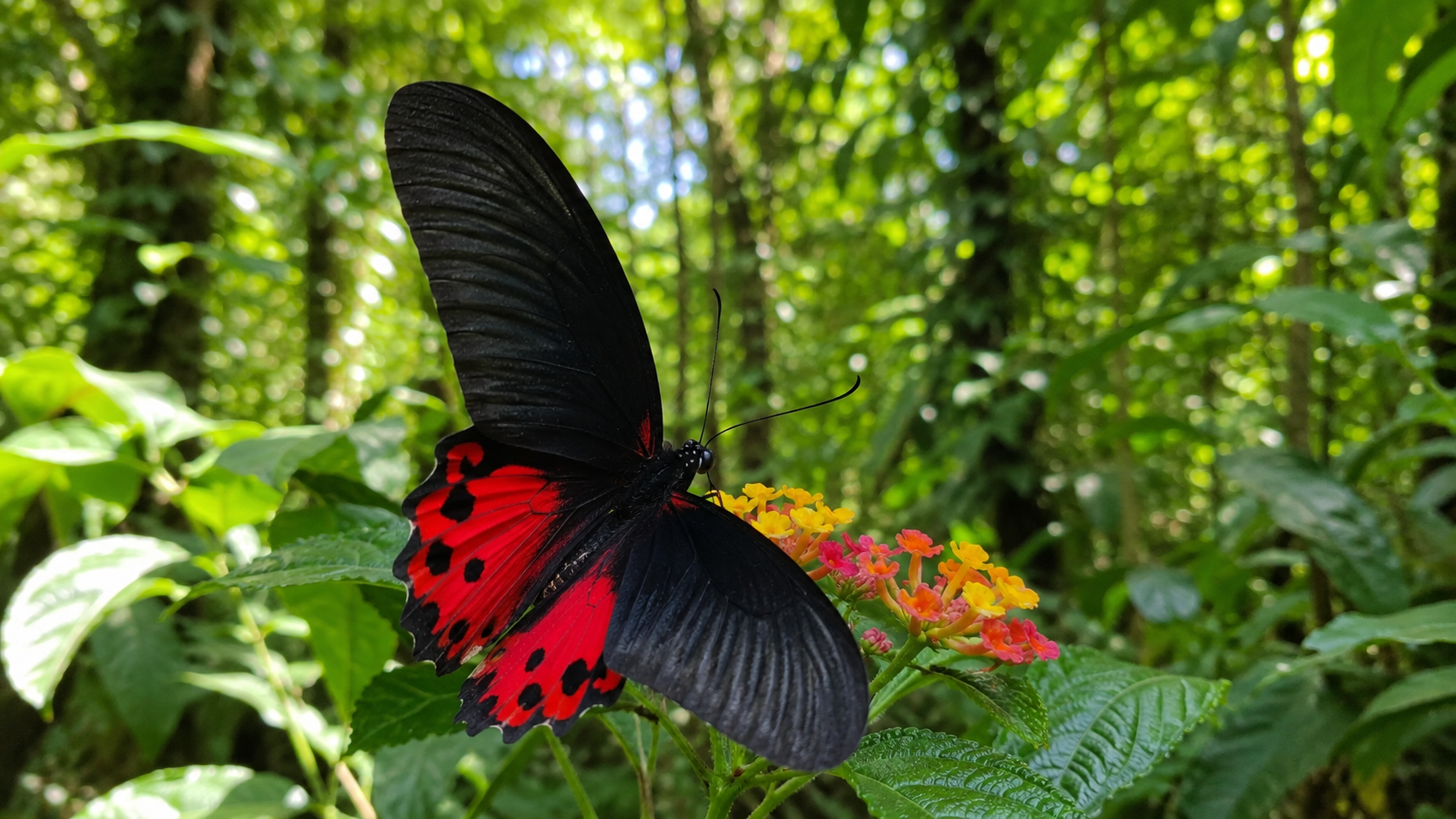
- Sri Lanka Rose (Pachliopta jophon) — the island's largest endemic swallowtail; scarlet hindwings; slow-flapping glide through the forest understory
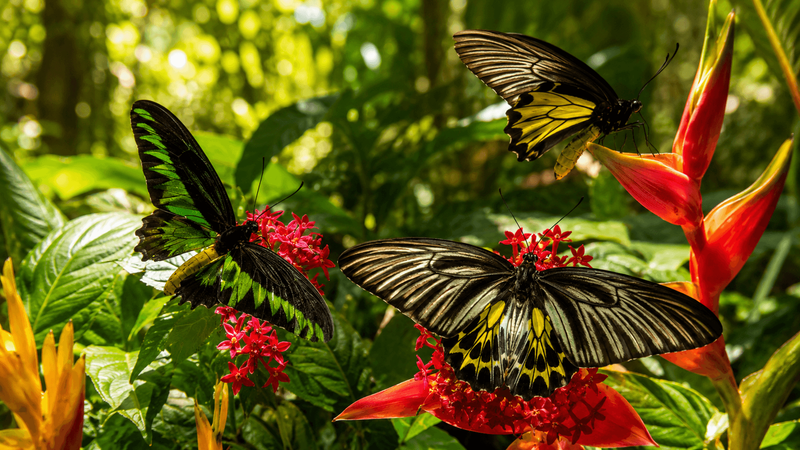
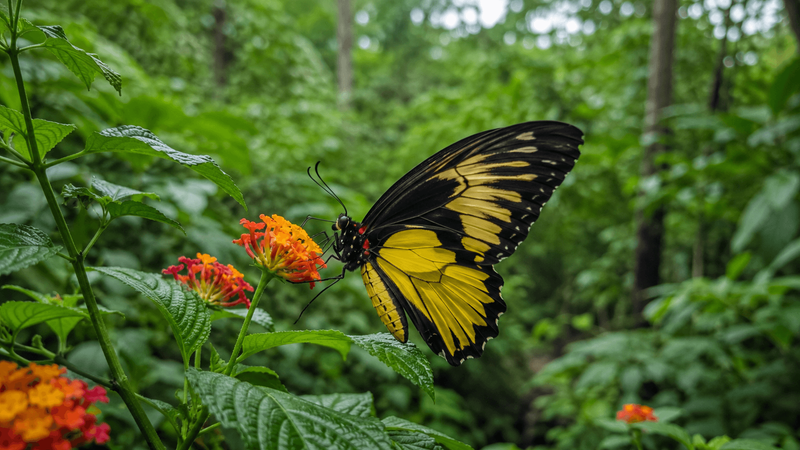
- Sri Lanka Birdwing (Troides darsius) — large golden-yellow and black; canopy glider; males at flowers in sunlit gaps
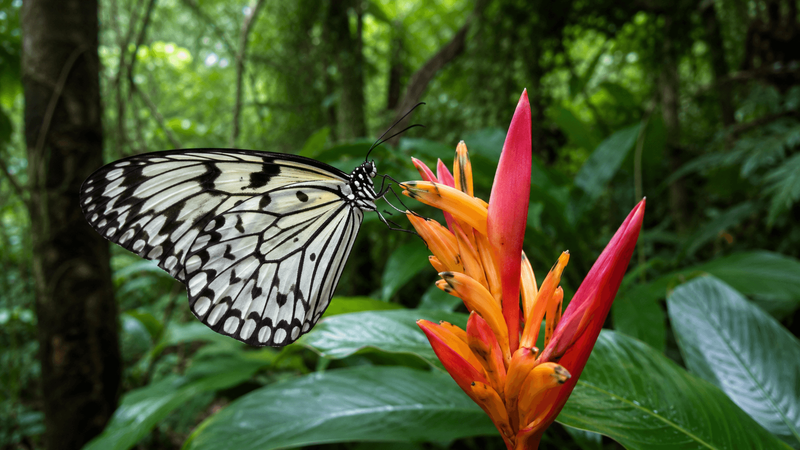
- Ceylon Tree Nymph (Idea iasonia) — Sri Lanka's only species of Idea; large, paper-white with black spots; slow, drifting flight through forest interior
- Sri Lanka Lacewing (Cethosia nietneri) — striking orange-and-black; active in dappled light along stream margins
- Multiple endemic Neptis sailers, Lethe and Mycalesis browns, and numerous endemic lycaenids
Sinharaja receives the highest annual rainfall in Sri Lanka (over 5,000 mm at some stations), making dry-season visits (January–April) essential for comfortable exploration. Guided walks along the main forest trail and the buffer zone edges are the most productive approach; the forest interior can be explored on community-managed trails.
The Central Highlands
The Central Highlands — including Adams Peak (Sri Pada, 2,243 m), Horton Plains National Park (2,100–2,300 m), and the Knuckles Mountain Range (up to 1,863 m) — form a distinct ecological zone with a characteristic Afromontane-influenced flora and several high-altitude endemic butterflies.
Horton Plains National Park (3,160 ha, Sri Lanka's highest protected area) is the primary site for montane endemic butterflies:
- Blachier's Hedge Blue (Udara lanka) — small, pale blue; grassland edge
- Pea Blue (Lampides boeticus) — cosmopolitan species that reaches Horton Plains but is accompanied by endemic relatives
- Several endemic Mycalesis and Lethe species restricted to the montane grasslands above 1,800 m
- Great Orange Tip (Hebomoia leucippe) — dramatic large pierid at forest edges
The Knuckles Mountain Range north of Kandy is a UNESCO World Heritage Site (2010) in its own right — a complex of ridges, valleys, and cloud forest patches with both lowland wet-zone and montane species in close proximity. It is less visited than Sinharaja but considered equally rich by specialists.
Dry zone and ancient forests
Sri Lanka's dry zone covers more than half the island and contains its own distinct butterfly fauna. The dry deciduous forests of the North Central Province (around Anuradhapura and Polonnaruwa) and the national parks of the eastern coast (Gal Oya, Lahugala) harbour:
- Blue Mormon (Papilio polymnestor) — large, spectacular swallowtail; citrus family caterpillars; common throughout the island but most visible in the dry zone
- Common Nawab (Polyura athamas) — powerful charaxine nymphalid; fast, high-flying
- Lemon Emigrant (Catopsilia pomona) — abundant yellow pierid; notable migrations along dry-zone river valleys during monsoon
- Tamil Lacewing (Cethosia mahratta) — dry-zone counterpart to the wet-zone Lacewing; orange-and-black
- Multiple Junonia pansies at dry-zone waterhole margins and scrub edges
Yala National Park — Sri Lanka's most visited wildlife reserve — is not primarily a butterfly destination, but its dry mixed evergreen forest and scrub support a good cross-section of the dry-zone fauna, and butterflies are conspicuous in the morning hours before tourist vehicles concentrate at water holes.
Iconic species
Sri Lanka Rose (Pachliopta jophon) — endemic; largest and most dramatic of the island's swallowtails; Sinharaja and Knuckles.
Sri Lanka Birdwing (Troides darsius) — endemic; among the largest butterflies in South Asia; males brilliant yellow and black; canopy species of the wet zone.
Ceylon Tree Nymph (Idea iasonia) — endemic; the island's only Idea species; spectacular slow-gliding flight; forests of the wet zone.
Blue Mormon (Papilio polymnestor) — not endemic but common and dramatic; large black-and-iridescent-blue swallowtail; widespread through forests and gardens.
Sri Lanka Lacewing (Cethosia nietneri) — endemic; bright orange and white with lace-like black pattern; stream-margin forest.
Psyche (Leptosia nina) — not endemic but characteristically Sri Lankan in feel; tiny white butterfly with slow, bouncing flight low over shaded ground; ubiquitous in forest understory.
Observation seasonality
Sri Lanka's butterfly year is shaped by the two monsoons:
Southwest monsoon (May–September): brings heavy rain to the wet zone; Sinharaja and the highlands become difficult and less productive for adult watching. Simultaneously, the dry zone (north, east) has its best butterfly weather.
Northeast monsoon (November–January): brings rain to the north and east; the wet zone and central highlands enjoy relatively dry, sunny conditions — their best butterfly season.
January–April is generally considered the best single period island-wide: the northeast monsoon has ended, the southwest monsoon has not yet begun, and both wet-zone and dry-zone sites are productive simultaneously.
Conservation
Sri Lanka has a relatively well-developed protected area network for its size. Key pressures on butterfly populations include:
- Deforestation: less than 23% of Sri Lanka's original forest cover remains; the wet zone has lost more than 80% of its original extent
- Tea and rubber plantation expansion: the central highlands have been extensively converted; the remaining forest patches are islands in a sea of monoculture
- Tourism pressure: Sinharaja, Horton Plains, and Knuckles all experience visitor pressure that damages trails and disturbs forest edge habitats
- Pesticide use in agricultural areas bordering the dry-zone national parks
The Department of Wildlife Conservation manages the island's national parks and sanctuaries. NGO programmes focused on Sinharaja and the Knuckles include community-based ecotourism initiatives that provide conservation incentives for adjacent communities.
Interesting facts
- Sri Lanka is sometimes called the "teardrop of India" for its geographical shape — the same tear-shaped outline that, seen from the air, appears to be dripping the biodiversity of the subcontinent into the Indian Ocean in concentrated form
- The Sri Lanka Birdwing (Troides darsius) is listed on CITES Appendix II, meaning international trade requires export permits — one of only a handful of South Asian butterflies with this protection
- Sri Lanka's dry-zone tanks (ancient irrigation reservoirs) up to 2,000 years old create wetland habitats within the dry zone that support a distinctive riparian butterfly community not found in either the pure rainforest or the dry scrub
- Several Sri Lankan endemic butterflies have only been described in recent decades — the Knuckles Mountain Range in particular has yielded new species records as recently as the 2000s and 2010s, suggesting the island's fauna is still being fully documented